

What NVIDIA's $12.9B Hugging Face Deal Means for Founders
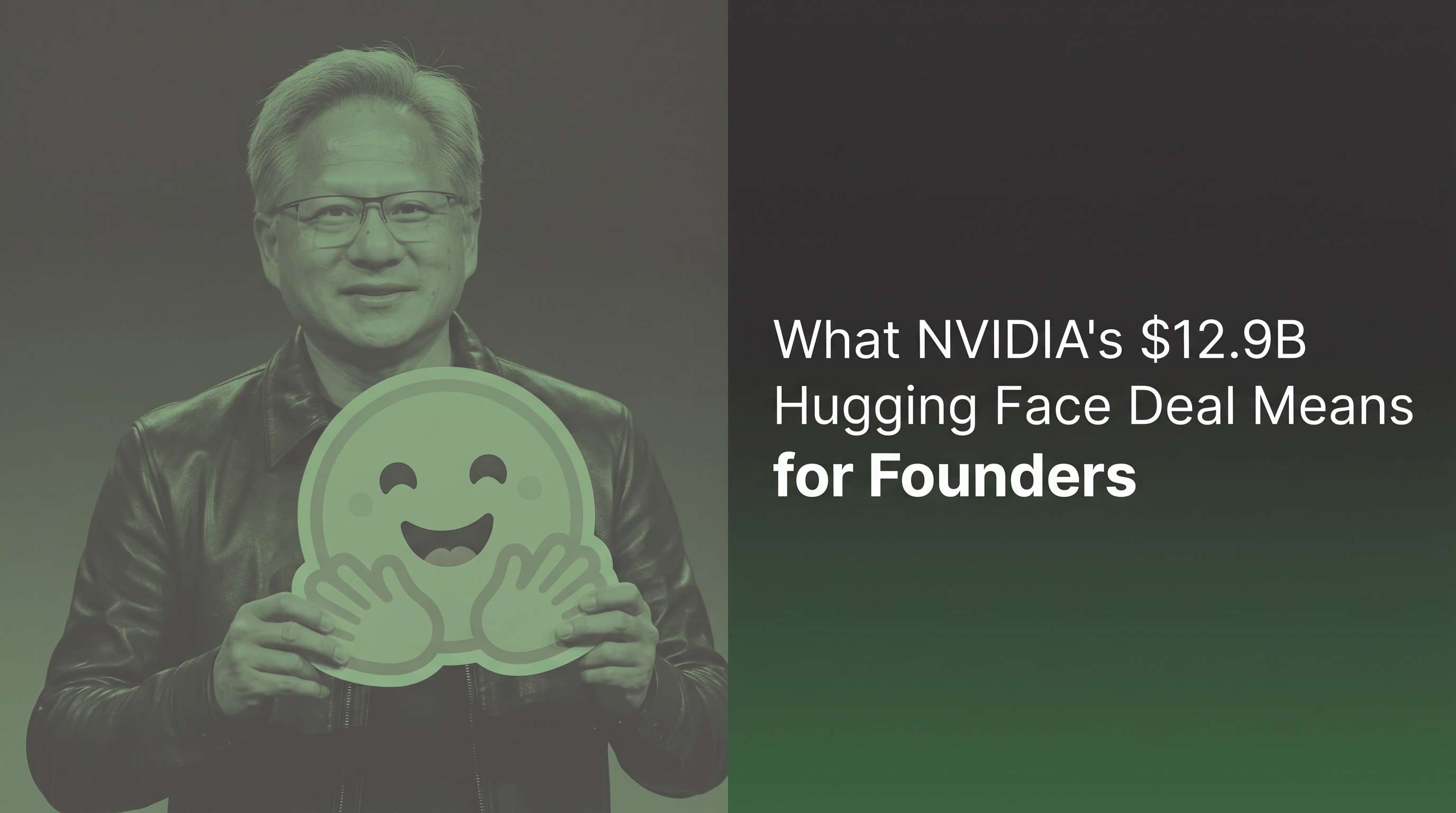
NVIDIA, the world’s most valuable company, just paid $12.9 billion for Hugging Face. That’s roughly 86 times revenue. About three weeks of NVIDIA’s cash flow. The kind of deal Jensen Huang can make without asking anyone.
If you’re not familiar, Hugging Face is essentially the GitHub of AI. It’s where developers go to find, download, and deploy open-source AI models, hosting over 3 million models and serving 18 million developers.
Hugging Face keeps its name, its developers, and its neutrality. NVIDIA chips won’t be required to build on it. The announcement reads less like an acquisition and more like an endowment.
So why pay $13 billion for a company doing $150 million in revenue?
NVIDIA Didn’t Buy Revenue. It Bought Demand.
Every time a developer downloads an open model from Hugging Face and runs it, they need compute. That compute runs on GPUs. Those GPUs are overwhelmingly NVIDIA’s.
NVIDIA’s own SEC filing says it plainly: “Demand for open-source foundation models and applications based on them promotes the use of our products worldwide.”
Every open-weight model release is a demand event for NVIDIA. They just bought the venue where those events happen.
Same playbook Microsoft ran with GitHub in 2018. Pay billions for the platform where developers already live, promise neutrality, build your tools around it.
The Real Lesson: NVIDIA Didn’t Buy a Product. It Bought a Position.
Here’s what makes this deal worth studying as a founder.
Hugging Face isn’t valuable because of what it builds. It’s valuable because of where it sits. Every open model flows through it. Every download creates GPU demand. It’s the chokepoint in the value chain. NVIDIA didn’t buy better technology. It bought the spot where demand happens.
That’s a lesson every founder should apply to their own company: are you building a product, or are you building a position?
The best startups don’t just solve a problem. They plant themselves at a point in the workflow where everything has to flow through them. The compliance layer every transaction passes through. The validation tool every founder uses before they pitch. The data source an entire industry depends on. These companies become hard to rip out, not because the product is irreplaceable, but because the position is.
Ask yourself: if your product disappeared tomorrow, would your customers route around you in a week? Or would an entire workflow break? The answer tells you whether you’ve built a product or a position.
What This Means for the Market
The biggest companies in the world are consolidating the AI stack. NVIDIA buys the distribution layer. Meta open-sources Llama. Google drops Gemini prices. Every move makes the inputs cheaper and more accessible for everyone building on top.
That’s genuinely good for founders. Models are commoditizing. The cost of intelligence is dropping 10x every year. The building blocks have never been cheaper or more powerful.
But it also means the bar has moved. The question every investor is now asking is: “Why can’t the incumbent build this in six months?” If your answer depends on the model you’re using, you don’t have an answer. If your answer is that you own the data, the customer relationship, or the position in the value chain that no one else occupies, you have a company worth funding.
The hard part was never getting access to a model. The hard part is knowing where to plant yourself, which customers to serve, and what problem is worth validating before you build. That’s where the value is. That’s where we invest.
Apply for Funding Apply to SIV Instant. We give real investor feedback in hours, not weeks and months. Tell Us About Your Idea → Back to All News