
Startup Validation: The Complete Step-by-Step Guide (2026)
The two biggest killers of startups are building something nobody wants and scaling something before you’ve proven it works. Both are validation problems — but they manifest differently.
According to CB Insights, 35% of startups fail because there’s “no market need.” But the less-cited and arguably more dangerous statistic: 74% of startup failures are due to prematurely scaling without a validated business model. You can build something people want and still die because you scaled too fast, hired too early, or burned capital before you understood your unit economics.
Startup validation is the process that prevents both of these outcomes. It’s not a single step — it’s a specific sequence of tests, each designed to reduce a specific type of risk before you commit real time or money. This guide walks through that entire sequence — the same framework we’ve used with over 1,000 founders through the Startup Ignition Bootcamp.
What Is Startup Validation?
Startup validation is the process of systematically testing whether your business idea is worth pursuing — before you build it. It answers five questions, in order:
- Do you have founder-market fit? Are you the right person for this problem? Startups that skip this step often find themselves 12 months in, realizing they don’t actually care enough about the space to survive the trough of sorrow.
- Does a real problem exist? Not a hypothetical problem, not a problem you assume people have, but a problem people are actively trying to solve and willing to pay to fix.
- Have you earned the right to build? Do you understand the customer journey deeply enough to know how your solution fits into their actual behavior — not your imagined version of it?
- Will people pay for your solution? Enthusiasm isn’t validation. Someone saying “that’s a cool idea” is not the same as someone pulling out their credit card.
- Can you build a viable business around it? A real problem with a real solution still isn’t a business if the economics don’t work.
The distinction between hypothetical validation and actual validation matters here. Hypothetical validation is asking customers — interviews, surveys, focus groups. It tells you what people say. Actual validation is observing customers — riskiest assumption tests, MVPs, pre-sales. It tells you what people do. You start with the former and graduate to the latter. Both are necessary; neither alone is sufficient.
Why Most Founders Skip Validation
The most dangerous reason founders skip validation is that they mistake building for learning. Shipping code feels productive. Running interviews feels slow. But shipping the wrong product is the fastest way to waste your runway.
At Startup Ignition Ventures, we’ve reviewed thousands of pitches across our fund and 200+ angel investments. The pattern is consistent: validated startups raise smaller rounds on better terms because they’ve proven demand before asking for capital. An unvalidated startup is asking investors to bet on a guess. A validated startup is asking investors to bet on evidence. (If you’re approaching that stage, see our guide to finding pre-seed funding in Utah.)
74% of startup failures are due to prematurely scaling without a validated business model. That’s the real cost of skipping validation — not just wasted time, but wasted runway you’ll never get back.
The Startup Validation Framework: The 12-Step Process
This is the actual Startup Ignition process — the same sequence taught in our startup bootcamp and built into the ToolSuite. Each step builds on the last. Skipping steps is how founders create expensive problems later.
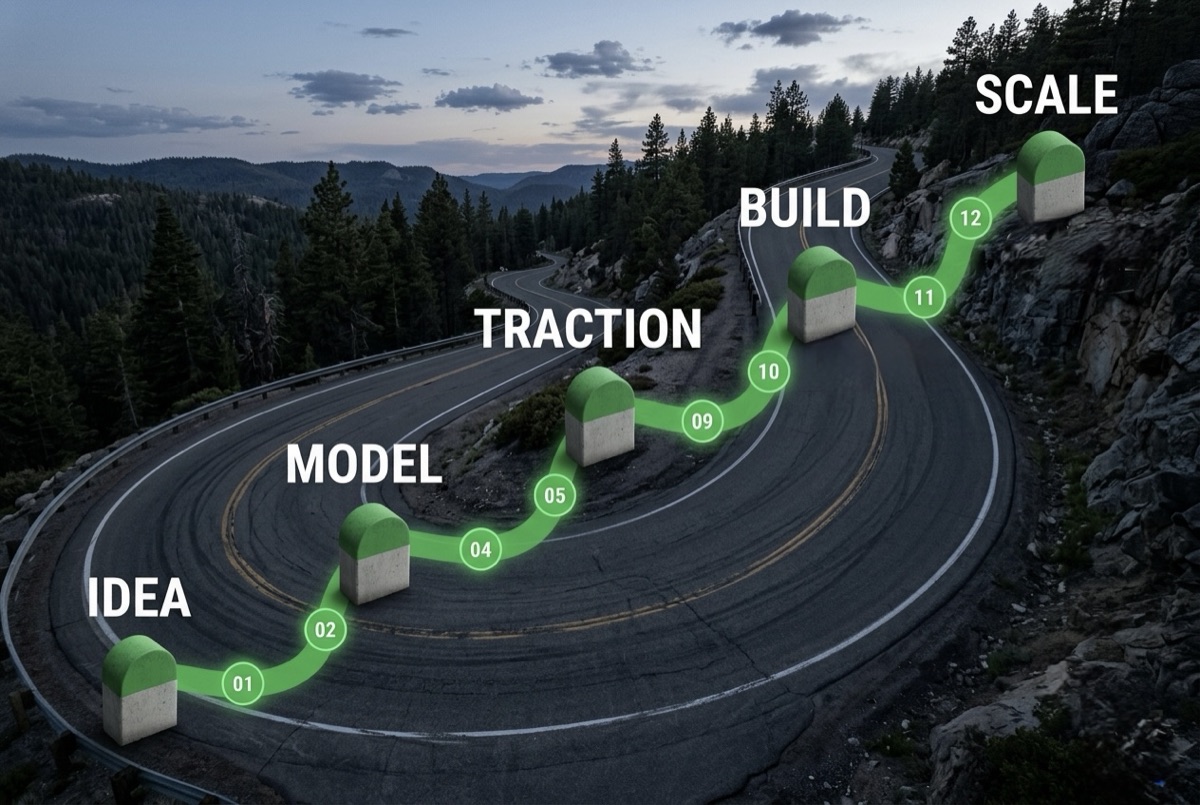
Important: These 12 steps are presented in sequence, but validation is not a linear checklist you complete and move on from. It’s an iterative loop — you build a hypothesis, test it, learn, update the hypothesis, and test again. What you’re validating changes at each stage of the journey (IDEA → MODEL → TRACTION → BUILD → SCALE), but the cycle of hypothesis → test → learn → iterate never stops.
Step 1: Discover a Problem or Need
Most founders start with a solution and go looking for a problem. This is backwards. The strongest startups begin with a problem so painful that customers are already spending money on bad alternatives.
What to do:
- Write down the problem in one sentence. If you can’t, you don’t understand it well enough yet.
- Identify who has this problem. Be specific — not “small businesses” but “B2B SaaS companies with 10-50 employees who manage customer onboarding manually.”
- Research how people currently solve it. What are the existing alternatives? What do people hate about them?
Test your founder-market fit here. Why do you care about this problem? What unique insight or experience do you bring? Founders who choose problems they’re personally connected to are dramatically more likely to push through the inevitable hard years.
Step 2: Devise a Solution
Only after you deeply understand the problem do you propose a solution. Your solution should directly address the pain you’ve identified — not a feature list you think is cool.
Keep it simple. The best early solutions are embarrassingly narrow. You’re solving one problem for one type of customer in one specific way.
Step 3: Analyze the Idea
Before investing weeks in validation, run your idea through two structured filters:
The Idea Analysis Worksheet forces you to articulate the problem, solution, target customer, and competitive landscape in a structured format. It exposes gaps in your thinking before you invest time in deeper validation.
The Big Idea Canvas (developed by Nathan Furr and Paul Ahlstrom) goes deeper. It asks critical questions most founders skip: How big is the pain — mosquito bite, dog bite, or shark bite? What type of innovation is this — incremental, 10x, platform, or geographic? Is the market timing right? These filters separate ideas worth validating from ideas that feel exciting but lack structural potential.
Both tools are available in the Startup Ignition ToolSuite — the founder operating system that walks you through this entire process. The goal at this stage is to filter quickly — kill weak ideas in hours, not months.
Step 4: Assess Hypothetical Potential (The Wow! Factor Test)
The Wow! Factor Test, developed by Dr. Gary Rhoads, is a specific assessment designed to measure whether your idea is “sticky” — whether it creates a strong enough reaction in potential customers to predict real demand.
This isn’t a survey. It’s a structured script that tests whether customers light up when they hear your value proposition, or give you polite indifference. Research has shown the Wow! Factor Test is a highly accurate predictor of eventual market success — ideas scoring below a 5 out of 10 on the Wow! Factor scale have never been successful. That’s a zero-risk, high-value screen that should happen before you ever invest in customer discovery. If you can’t get a “wow” reaction at this stage, building is premature.
Step 5: Map the Customer Journey
Before you build anything, map how your customer discovers, evaluates, and adopts solutions in this space. Understanding the customer journey reveals where your product fits into their actual behavior — not your imagined version of their behavior.
This is what we mean by earning the right to build. You must understand how customers currently solve the problem, where they experience friction, and how your solution inserts into their existing workflow. Products that ignore the customer journey create adoption friction that no amount of marketing can overcome.
Step 6: Create a Business Model Canvas Hypothesis
Now map your full business model canvas — not as a finished document, but as a set of hypotheses to test.
Key elements:
- Value proposition: What you’re offering and why it matters
- Customer segments: Who specifically you’re serving
- Channels: How you’ll reach them
- Revenue model: How you’ll make money
- Cost structure: What it costs to deliver
- Key metrics: What numbers define success
Every box in the canvas is an assumption. The goal of the next steps is to test those assumptions systematically.
Step 7: Identify Your Riskiest Assumptions
Not all assumptions are equal. Some, if wrong, kill the business. Others are inconvenient but survivable. Your job is to rank them and test the riskiest ones first.
Common high-risk assumptions:
- “Customers will pay $X for this” (pricing)
- “We can acquire customers for less than $Y” (unit economics)
- “This problem is painful enough to change behavior” (switching cost)
- “Our target customer has budget authority” (buyer vs. user)
Stop wasting time on things that don’t matter yet. Test what could kill you first.
Step 8: Design Interview Scripts and Low-Cost Experiments
For each risky assumption, design a specific test — either a customer discovery interview or a low-cost experiment.
For interviews:
- Talk to at least 20-30 potential customers. Not friends, not family.
- Ask about their current behavior, not hypothetical future behavior.
- Listen for emotion and specifics. Frustration is signal. Politeness is noise.
For experiments:
- Landing page tests (do people click “Buy Now”?)
- Concierge tests (can you deliver the value manually?)
- Pre-sales (will someone actually pay before the product exists?)
For a practical breakdown of each experiment type — with timelines, costs, and examples — see our guide to 7 proven methods for testing a startup idea.
Step 9: Conduct Customer Discovery
This is where most of the work happens. Run your interviews. Execute your experiments. Collect real data.
We’ve published a complete guide to customer discovery questions with the exact frameworks we teach in our startup bootcamp. The short version: your job is to understand the problem deeply enough that you could describe it better than your customer can.
What you’re looking for:
- At least 60-70% of people confirm the problem exists
- They can tell you specifically how they currently solve it
- Some of them ask when your product will be available — unprompted
Our bootcamp targets 30 conversations as a baseline. Five interviews is not enough for pattern recognition.
Step 10: Run Riskiest Assumption Tests (RATs)
This is where you move from hypothetical validation (what people say) to actual validation (what people do).
RATs are focused experiments designed to test one specific assumption with real behavior:
- Pre-sell: Create a landing page with a price and a “Buy Now” button. If people click, you have signal.
- Concierge MVP: Deliver the service manually to a small number of customers. You learn the workflow before you automate it.
- Wizard of Oz MVP: The customer thinks they’re using a product, but you’re doing the work behind the scenes.
- Single-feature MVP: Build one core feature — the one that solves the most painful part of the problem — and ship it.
Each RAT should take days or weeks, not months. If it takes months, you’re not running an experiment — you’re building a product without validation.
Step 11: Build and Test an MVP
An MVP is the smallest thing you can build to test your most critical remaining assumption. It is not version 1.0. It’s an experiment designed to generate data.
Note that MVPs and RATs overlap in practice — a concierge MVP is a RAT. A pre-sell landing page is a RAT. The distinction is that by Step 11, you’ve already run lighter experiments (Steps 8-10) and now you’re investing in a slightly more built-out version to test the assumptions that survived those earlier tests.
By this point, your MVP should be informed by everything you’ve learned in Steps 1-10. You’re not guessing what to build — you’re building the specific thing your validated customers told you they need and will pay for.
Step 12: Validate Product-Market Fit
Product-market fit isn’t a single moment — it’s a set of measurable signals. But what you measure depends on where you are in the journey:
- In the IDEA stage, your metrics are problem confirmation and Wow! Factor scores. Don’t measure retention before you’ve confirmed the problem exists.
- In the MODEL stage, you’re measuring willingness to pay, assumption test results, and business model viability.
- In the TRACTION stage, you graduate to the classic product-market fit signals:
- Activation: Do people who sign up actually use the product?
- Retention: Do they come back? Do they keep paying?
- Referral: Do they tell other people about it?
- Revenue: Are people paying? Is the amount consistent with your business model?
After each cycle, you make one of three decisions:
- Persevere — the data confirms your assumptions. Keep building.
- Pivot — the problem is real but your solution isn’t right. Change your approach.
- Kill — the problem isn’t real enough or the economics don’t work. Move on.
Killing an idea after 6-8 weeks of validation is not failure. It’s the most efficient outcome possible — you saved months of building and potentially hundreds of thousands of dollars.
The Validation Roadmap: Where Are You?
The full journey from idea to scale follows a specific sequence. Most founders try to skip to the end.
| Stage | What You’re Proving | Key Activities |
|---|---|---|
| IDEA | ”This problem is real and I’m the right founder for it” | Problem discovery, founder-market fit, idea analysis, Wow! Factor Test |
| MODEL | ”I can build a viable business around this” | Business Model Canvas, assumption ranking, customer discovery, RATs |
| TRACTION | ”People will pay for this and come back” | MVP, pre-sales, retention metrics, unit economics |
| BUILD | ”This can be a real product” | Product development, hiring, first revenue |
| SCALE | ”This can grow efficiently” | Growth channels, team building, fundraising |
Most founders jump from IDEA straight to BUILD. The ones who succeed go IDEA → MODEL → TRACTION → BUILD → SCALE, in order.
Tools for Startup Validation
The right tools compress validation from months to weeks.
| Category | What It Does | Examples |
|---|---|---|
| Idea Analysis & Scoring | Tests your concept against market data | Startup Ignition ToolSuite |
| Wow! Factor Testing | Measures initial customer reaction to your value proposition | Startup Ignition ToolSuite |
| Customer Discovery | Structures and records customer interviews | Startup Ignition AI Interviews, Dovetail |
| Business Model Canvas | Maps revenue model and unit economics | Startup Ignition BMC Generator, Strategyzer |
| Landing Page Testing | Measures demand before you build | Carrd, Webflow, Unbounce |
| AI Mentor | On-demand coaching from trained startup expertise | AI Startup Mentor |
For a deeper comparison of AI-specific tools, see our guide to the best AI tools for startup validation in 2026.
Common Validation Mistakes
1. Confusing building with learning. Shipping code feels productive. Running interviews feels slow. But shipping the wrong product is the most expensive mistake a founder can make.
2. Skipping founder-market fit. If you don’t genuinely care about the problem, you won’t survive the trough of sorrow. Validate yourself before you validate the market.
3. Confusing interest with intent. “That’s a cool idea” is not validation. “I would pay $50/month for that” is closer. “Here’s my credit card” is real.
4. Validating the solution before validating the problem. If the problem isn’t real, no solution will save you. Always start with the problem.
5. Running a survey instead of having conversations. Surveys are useful for quantitative data at scale. They’re terrible for understanding the emotional depth of a problem. Do interviews first, surveys second.
6. Talking to too few people. Five interviews is not enough. Twenty is the minimum. Thirty is better. Our startup bootcamp targets 30 conversations as a baseline.
7. Never graduating from hypothetical to actual validation. Interviews tell you what people say. RATs and MVPs tell you what people do. You need both. Most founders stop at interviews and never run a real experiment.
8. Premature scaling. You’ve validated with 10 customers and you’re hiring a sales team. This is the #1 killer — 74% of startup failures trace back to scaling before the model is proven.
How Long Does Startup Validation Take?
A focused validation process should take 6-10 weeks, depending on your pace and access to potential customers:
- Week 1-2: Problem discovery, founder-market fit assessment, idea analysis, Wow! Factor Test
- Week 2-4: Customer journey mapping, Business Model Canvas, assumption ranking
- Week 4-7: Customer discovery interviews (aim for 3-5 per week, 30 total)
- Week 7-9: Riskiest Assumption Tests, low-cost experiments
- Week 9-10: Synthesize findings, decide: persevere, pivot, or kill
You can accelerate this with AI-powered validation tools that automate idea analysis, generate interview frameworks, run AI-powered customer interviews, and stress-test your business model. Or condense the entire process into a 3-day intensive through the Startup Ignition Bootcamp — with cohorts in Provo, Miami, Los Angeles, and Dallas.
FAQ
What is startup validation?
Startup validation is the process of systematically testing whether a business idea is worth pursuing before investing significant time or money. It follows a specific sequence: founder-market fit, problem validation, customer discovery, business model hypothesis testing, riskiest assumption tests, and MVP experiments. The goal is to move from hypothetical validation (what people say) to actual validation (what people do).
How do I validate a startup idea before building?
Follow the 12-step process: discover a real problem, devise a solution, analyze the idea with structured tools, run a Wow! Factor Test, map the customer journey, build a Business Model Canvas hypothesis, identify riskiest assumptions, design interview scripts, conduct 20-30 customer discovery interviews, run Riskiest Assumption Tests, build a minimum viable product, and measure product-market fit signals.
What are the best tools for startup validation?
The best tools combine AI-powered idea analysis with customer discovery frameworks, business model mapping, and assumption testing. The Startup Ignition ToolSuite offers all of these in one platform — including Idea Analysis, Wow! Factor Testing, Business Model Canvas, AI-powered customer interviews, and an AI mentor trained on real startup investing experience.
How many customer interviews do I need for validation?
At minimum, 20 conversations with potential customers. We recommend 30. You’re looking for patterns — if 60-70% of people confirm the problem exists and describe similar pain points, that’s strong signal. If responses are scattered with no clear pattern, refine your target customer or reconsider the problem.
What’s the difference between hypothetical and actual validation?
Hypothetical validation is asking customers — interviews, surveys, focus groups. It tells you what people say they would do. Actual validation is observing behavior — pre-sales, MVPs, Riskiest Assumption Tests. It tells you what people actually do. Both are necessary: hypothetical validation helps you understand the problem, actual validation proves people will pay for the solution.
Can I validate a startup idea while working full-time?
Yes. Most founders who go through our startup bootcamp validate their ideas while employed. Customer interviews can be conducted during lunch breaks, evenings, and weekends. AI-powered interviews run 24/7. A realistic pace is 3-5 interviews per week, which gets you to 30 in about 6-8 weeks.
What’s the difference between validation and market research?
Market research uses reports, surveys, and demographic data to understand a market broadly. Validation uses direct customer conversations, assumption tests, and experiments to test specific hypotheses about your business. Both are useful, but validation is what actually reduces the risk of building something nobody wants — or scaling something before the model is proven.
 Back to All News