
What Makes a Good Startup Idea in 2026? (6-Point Framework)
Every founder starts with an idea. Maybe you’ve spotted a gap in a market. Maybe you’ve experienced a frustration firsthand. Maybe you woke up at 2 a.m. convinced you’ve found the next big thing.
The question isn’t whether you have a startup idea. It’s whether that idea is actually good.
What separates a good startup idea from an interesting one? It’s not the technology. It’s not how fast you can build it. It’s whether there’s a real customer with a real problem who will pay real money for your solution, and whether you can build a sustainable business around that.
Most founders skip straight to building. They see a problem, imagine a product, and start coding. In 2026, AI has made that instinct even harder to resist. You can vibe code an MVP in a weekend and have something deployed by Monday morning. But building a product is not the same thing as validating a business. It’s the core principle of lean startup, and it’s more relevant now than it’s ever been.
In this article, we’re going to break down the entire process: how to evaluate whether your startup idea is actually good, how to validate it before you build, and where the real opportunities are right now. It’s something we went deep on in Episode 58 of the Startup Ignition Podcast, and we wanted to lay it all out here.
PODCAST · EPISODE 58
What Makes a Good Startup Idea?
Listen to the full conversation between John and Tyler Richards on the Startup Ignition Podcast.
Why Good Startup Ideas Matter More Now Than Ever
The competition has never been this intense. There were 235,800 new apps submitted to Apple’s App Store in Q1 2026 alone, an 84% increase over the year before. On just one vibe coding platform, 200,000 new projects are created every single day. Global VC investment hit $510 billion in the first half of 2026, but the vast majority of that capital is concentrated in a handful of massive AI companies, leaving early-stage founders competing for a smaller slice than the headline suggests.
Building a product has never been easier. But that’s exactly the problem. When everyone can ship a working app in a weekend, a working product is no longer what sets you apart. Your competitors can build just as fast as you. And in many cases, your customers can build it for themselves.
So what’s left? The idea. The right customer, the right problem, the right business model. That’s what investors fund. That’s what customers pay for. That’s what survives. The startup failure rate is still 90%, and 42% of those failures still come down to the same cause: no market need. Founders are shipping faster than ever but still haven’t found product-market fit. Building got easier but picking the right thing to build didn’t. That’s why the idea matters more now than it ever has.
A Lesson From Steve Blank’s Stanford Classroom
In June 2026, Steve Blank, the father of lean startup and customer development, published a reflection on the 16th year of his startup class at Stanford. The class, called the Lean LaunchPad, puts students into teams with the goal of coming up with a startup idea, talking to real customers, and building it using his lean startup and customer discovery methodology.
During the 2026 quarter, eight student teams spoke with 978 potential customers.
But the most striking finding was what AI had done to his students’ approach to validation.
All eight teams used AI to build products at incredible speed, reducing development time from weeks to hours. But that speed came with a cost. Blank observed that students confused a polished deliverable with actual validation. A finished-looking product felt like success, so teams skipped the hard work of deeply understanding customer needs. As Blank put it, “creating products rapidly allowed teams to make bad ideas go faster.”
The result: teams pivoted late because they assumed a polished product meant product-market fit. They showed less depth in understanding the problems they were solving. Not because they were incapable, but because the speed of building tricked them into thinking the work was done.
At Startup Ignition, we also run a venture fund and listen to thousands of pitches a year. We see the same thing Blank is describing play out in the field every single day. Founders come in with a working product and assume the business model is validated, when really they’ve just proven they can prompt an AI. The pattern is unmistakable, and it’s only getting worse.
The Vibe Coding Trap
A founder has an idea. They vibe code a working product over the weekend. By Sunday night it’s deployed with a landing page, authentication, functional UI, maybe even Stripe integration. And because the product exists, the founder believes the business has been validated.
It hasn’t.
We see this constantly in pitches. We ask what customers they’ve talked to. We ask if anyone has agreed to pay. The answer, more and more: “I haven’t talked to anyone yet, but look… it’s built. It works.”
Building a product proves you can build a product. It doesn’t prove:
- A customer actually has the problem you think they have
- The problem is painful enough to pay to solve
- Your specific solution is the one they’d choose
- You can acquire customers profitably
In lean startup methodology, building without validating customers first is a form of waste. That hasn’t changed. AI just makes the waste happen faster.
And here’s the part most founders miss: if AI empowered you to build this solution, it’s probably empowered your customer to build it for themselves too. Your moat disappears on both sides.
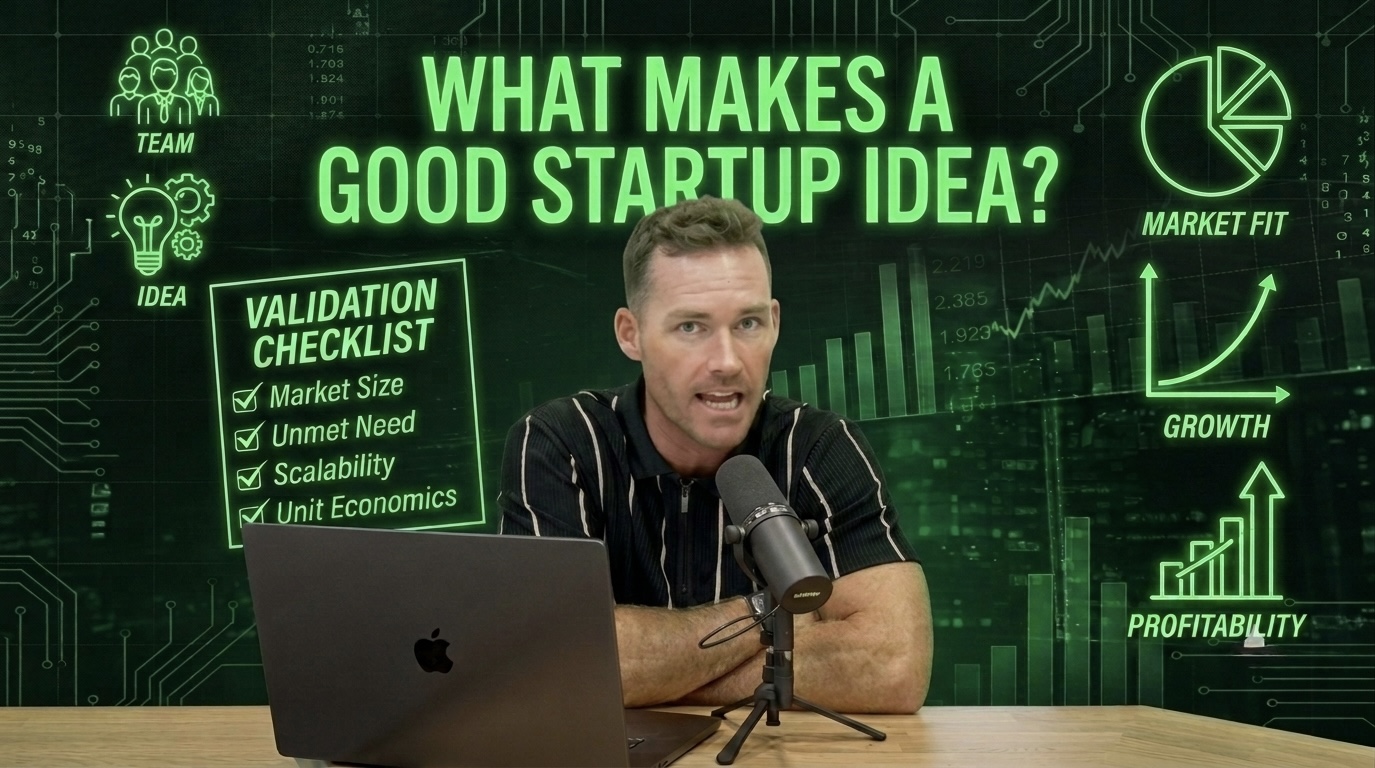
What Makes a Good Startup Idea: 6 Things That Matter
So what actually separates a good startup idea from an interesting product? After evaluating hundreds of startup ideas as pre-seed investors and mentoring thousands of founders, here’s the framework we use.
1. A Real Customer Pain
Good ideas don’t start with technology. They start with a customer who has a problem worth solving.
The question isn’t “What can I build?” It’s “Who urgently needs something solved?” Don’t sit in your room thinking about what’s cool to tinker with. Go find a customer with a pain and solve it for them. As Steve Blank says: get out of the building.
2. Urgency
A customer might have a problem, but if they’re not in a hurry to solve it, your startup will stall. The best ideas target customers whose hair is on fire. They need this solved now, not someday.
Without urgency, sales cycles stretch forever. Pilots never convert. “Interesting” meetings never lead to purchase orders.
3. Willingness to Pay
This is where most ideas fall apart. A customer might acknowledge the problem. They might say your solution is cool. But will they open their wallet?
Too many founders spend a year accumulating free beta users who never convert. Getting someone to use something for free is not validation. Getting them to pay is. If you can’t get a financial commitment, even a small one, you don’t have a business. You have a hobby.
4. A Workflow You Can Transform
One of the strongest signals: can you take an existing workflow and change its economics? If a business spends $10,000 a month on a process and you deliver the same outcome for $1,000, that’s compelling. If you can double their revenue from that workflow, that’s compelling.
We have a portfolio company that embedded an AI feature and cut the cost of a critical customer workflow by 99%. They went from steady growth to explosive growth overnight. That’s what a transformed workflow looks like.
The formula: find a must-have workflow where a business can’t survive without it, then dramatically improve the economics.
5. A Path to Profitability
Revenue is not profit. Your expenses need to be less than your revenue, eventually. The era of burning cash to chase growth is behind us. Investors want capital-efficient businesses that can sustain themselves.
6. A Defensible Position
If OpenAI, Anthropic, or Google could add your feature to their next release and make you irrelevant overnight, you don’t have a defensible idea. More on this below.
How to Find a Startup Idea: Start Narrow
One of the biggest mistakes we see in pitches: founders trying to be everything to everyone.
We had a pitch recently from a startup building software for the pet industry. Their deck covered solutions for dog groomers, trainers, kennels, and boarding houses all at once. Our feedback: pick one and master it first. You can’t be the same thing for a groomer and a trainer. Go after your lowest-hanging fruit and dominate it before expanding.
Narrowing down doesn’t mean small. It means finding your wedge, the beachhead that proves your model works. Investors don’t want your five-year $100M projection. They want to know: what customers will you get in the next 6-12 months to survive year one?
A concrete example. “AI for sales” is one of the hottest categories right now. Dozens of founders are building broad AI sales tools. But if someone came to us and said:
“I’m building an AI that helps HVAC installers follow up with lost estimate leads within 15 minutes.”
That’s a conversation we want to have. Specific customer, specific pain, specific workflow, measurable value. That’s infinitely more investable than “AI for sales.”
Narrow gives you clarity at every stage: who your customer is, what questions to ask, what features to build, and where to find your first ten paying customers.
AI Startup Ideas: Why Vertical Beats Horizontal
This might be the most important strategic decision founders face in 2026.
Horizontal AI tools are under serious threat. If you’re building a general-purpose writing assistant, chatbot, or sales copilot, any major AI company could release that capability in their next update and wipe you out. It’s the same pattern from the ’90s. Microsoft would ship a new Windows version that included a feature some startup had built its entire business around. That company would die overnight.
The same dynamic is playing out with AI right now. Every frontier model release makes certain startups obsolete.
Vertical solutions are a different story. Here’s a real example from a recent VC meeting. An orthodontist running a busy practice. He makes great money putting braces on kids. He is never going to vibe code his own practice management software. He’s not going to hire someone to do it either. He’s going to buy the best one built specifically for orthodontists, because it’s core to his business and he needs it to work perfectly.
Will there be pricing pressure? Sure. But the need for deep, specialized software that serves a specific industry isn’t going away. He’s still buying, not building.
If you’re looking for AI startup ideas in 2026: go vertical. Find a specific industry with a must-have workflow you can transform. The narrower your solution, the harder it is for a frontier model to replace you.
Use AI to Validate Faster, Not Just Build Faster
Here’s the mindset shift.
Don’t use AI primarily to build product faster. Use it to validate faster.
The purpose of validation isn’t to prove your idea is right. It’s to discover which parts are wrong, as quickly and cheaply as possible. AI can accelerate every part of that:
- Market research: map competitive landscapes and underserved segments
- Customer discovery: synthesize interview data and spot patterns
- Assumption testing: design and run experiments faster
- Financial modeling: stress-test unit economics and pricing strategies
The goal is to earn the right to build by finding product-market fit first, and then use AI to build. That sequence matters. Reversing it is how startups burn through two-thirds of their capital before realizing they need to pivot.
We’ve watched it happen. Over the last few years, several companies we liked (good teams, interesting ideas) raised more money than we thought they needed. In nearly every case, they burned most of that capital, a co-founder left, and they pivoted to essentially a brand-new business. A more disciplined validation process would have surfaced the need to pivot before the money was gone.
Involve Customers From Day One
Because products can be built so fast now, there’s an opportunity most founders are missing: customers can become co-designers of the product. The old model of disappearing into a room for months and emerging with a finished product is dead.
Now you can build a feature in a day, put it in front of a customer, get feedback, and iterate by tomorrow. The build-measure-learn loop runs at a pace that was unimaginable five years ago.
Our recommendation: find three to five customers who believe in what you’re doing and use them as your laboratory. These aren’t wins to put on a slide. They’re experiments. Work with them to figure out what features matter, how to price, what breaks, and whether they’d tell other people about it.
Once you’ve nailed it with five, go get the next 35. You’ll know exactly what you’re doing.
The exception: if customers are finding you organically and word of mouth is snowballing, don’t slow that down. But if you’re spending money to acquire customers before the product is ready, that’s the dangerous path. That’s how startups raise a big round, burn most of it on an unfinished product, and end up pivoting anyway.
Speed vs. Discipline
We’re not telling founders to move slowly. Speed matters. Markets move fast. The founder who built a GLP-1 e-commerce platform generating hundreds of millions as essentially a solo operator didn’t get there by being overly cautious.
But that’s the exception. And even in that case, the founder identified a massive, urgent customer need. They didn’t just build something cool and hope people showed up.
Our approach at Startup Ignition leans toward lean startup discipline. We’ve mentored thousands of founders, and when we tell someone to stop and validate before building, nine out of ten times we’re right. That’s not arrogance. It’s pattern recognition from over a decade of doing this. We’ve watched founders ignore the advice, burn through capital, lose a co-founder, and pivot to exactly the thing we suggested in the first place.
It’s always cheaper to pivot earlier. Validation doesn’t slow you down. It prevents the expensive resets that actually slow startups down.
Quick Self-Assessment: Is Your Startup Idea Good?
Before you write another line of code, run your idea through these seven questions:
- Can you name a specific customer segment (not “everyone”) who has this problem?
- Have you talked to at least 10 people in that segment who confirmed the problem is real and worth paying to solve? (Here’s how.)
- Is there urgency? Would the customer act in the next 30 days, or is this a “someday” problem?
- Can you describe the existing workflow you’re replacing and quantify how much better your solution is?
- Is it defensible? Could a frontier AI company add this to their next release and make you irrelevant?
- Can you build a profitable business, not just a product people use, but a company with healthy economics?
- Do you have a wedge? Can you name your first 10 customers and explain why they’d buy within six months?
If you can answer all seven with evidence, you likely have a good startup idea. If you can’t, you don’t necessarily have a bad idea. You have an untested one. Go test it.
Want an instant read? The Startup Ignition ToolSuite includes a free Idea Analyzer that evaluates your startup idea against thousands of real startup outcomes, including the strategies, frameworks, and data from companies that succeeded and failed. Describe your idea in a few sentences and get an immediate analysis of what’s strong, what’s weak, and what to test next. It’s the fastest way to pressure-test your idea before you invest a weekend vibe coding something nobody needs.

FREE TOOL
Startup Idea Analyzer
Describe your idea and get an instant analysis against thousands of real startup outcomes. Try it free →
The Bottom Line
The AI era hasn’t changed what makes a good startup idea. It’s compressed the timeline and raised the stakes. Building is essentially free, which means it’s no longer the hard part. Finding something worth building is.
The best startup ideas in 2026:
- Solve a real, validated customer pain, not a hypothetical one
- Target a narrow, specific segment with a clear wedge into the market
- Transform a must-have workflow in a way that changes its economics
- Occupy a vertical position that frontier AI can’t trivially replicate
- Are built by founders who used AI to validate faster, not just build faster
- Involve customers as co-creators from day one
Just because you can build it doesn’t mean you should. Earn the right to build first.
If you want to start right now, describe your idea in the ToolSuite’s free Idea Analyzer and get an instant assessment. If you want hands-on help validating and building the right way, that’s what our bootcamp is for.
Based on Episode 58 of the Startup Ignition Podcast. John and Tyler break down what makes a good startup idea in 2026, react to Steve Blank’s Stanford findings, and share real examples from their portfolio and pitch pipeline. Listen to the full episode here.
 Back to All News