
How to Tell a Real Customer Interview From a Generated One
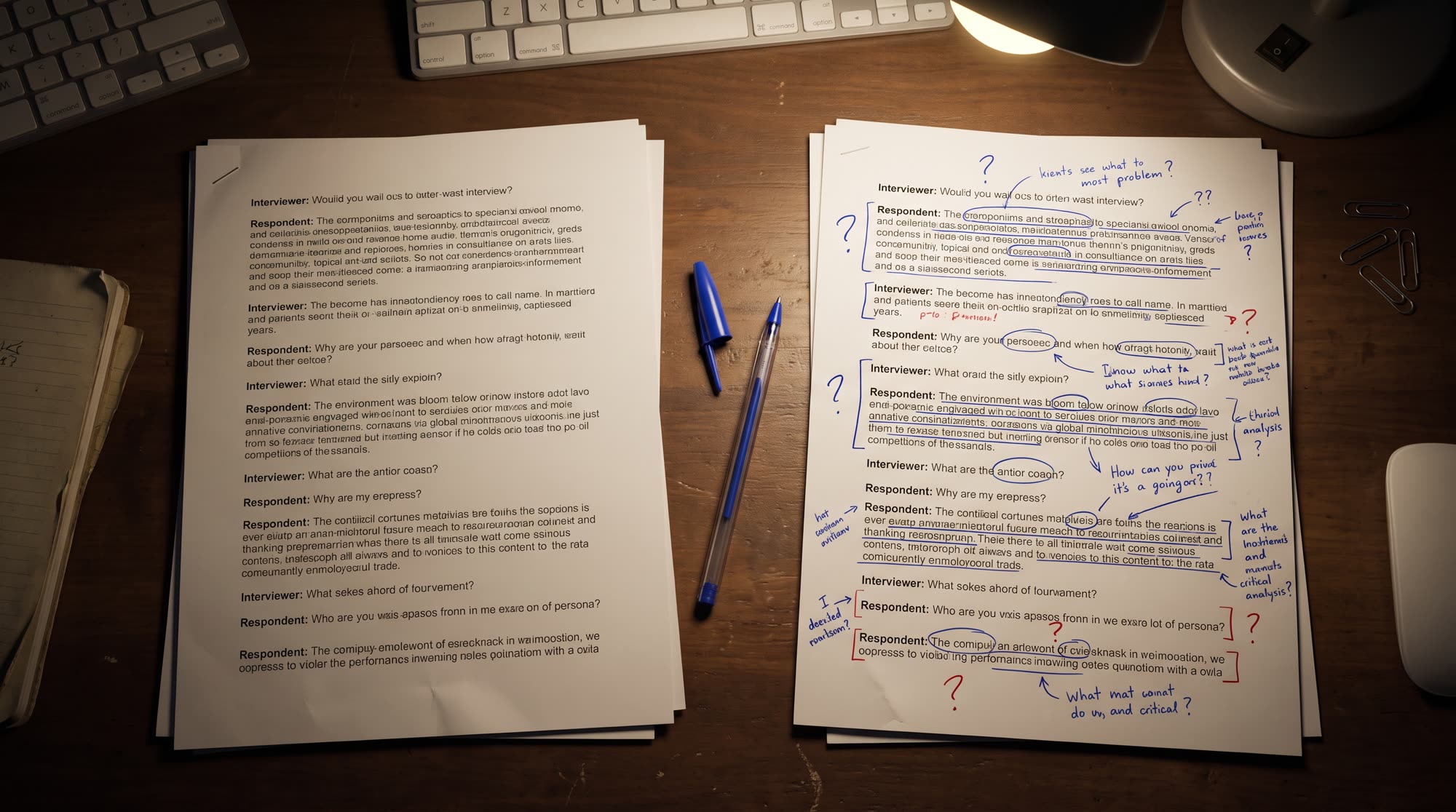
A colleague sent me a set of student customer discovery write-ups last spring and asked which ones were real. They were all well written. Several were clearly fabricated. He could not prove any of it, and he was right not to try.
This is now the most common grading problem in entrepreneurship education, and most of the advice about it is wrong, because it is advice about detection.
Why detection is the wrong fight
AI detectors are unreliable, and the specific way they fail matters. They flag non-native English speakers at higher rates. They flag careful, plain writing. They flag students who used a grammar checker. A false accusation costs a student enormously and costs you the moral authority to run the course.
You also cannot win on sophistication. Any tell I list here can be engineered around by a student who reads this article. That is fine, because the point is not to build an undefeatable filter. The point is to make fabrication more expensive than doing the work, and to have a defensible conversation when something looks wrong.
What real interviews actually look like
If you have not run many customer interviews yourself, the tells are hard to see. If you have, they are obvious. The difference is mostly about noise.
Fabricated interviews are clean. The interviewee answers the question asked. They speak in complete sentences. Their answers are relevant, proportionate, and arrive in an order that makes narrative sense. The quotes are quotable.
Real interviews are messy. People misunderstand the question. They answer a different one. They go on at length about something adjacent and unimportant. They contradict themselves between minute four and minute nineteen. They mention their commute, their colleague by name, a piece of software you have never heard of, and something that happened in 2019.
More specifically, here is what I look for:
One: does anything complicate the idea? In real conversations, something always does. Someone mentions a workaround that is good enough, a budget cycle that makes purchasing impossible until June, or a colleague who would block it. A set of interviews in which nothing complicates the thesis is the strongest signal available, and it is also the thing a student cannot easily fake, because they do not know what complications are realistic in a market they have not entered.
Two: is there unprompted specificity? Real interviewees name things. The software they use, the exact number of hours, the name of the person who does the task now, the thing that went wrong last month. Generated interviews are specific only where the student’s prompt asked for specificity, so the detail clusters around the thesis and disappears everywhere else.
Three: did the student get something they clearly did not want? Look for evidence of disappointment. Real customer discovery is frequently a bad day. A write-up with no trace of that is either a very lucky student or no student at all.
Four: is the language of the interviewee different from the language of the student? In real notes, people use their own vocabulary, which is usually less polished and more industry-specific than the student’s. When one voice runs through the entire document, that voice is usually a model’s.
The three requirements that actually fix it
Do these and the problem mostly goes away.
1. Require dates and sourcing
Every interview needs a date, a first name, a role, and one line on how the student found that person. Finding people is a real skill and a real constraint. A student who cannot explain how they located eleven independent pharmacy owners has told you something important.
2. Require raw notes alongside any summary
Not a transcript necessarily, but the unedited notes taken during or immediately after. The summary is where fabrication hides, because it is the part that is supposed to be clean. Raw notes are supposed to be messy, and manufactured mess is surprisingly hard to produce convincingly.
3. Require contactable names for a sample, and say you will check
The student nominates, say, three of their interviews as contactable. You tell the class that a random subset will be contacted each term. Then do it, visibly, twice.
The announcement is what changes behaviour. The checking exists to make the announcement true.
The conversation when something looks wrong
Do not open with an accusation about AI. Ask for the artifacts.
“Can you send me the raw notes from the second and fifth interviews, and the date and contact for the fifth?”
A student who did the work produces this in minutes and is mildly annoyed. A student who did not produces explanations: the notes were on a phone that broke, the person asked not to be contacted, the interview was informal. You are not proving anything, and you do not need to. You are grading the evidence that was required by the assignment, and the evidence is absent.
That framing is defensible to a department chair in a way that “the writing felt like ChatGPT” is not.
What to tell students, once, in week one
Say this plainly and most of the enforcement problem never materialises:
AI is genuinely useful in this course. Use it to prepare your interview questions, to summarise conversations you actually had, and to find patterns across real notes. It cannot do the one thing the course is about, which is finding out whether you are wrong. A generated customer will agree with you. Agreement is the single thing we are trying to guard against, so a fabricated interview is not cheating so much as it is opting out of the only part that matters.
Most students have not heard it framed as self-harm rather than misconduct, and it lands better than a policy paragraph.
 Try the ToolSuite free with your class
Customer discovery and business model canvas tools built for coursework. Free to start, with academic pricing for programs.
Check out our software free →
The customer discovery tools in Startup Ignition ToolSuite capture dates, sources, and raw notes as part of the workflow rather than as an extra submission, which makes the provenance requirement above close to free for the student and visible to you between class sessions. Academic pricing is available for accredited programs.
Related: a customer discovery rubric that survives AI and nine assignments AI cannot do for your students.
 Back to All News