


AI Idea Validator
Describe your idea. We run it against the best startups of all time, show you how it compares, score it 1 to 10, and tell you the next steps to take.
Completely free.
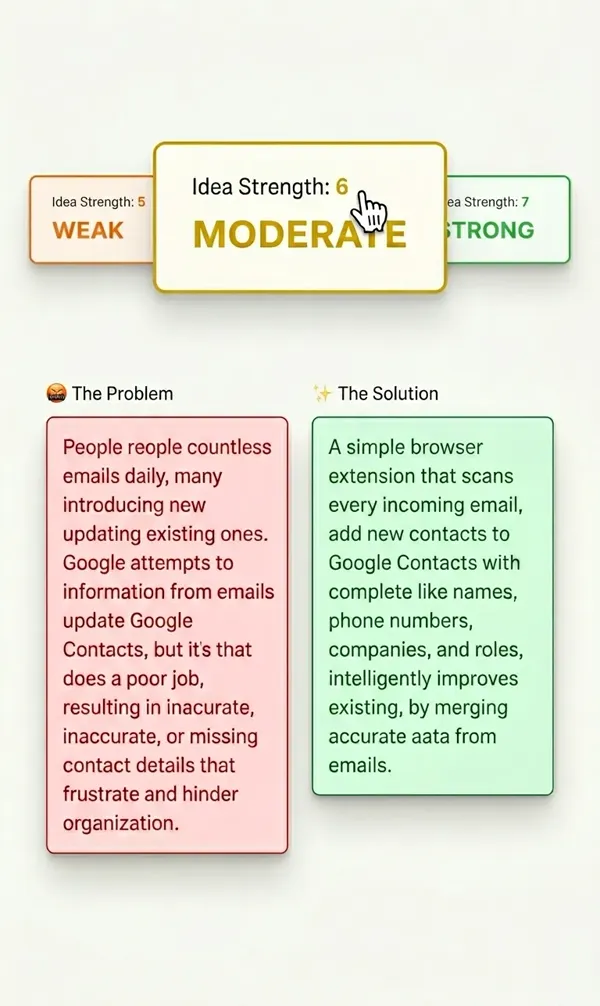
What the idea validator gives you back
A score out of 10, rated Weak, Moderate or Strong. Useful less as a grade than as a starting position: a 6 you can argue up to an 8 by tightening the problem statement is a productive afternoon.
Underneath it, your problem and your solution written back to you. Founders underrate this part. If the analysis describes your idea in a way you disagree with, you have found a clarity problem before an investor did.
Then the pros and cons, whoever else is already doing it, and whether the thing scales. Most first-time founders meet a direct competitor here, which is far cheaper to learn now than six months into building.
Your startup idea, validated against the ones that worked
Not a generic chatbot answering from the open internet. The analysis is built on the patterns Startup Ignition has compiled over a decade: the validation moves behind some of the biggest companies ever built, alongside the ones that failed and why.
-
 Explainer-video MVP
 -
 Lean validation
 -
 Concierge MVP
 -
 Manual onboarding
 -
 The pivot
 -
 Landing-page test
 -
 API-first MVP
 -
 Lean iteration
 -
 Bootstrapped lean
 -
 Build-measure-learn
Every one of these companies found its market by testing something specific before building it. Those are the moves your idea gets measured against, together with what John and Tyler Richards have seen across 1,000+ ventures mentored and 200+ angel investments.
How to validate a startup idea in three steps
Describe the idea
One or two sentences in plain language. No deck, no business plan, no jargon. If you cannot describe it in two sentences, that is itself a finding.
Run the analysis
Your idea is analyzed against thousands of real startup outcomes, both the ones that worked and the ones that did not.
Go test the riskiest part
Read the result as a list of assumptions. Pick the one that would kill the idea if it were wrong, and go talk to customers about that one first.
What an AI idea validator cannot tell you
It will not tell you whether your startup will succeed. Nothing can. Success depends on execution, timing, and customers who have not been spoken to yet, and any tool that claims to predict it is selling you confidence rather than information.
What it does is compress the first few weeks of desk research into a couple of minutes, surface the competitors you had not found, and name the assumptions your idea is resting on. Validation is not a verdict. It is a list of things to go find out.
The founders who get the most out of it treat a Moderate score as a prompt rather than a rejection, and go looking for why.
Where this fits
Idea Analysis is the first tool in the Startup Ignition ToolSuite. Validation tells you what to test. The rest is how you test it.
Built by the team behind Startup Ignition Ventures, who have made 200+ angel investments and backed 22 companies in Fund I. Further reading: the best AI tools for startup validation and how to test a startup idea.
AI idea validator: common questions
An AI idea validator takes a plain-language description of a business idea and returns a structured read on it: how strong the idea looks, what problem it actually solves, who else is already solving it, and where it is likely to break. It replaces the first few weeks of desk research you would otherwise do by hand, and it is meant to tell you what to go test next, not to give you a verdict.
Describe the idea in a sentence or two, run the analysis, and read the result as a set of assumptions rather than a score to celebrate. The Idea Analysis returns an Idea Strength rating out of 10, restates the problem and solution back to you, and surfaces pros, cons, competition and scalability. The value is in the disagreements: where the analysis reads your idea differently from how you meant it, that gap is usually the thing worth testing with real customers.
Yes, your first Idea Analysis is free. Signing up gives you 30 one-time credits and no credit card is required. Running more analyses, iterating on a pivot, or moving into the other tools consumes credits from that allowance or from a paid plan.
No, and you should be wary of any tool that claims otherwise. No analysis can predict an outcome that depends on execution, timing and customers who have not been spoken to yet. What it can do is compress the research, surface the competition you had not found, and name the assumptions your idea rests on so you can go test the riskiest one first.
An Idea Strength score out of 10 with a Weak, Moderate or Strong reading; the problem and the solution written back to you in clear terms; and a breakdown covering pros and cons, existing competition, and how the idea scales. The restatement matters more than founders expect. If the analysis describes your idea back in a way you disagree with, you have found a clarity problem you would otherwise have carried into every investor conversation.
No. Your ideas remain yours and we do not train our AI on user content.
Idea Analysis is the first step of a longer sequence. The ToolSuite continues into Deep Secondary Market Research, the Big Idea Canvas, customer discovery scripts and AI-run interviews, the Business Model Canvas, and investor-readiness tools. Validation tells you what to test. The rest of the platform is how you test it.
Run your first analysis free
30 credits on signup. No credit card. Your idea stays yours.
Or see the full ToolSuite, which this is the first tool of.