
Steve Blank on AI and the MVP: What His Four-Part Series Says

Between 21 and 30 September 2026, Steve Blank published a four-part series on what AI did to the Lean LaunchPad, the course he created in 2011 and which is now taught at hundreds of universities. It is the most substantial thing written this year about how AI changes the practice of starting a company, and it introduces vocabulary that is going to stick.
I have a stake in reading it closely. I taught entrepreneurship at BYU for nearly two decades and have spent the eleven years since running Startup Ignition Bootcamp — more than 50 cohorts, over 1,000 ventures, teaching the same Customer Development method Blank wrote. When the person who built the canonical version of a curriculum says the curriculum broke, anyone running one owes it a careful read rather than a hot take.
What follows is a summary of each of the four parts, and what I think is worth taking from them. For the longer argument about what this looks like outside a classroom, see A Product Is No Longer Proof.
Part 1: The Year AI Came For Us
Read part one · 21 September
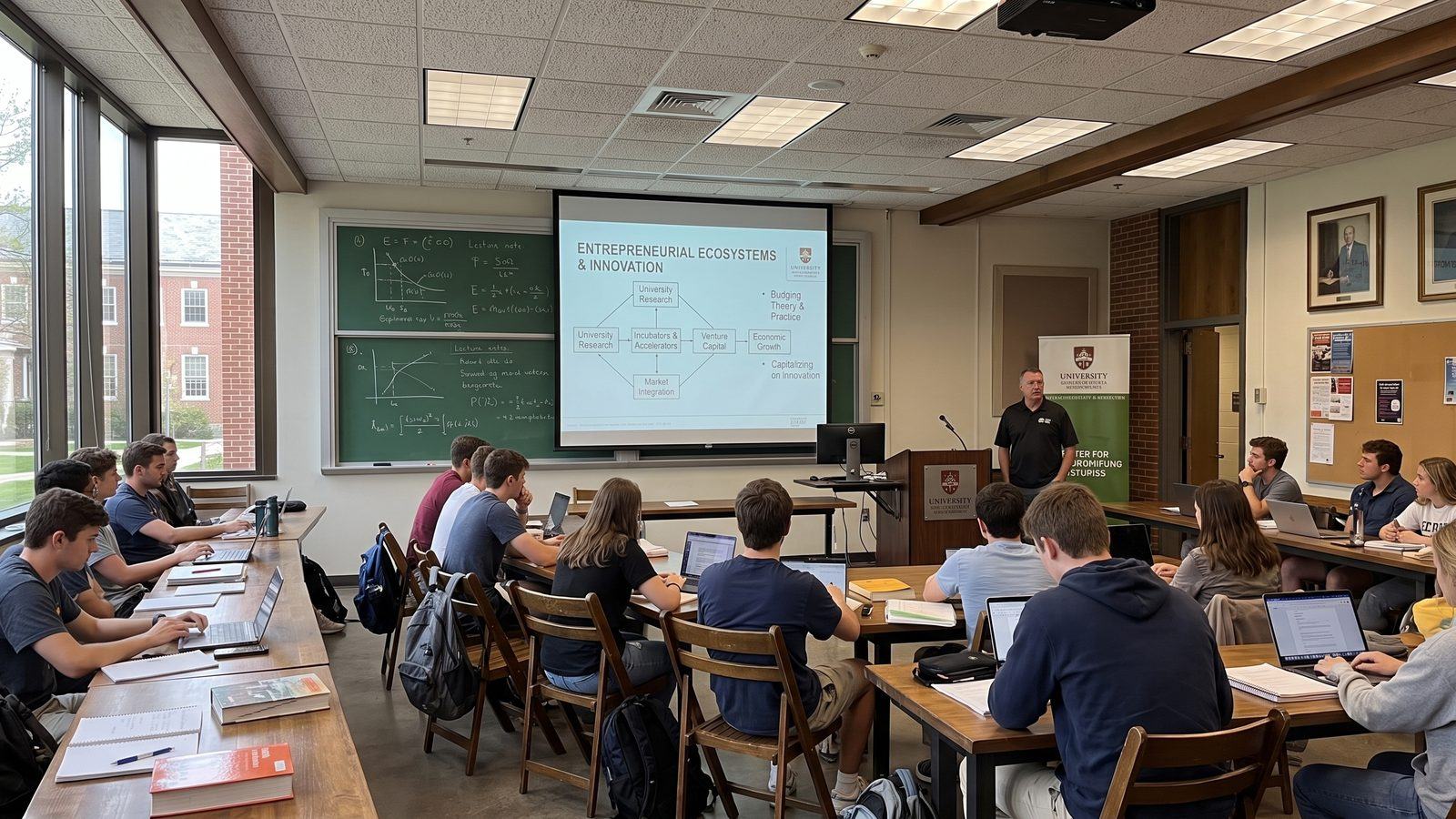
Blank’s Spring 2026 class at Stanford ran as it always has: ten weeks, student teams, 100+ customer interviews, building toward an MVP as the evidence accumulates.
This year every presenting team showed up on day one with a finished, functional product, built with AI before the class started.
His finding is not that they cheated. The products were real. The learning was worse. Teams substituted AI for customer research and assumed the AI-generated insight was accurate. The polish increased confirmation bias and made pivoting psychologically expensive even as it became technically cheap. They collected compliments instead of disconfirming evidence.
Two terms come from this part. Evidence theater — polished deliverables that feel like progress while reflecting almost no discovery. And learning debt — what a team accrues by skipping the struggle that produces insight.
Part 2: AI Killed the MVP, Long Live the IUP
Read part two · 24 September
Here Blank isolates what actually broke.
An MVP used to carry two signals at once. It showed the team could build. And because building was slow and expensive, it showed that what they built had accumulated learning along the way. AI breaks both. A polished product no longer tells you the team has technical depth, has spoken to a customer, has tested an assumption, or has invested much of anything.
So he renames it: an AI-generated day-one product is an Initial Untested Product, not a Minimum Viable Product. The artifact keeps its place and loses its claim to be evidence.
The more interesting move is what he does next. He says the rename is not the fix:
“we had confused the symptoms (the MVP is dead) with the much larger real problems facing the class.”
Renaming the artifact does not repair a course built on the assumption that artifacts carry evidence. He goes back to first principles instead — and is explicit that the foundations hold. Customer Development, the Business Model Canvas, hypotheses, interviews, evidence, pivots: all stay. Startups still do not execute known business models; they search for a repeatable and scalable one.
Stated plainly, his argument is that AI did not eliminate the MVP. It eliminated the assumption that having one is evidence you have learned anything.
Part 3: The World Outside the Classroom Changed
Read part three · 28 September
The third part widens the lens before it answers anything. Blank’s point is that it was never only the classroom that changed. His course was designed around the 2011 versions of four external conditions:
- Venture capital — how much startups can raise, when, and from whom
- How products get built — the core platforms and development tools
- What building costs — time to market, team size, capital required
- Customer adoption — how buyers evaluate, purchase, deploy and use, how fast, and how they decide between building and buying
The fourth is the one founders underrate. AI did not only make you faster; it made your customer and your competitor faster too. A buyer who would once have waited eighteen months can now have their own team stand up something adequate in a fortnight. Blank’s framing is that the bottlenecks did not disappear, they moved — and the conclusion he draws is that finding a defensible moat is no longer a Series A problem you can defer.
Two further claims come out of this part.
Product/market fit is fragmenting. For fifteen years it worked as a single phrase covering every stakeholder in every sector. Blank now replaces it with category-specific evidence: agent/outcome fit in enterprise software, mass creation and testing in consumer, digital-twin-to-physical fit in hardware, clinical endpoint evidence in life sciences, validated external assessment in education.
The design partner replaces the MVP as evidence. A design partner is a customer who co-develops with you and commits something scarce to do it — staff time, data, integration effort, permissions, test environments, changes to workflow — in exchange for early access, preferential terms, or influence over the product. Acquiring one becomes the evidence of Customer Validation in the second half of his redesigned course.
Part 4: Lean LaunchPad, The Next Generation
Read part four · 30 September
The redesign. The course splits into two halves with different jobs.
Weeks 1–4, “Think Deeply.” Stakeholders, problems and hypotheses, with teams running 10–15 interviews a week. No full product demos. Weekly presentations are hypothesis, experiment, result — not a walkthrough of what got built.
Weeks 5–9, “Act Quickly.” Rapid iteration toward a design partner, who becomes the primary measure of validation.
The artifact is no longer one thing you either have or do not have. It progresses, and each stage has a name:
- IUP — the Initial Untested Product you arrived with
- IUP Snippet — a small piece of it, isolated to test one value proposition rather than demo the whole
- PTP — a Partially Tested Product, the target by week 4
- DPVP — a Design Partner Validated Product, the target by week 9
- MTC — the Minimal Tested Canvas, which replaces the MVP for the parts of a business model that are not the product
- POF — Product-Outcome Fit, replacing Product/Market Fit
The snippet is the quietly clever part. If the problem is that a finished product answers no question, the fix is not a smaller product — it is isolating the one piece that tests the one hypothesis you are actually unsure about.
Two lines are worth having in full. On grading:
“Students will be graded on the quality of their outreach, not on the success of proving their snippet correct.”
That removes the incentive to be right, which is the incentive that produced evidence theater in the first place.
And on AI in the course, which he encourages rather than bans — teams are told to run agents with assigned expertise for research, notes and synthesis, while keeping the line clear between what the model produced and what the team verified:
“discovery is your job, not the agents’ job. But they can be powerful assistants.”
“live interviews grade the synthetic ones, never the reverse.”
What survives the redesign: team-based experiential learning, the Business Model and Value Proposition Canvases, Customer Development, hypothesis testing, field interviews, weekly evidence reviews. The method held. The artifact that used to carry its evidence did not.
The new vocabulary, in one place
| Term | What it means |
|---|---|
| Initial Untested Product (IUP) | An AI-generated day-one product. Keeps the artifact, drops the claim that it is evidence. |
| Evidence theater | Polished output that feels like progress but reflects no discovery. Test: what result would have made the founder stop? |
| Learning debt | What a team accrues by skipping the struggle that produces customer insight. |
| Design partner | A customer who commits scarce resources to co-develop. The replacement for the MVP as proof of validation. |
| IUP Snippet | A small piece of the product, isolated to test one hypothesis instead of demonstrating the whole. |
| PTP | Partially Tested Product — the week-4 target, refined against customer feedback. |
| DPVP | Design Partner Validated Product — the week-9 target, and the course’s definition of done. |
| MTC | Minimal Tested Canvas — replaces the MVP for the parts of a business model that are not the product. |
| POF | Product-Outcome Fit — replaces Product/Market Fit. |
| Category-specific fit | Product/market fit split into sector-appropriate evidence rather than one phrase for everything. |
What I think he got right, and the one thing I would push on
Three things, if you read nothing else.
The foundations did not move. This is not a repudiation of Lean Startup, and anyone reporting it that way has not read Part 2. Customer Development, hypotheses, evidence and pivots all survive intact.
One assumption broke, and it was load-bearing. Building used to prove learning had happened, because building was expensive. It no longer does, and every process that quietly relied on that inference — course design, diligence, a founder’s own sense of progress — inherits the problem.
Evidence now has to be something the customer spends. That is the common thread from evidence theater through to design partners. A demo costs the customer nothing, which is exactly why it proves nothing. Time, money, data, access, a changed workflow — those cost something, and that is what makes them evidence.
And one thing the redesign gets right that is easy to miss: grading the quality of the outreach rather than whether the hypothesis survived. Rewarding founders for being right is what produced evidence theater. Rewarding them for finding out is a different course, and arguably a different industry. We have run our three days that way for years and it is the single hardest thing to hold, because founders arrive wanting to be told they are right and the room has to refuse.
The one place I would push. The design partner is an enterprise-shaped instrument — it assumes a customer with staff to assign, systems to integrate and procurement to navigate. That describes a Stanford deep-tech team and almost none of the founders in our room, who are building for dentists, contractors and restaurant owners. Told the standard is a design partner, most first-time founders will conclude it does not apply to them and go back to showing the demo.
It does apply. It needs translating. The principle underneath is that evidence is whatever the customer cannot give you for free, and at small scale the currency is different: a deposit, a pre-order, an introduction to their boss, an afternoon they will not get back. Five dollars from a plumber is the same instrument as a Fortune 500 committing a test environment. Both cost the person something, and neither can be faked with enthusiasm. I would want that spelled out before a cohort of first-time founders reads “design partner” and decides the bar is set somewhere above them.
For what this looks like outside a classroom — in a room of self-funded founders, and on the other side of a pre-seed pitch — we wrote that up separately in A Product Is No Longer Proof.
Frequently Asked Questions
What is Steve Blank’s four-part series about?
In September 2026 Steve Blank published four posts on what AI did to his Lean LaunchPad course at Stanford. Part 1 reports that every presenting team arrived with a finished AI-built product and learned less for it. Part 2 argues the MVP has stopped working as evidence and proposes Initial Untested Product in its place. Part 3 covers the four things outside the classroom that changed and proposes the design partner as the new evidence of customer validation. Part 4 sets out the redesigned course: a Think Deeply half and an Act Quickly half, with the product progressing from Initial Untested Product to Partially Tested Product to Design Partner Validated Product.
What is an Initial Untested Product (IUP)?
Initial Untested Product is Steve Blank’s term for an AI-generated day-one product. A Minimum Viable Product used to carry two signals: that the team could build, and — because building was slow and costly — that what they built reflected learning from customer conversations. When a polished product can be generated in a weekend it carries neither, so the artifact keeps its place and loses its claim to be evidence.
What does Steve Blank mean by evidence theater?
Evidence theater is Blank’s term for polished deliverables that feel like progress while reflecting almost no customer discovery. A demo built to be shown rather than to answer a question, a waitlist that costs nobody anything to join, a deck of market-size charts no customer conversation would have changed. The test is whether any result would have caused the founder to stop.
What is a design partner?
A design partner is a customer who co-develops the product with you and commits something scarce to do it — staff time, data, integration effort, permissions, test environments, or changes to their workflow — in exchange for early access, preferential terms, or influence over what gets built. Blank proposes acquiring one as the evidence of customer validation that replaces the MVP in the second half of his course.
What is Product-Outcome Fit (POF)?
Product-Outcome Fit is the term Steve Blank uses in place of Product/Market Fit in his redesigned Lean LaunchPad. The change follows from his argument that product/market fit had become a single phrase covering every sector, and that evidence now has to be category-specific — an outcome a customer actually got, rather than a general sense that a market wants the thing.
What is an IUP snippet?
An IUP snippet is a small piece of an Initial Untested Product, isolated so it tests one specific value proposition instead of demonstrating the whole thing. It is Blank’s answer to the problem that a finished product answers no question: the fix is not a smaller product but a targeted one, built to settle the hypothesis the team is genuinely unsure about.
Is Steve Blank saying Lean Startup is dead?
No, and he is explicit about it. He keeps Customer Development, the Business Model Canvas, hypotheses, experimentation, evidence, interviews and pivoting. Startups still do not execute known business models; they search for one. What broke is narrower: building the product stopped counting as proof that any searching happened.
What is learning debt in a startup?
Learning debt is what a team accumulates by skipping the struggle that produces customer insight. Blank uses it to describe teams that arrived with working products and, because the building was done, never did the discovery the building used to require. The debt comes due later, when the assumptions nobody tested turn out to be wrong.
Startup Ignition Bootcamp 3-day intensive. Zero equity. Validate the idea before you build it, with exited founders and active investors. See Upcoming Cohorts →If you teach this material, the companion piece is what to change in an entrepreneurship curriculum now that AI builds the product.
John Richards is co-founder of Startup Ignition. He taught entrepreneurship at BYU for nearly two decades and has worked with more than 1,000 ventures since launching Startup Ignition Bootcamp in 2015.
 Back to All News