
The 2026 Startup Founder Friendsgiving: Who Gets a Seat at the Table
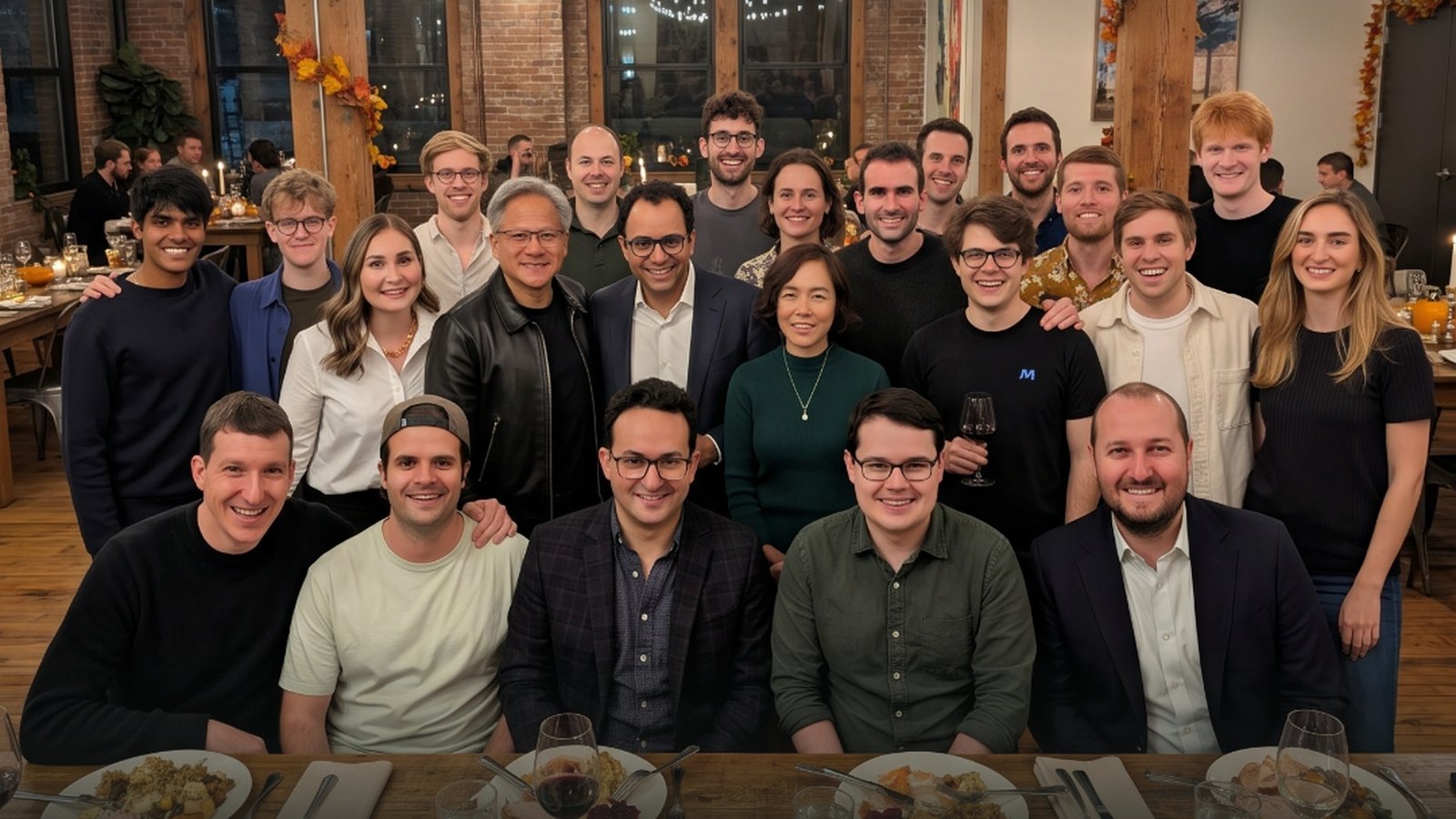
It’s the holiday season, and we couldn’t stop turning over the same question: what if we threw a Friendsgiving for this year’s best founders? Who would we invite? There are only so many chairs, so who actually makes the cut?
Every Thanksgiving somebody at the table asks what you really do for work, and every founder gives the same slightly apologetic answer. So we built the table we’d want to sit at. To learn something. To talk shop. To eat a good meal with some of the sharpest people of 2026.
Twelve seats, ranked by value created this year: sale price, latest valuation or market cap. The dinner is imaginary, the photos are AI-generated, and not one of these people has agreed to pass anybody the stuffing. The numbers are real, and sitting next to each other they say something about 2026 that no single headline did.
The biggest startup exits and raises of 2026, ranked
| Seat | Who | What happened in 2026 | Value |
|---|---|---|---|
| 12 | Jensen Huang, Nvidia | Market cap after an extraordinary year | ~$3.7T |
| 11 | Anthropic’s seven cofounders | Largest IPO ever, Nov 19 | $1.76T |
| 10 | Cursor founders | Sold to SpaceX in stock | $60B |
| 9 | Kalshi founders | Raised $1B | $22B |
| 8 | ElevenLabs founders | $300M employee tender | $22B |
| 7 | Mercor founders | Raised $750M | $20B |
| 6 | Lovable founders | Raised $400M | $13.3B |
| 5 | Hugging Face founders | Agreed sale to Nvidia | $12.93B |
| 4 | Fei-Fei Li, World Labs | Sold to AMD in stock | ~$8.2B |
| 3 | Brex founders | Sold to Capital One | $5.15B |
| 2 | Modular founders | Sold to Qualcomm in stock | $3.92B |
| 1 | Conductor founders | Acquired by Meta, Nov 4 | Undisclosed |
Read the table top to bottom and the oldest company on it took thirty-three years to reach the head of the table. The youngest took two.
The oldest company at this table took thirty-three years to get here. The youngest took two. They are eating the same dinner.
The guest list
Seat 1: Conductor
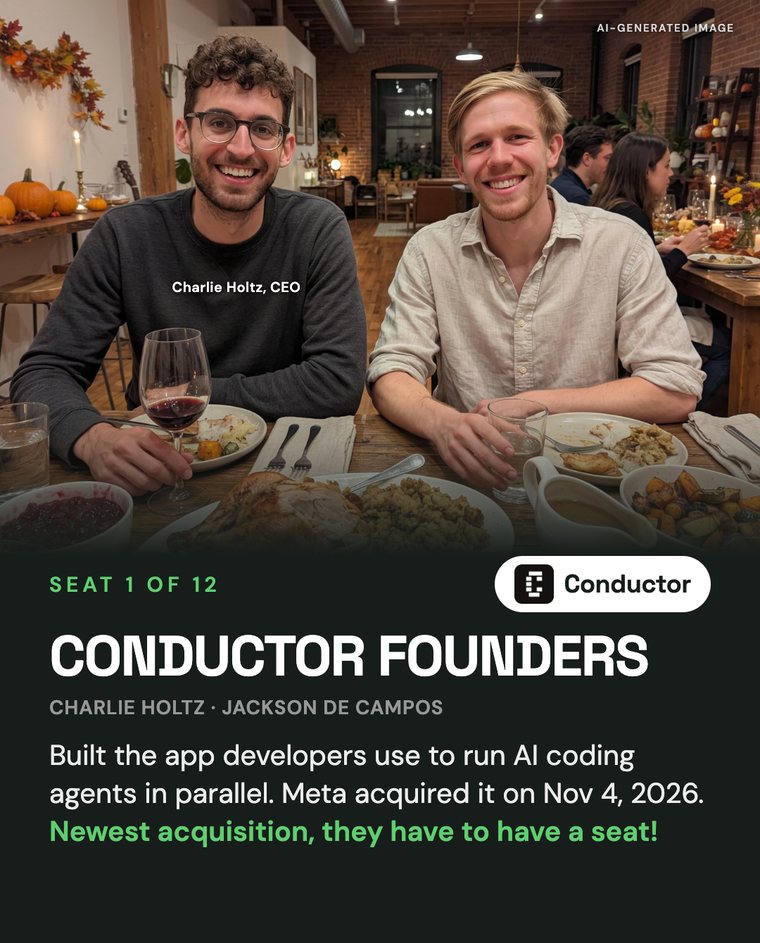
Charlie Holtz and Jackson de Campos. They built the app developers use to run AI coding agents in parallel, and Meta acquired it on November 4, 2026. Newest acquisition at the table, which earns them the first seat and the first question of the night. Two people built a tool for a workflow that did not exist eighteen months earlier.
Seat 2: Modular
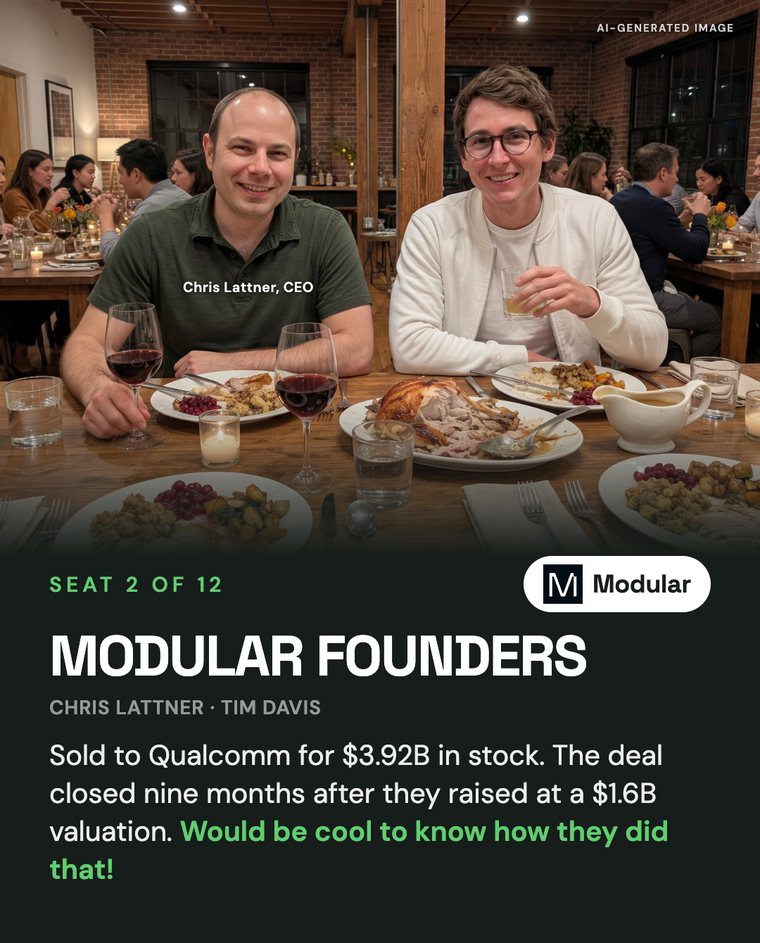
Chris Lattner and Tim Davis. Sold to Qualcomm for $3.92 billion in stock. The detail worth the conversation is the timing: the deal closed nine months after they raised at a $1.6 billion valuation. Modular built software that lets AI models run across chips from different vendors without rewriting code for each one, which turned out to be exactly what a chipmaker expanding into data centers could not build fast enough itself.
Seat 3: Brex
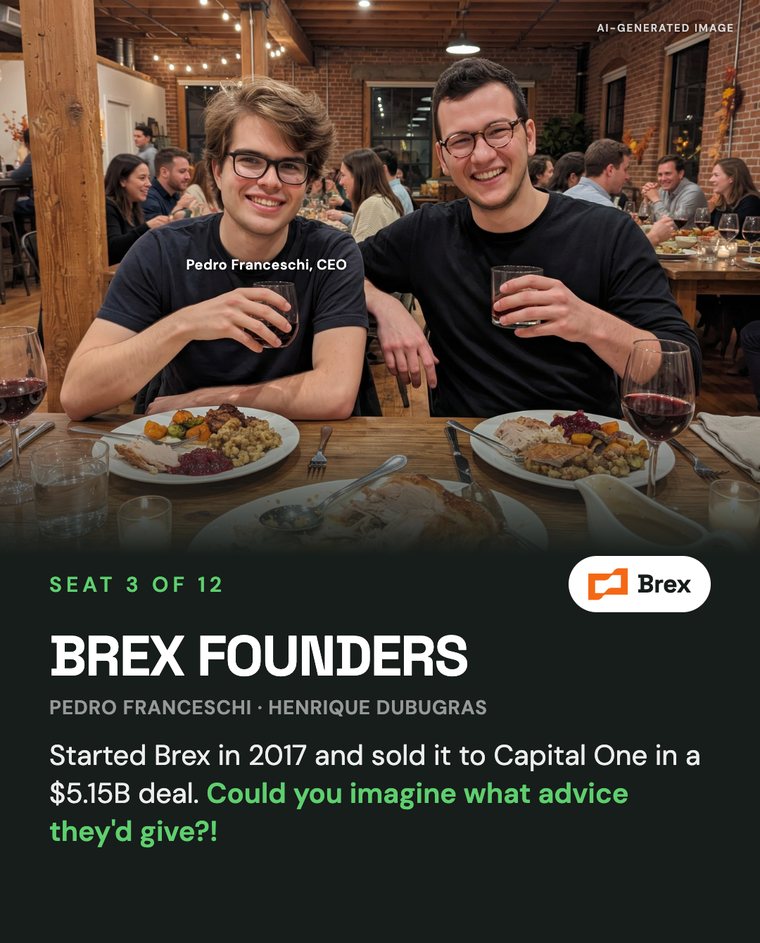
Pedro Franceschi and Henrique Dubugras. They started Brex in 2017 and sold it to Capital One in a $5.15 billion deal. Nine years, start to finish, which at this table counts as the scenic route. They are also the two people here who have been through the full arc, and the ones you would actually want advice from.
Seat 4: World Labs
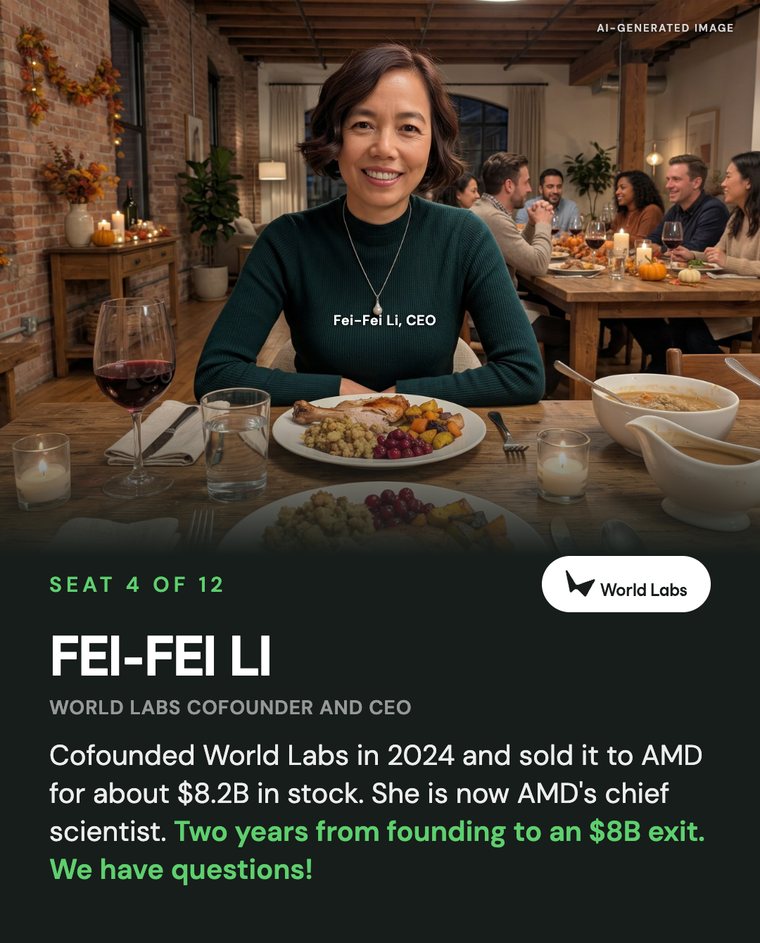
Fei-Fei Li. Cofounded World Labs in 2024 to build spatial intelligence models, sold it to AMD for about $8.2 billion in stock, and is now AMD’s chief scientist. Two years from founding to an eight-billion-dollar exit, and it became AMD’s second-largest acquisition ever after Xilinx.
Seat 5: Hugging Face
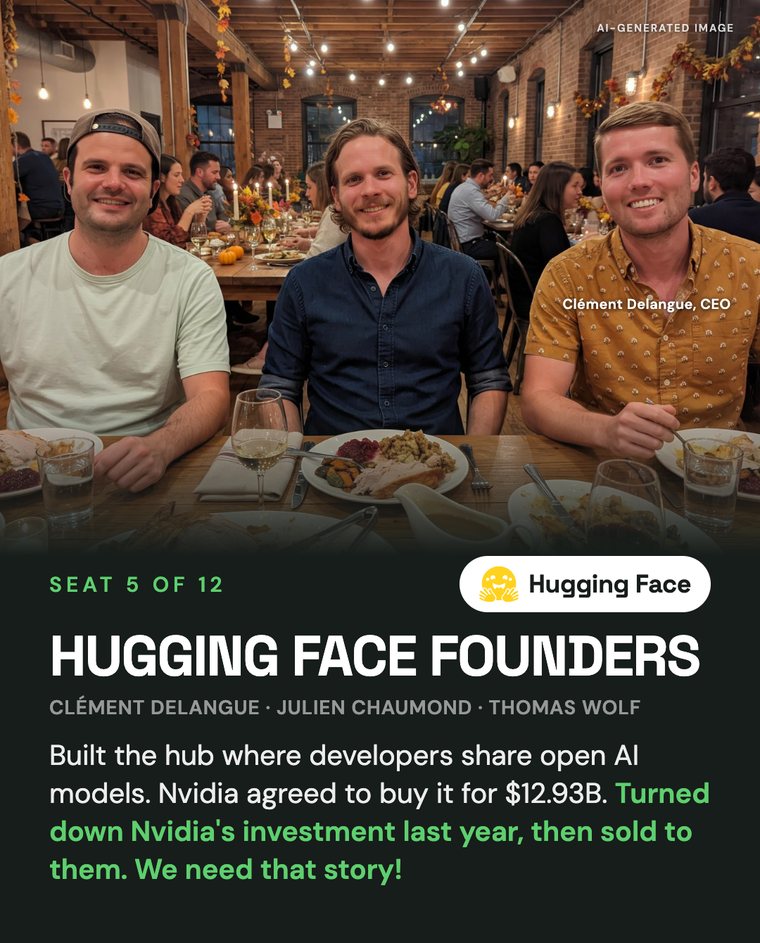
Clément Delangue, Julien Chaumond and Thomas Wolf. They built the hub where developers share open AI models, and Nvidia agreed to buy it for $12.93 billion. The story everyone wants over dessert: Hugging Face turned down a $500 million investment from Nvidia earlier in the year over concerns about one dominant investor, then sold the whole company to them months later. We wrote about what that deal means for founders when it was announced.
Seat 6: Lovable
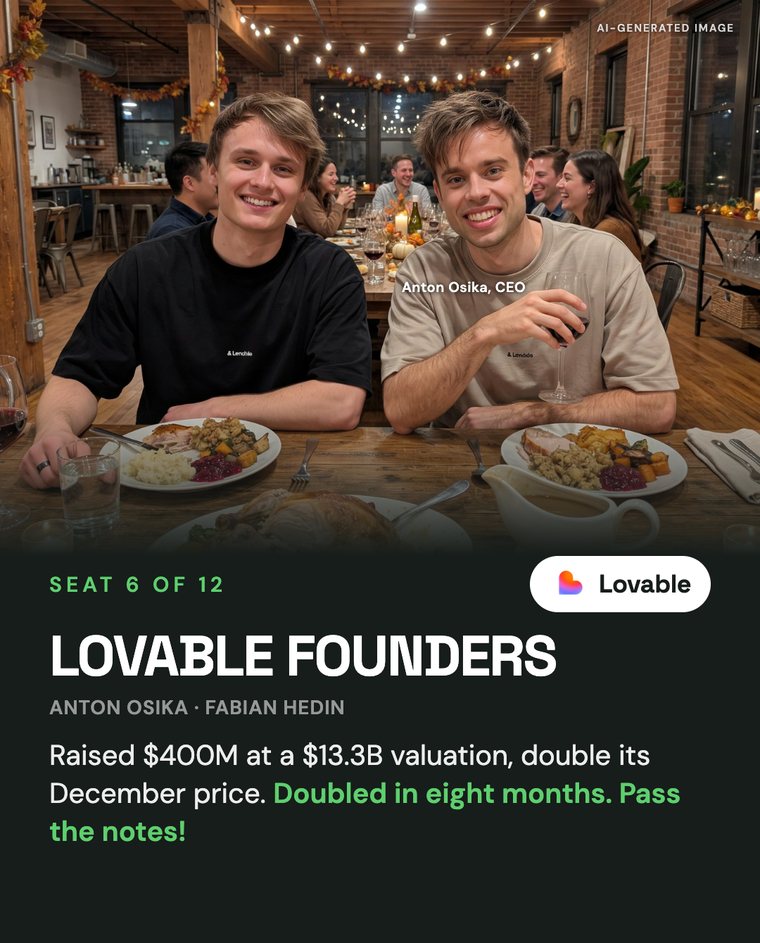
Anton Osika and Fabian Hedin. Raised $400 million at a $13.3 billion valuation, double what the company was worth the previous December. Doubling in eight months is the kind of number that makes everyone else at the table quietly recalculate their own.
Seat 7: Mercor
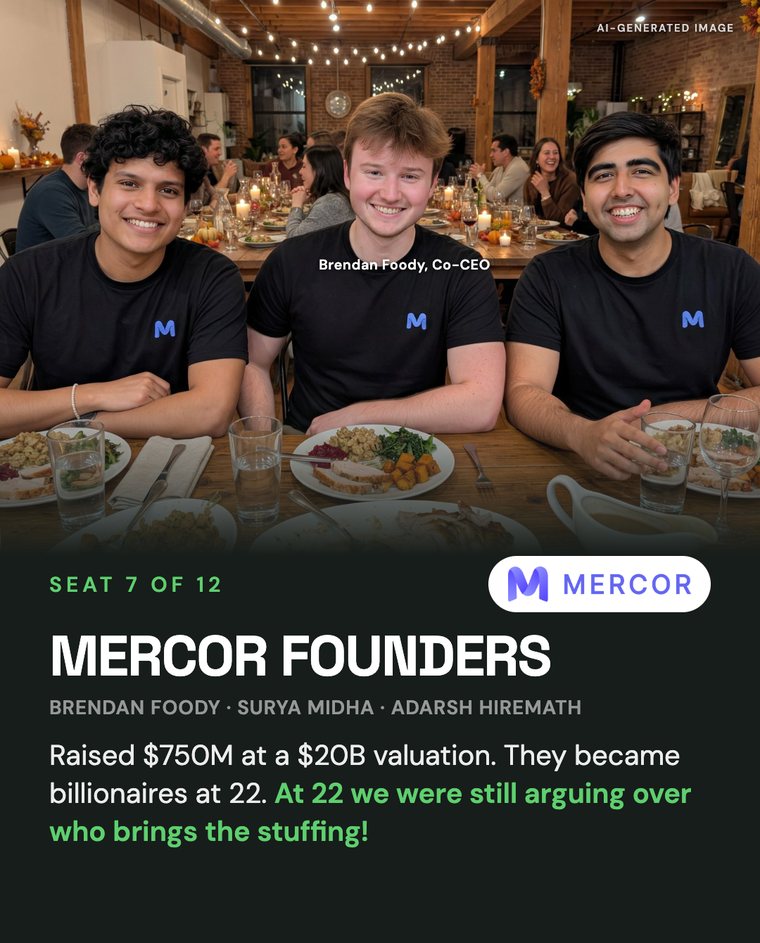
Brendan Foody, Surya Midha and Adarsh Hiremath. Raised $750 million at a $20 billion valuation and became billionaires at twenty-two. At twenty-two most founding teams are still arguing about who is bringing the stuffing.
Seat 8: ElevenLabs
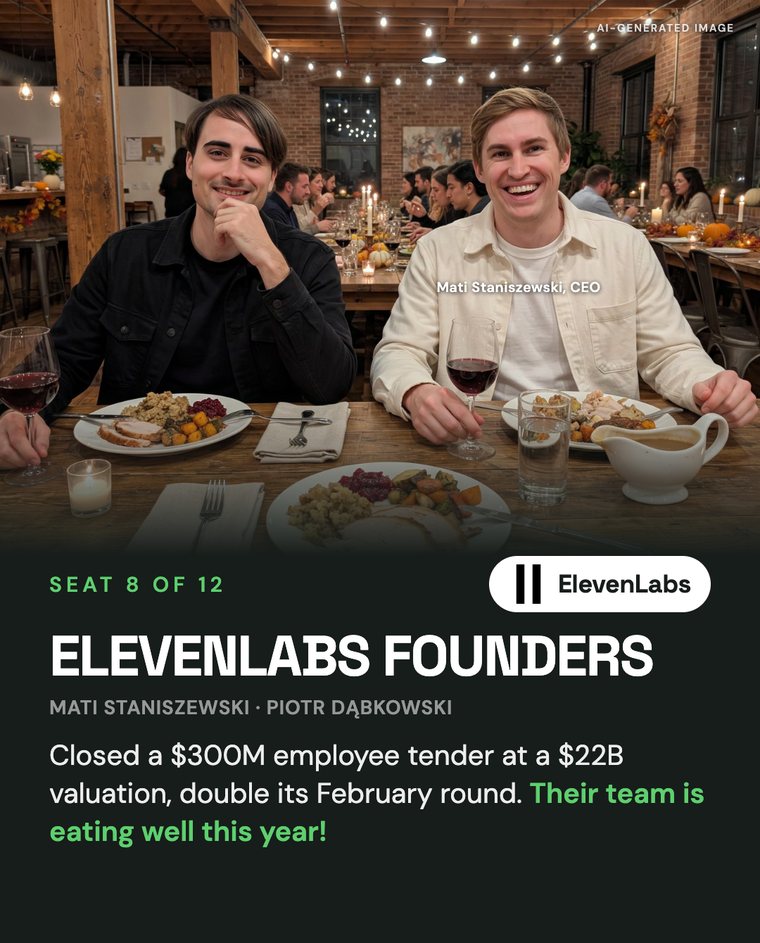
Mati Staniszewski and Piotr Dąbkowski. Closed a $300 million employee tender at a $22 billion valuation, double the February round. The tender is the part worth noticing. They took a round whose explicit purpose was letting the people who built the company actually sell some of it.
Seat 9: Kalshi
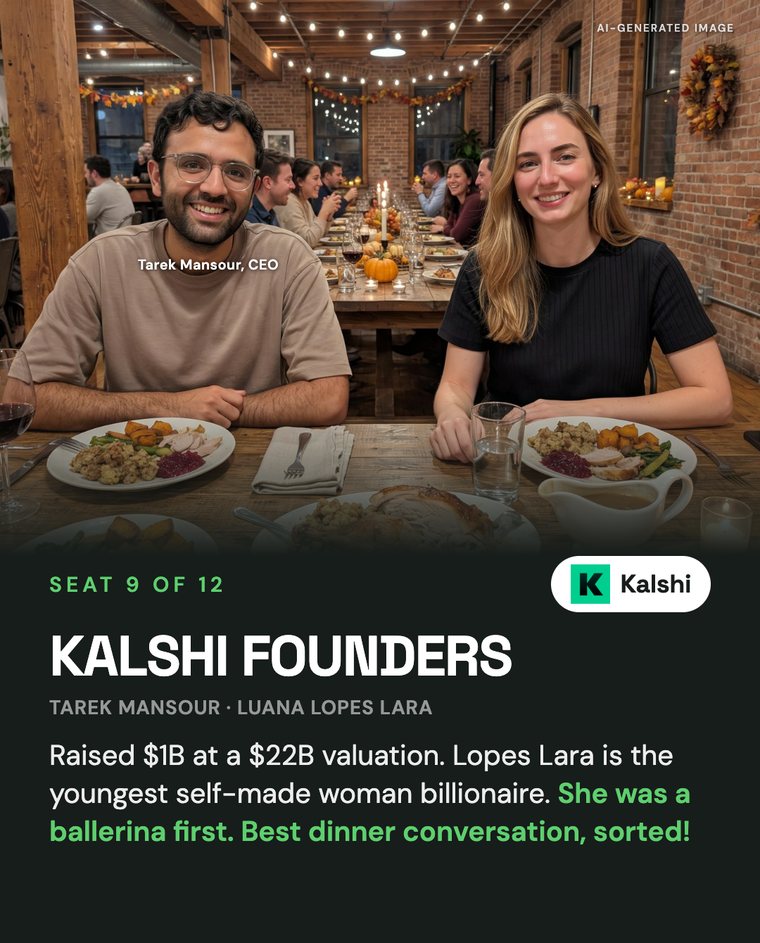
Tarek Mansour and Luana Lopes Lara. Raised $1 billion at a $22 billion valuation, and Lopes Lara became the youngest self-made woman billionaire. She trained as a ballerina before she built a federally regulated exchange, which makes her the person you seat next to the relative who insists founders all have the same background.
Seat 10: Cursor
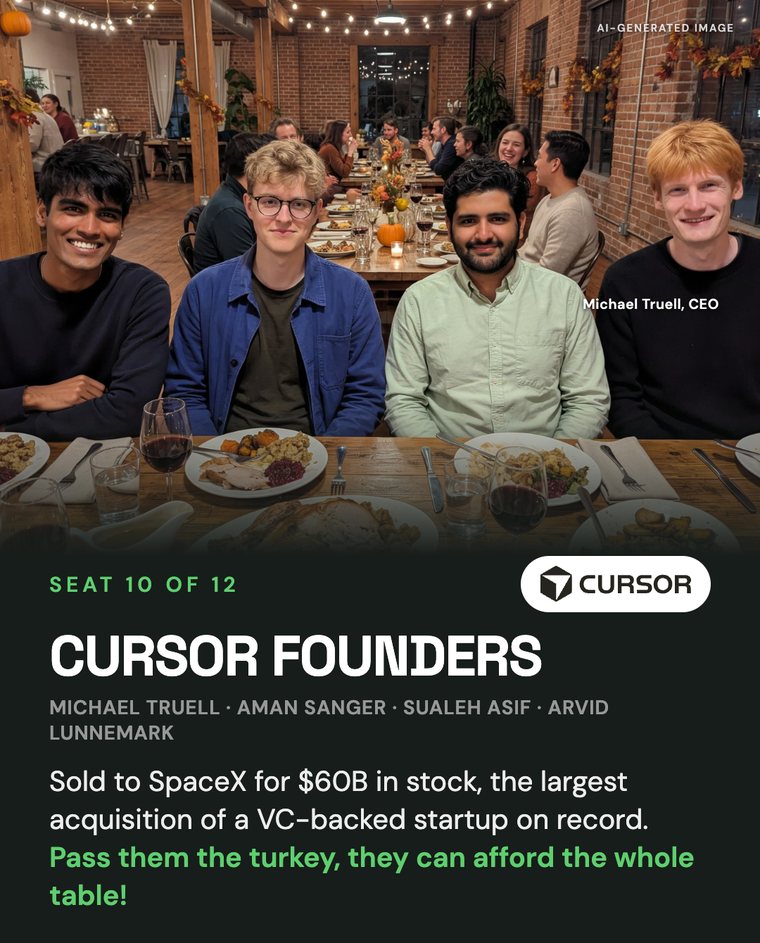
Michael Truell, Aman Sanger, Sualeh Asif and Arvid Lunnemark. Sold to SpaceX for $60 billion in stock, the largest acquisition of a venture-backed startup on record. The structure was unusual enough to be worth the retelling: SpaceX set up the deal before its own IPO as either a $60 billion purchase or a $10 billion break-up fee. They can afford the whole table.
Seat 11: Anthropic
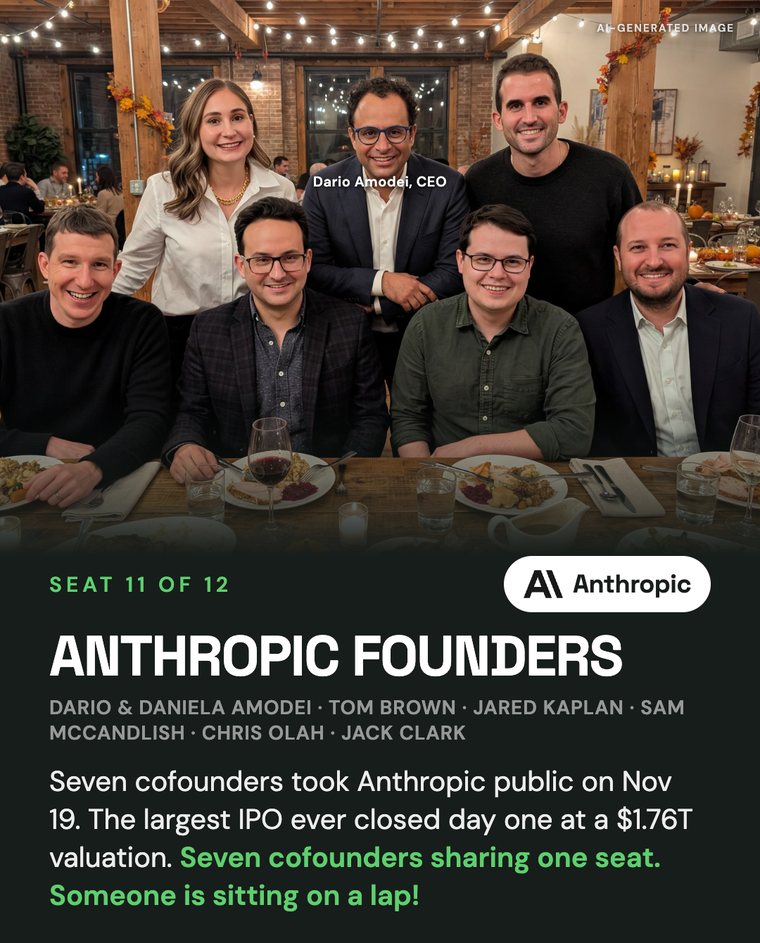
Dario and Daniela Amodei, Tom Brown, Jared Kaplan, Sam McCandlish, Chris Olah and Jack Clark. Seven cofounders took Anthropic public on November 19. The largest IPO in history by amount raised closed day one at a $1.76 trillion valuation. Seven cofounders and one seat means somebody is sitting on a lap, and it is also a useful reminder that the founder title gets shared far more often than the origin stories suggest. We looked at why the IPO might matter more to startups than to Anthropic before it priced.
Seat 12: Jensen Huang
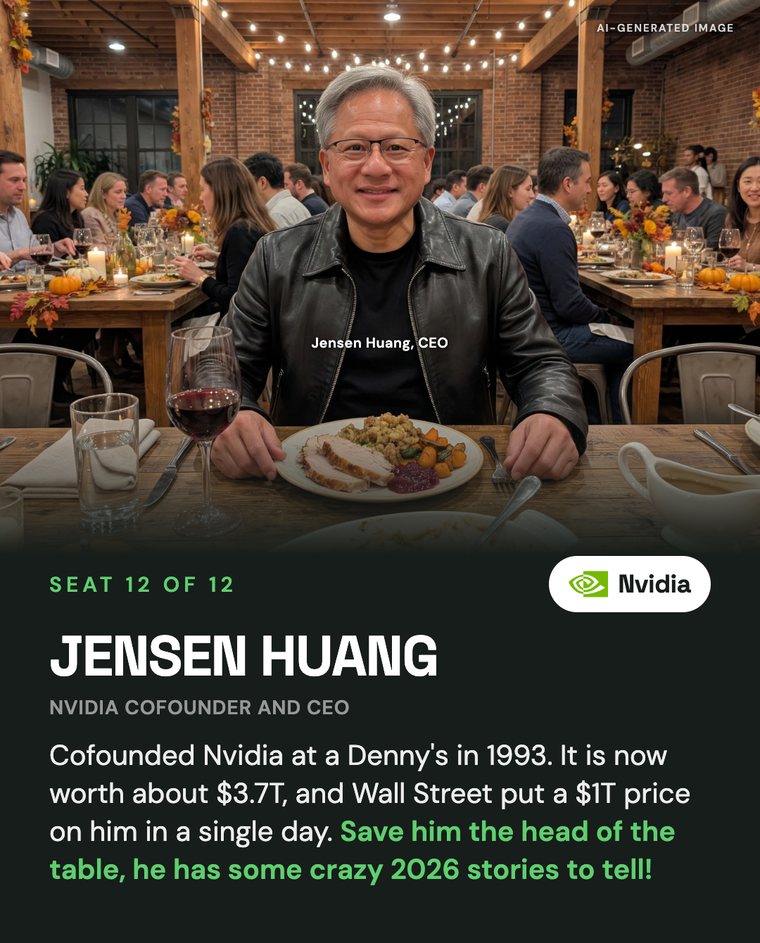
Nvidia cofounder and CEO. He cofounded Nvidia at a Denny’s in 1993. It is now worth about $3.7 trillion, and this year Wall Street added roughly a trillion dollars to it in a single day. He gets the head of the table, partly out of respect and partly because he is the only person here who can explain what the other eleven are building on.
What we can learn from those at the table
One of these companies on its own is just a success story. Twelve of them in one place is more useful, because you start to see what they have in common. Three things stand out, and each one has a test you can run on your own company this week.
Almost nobody here sells to consumers. Cursor, Modular, Hugging Face, Conductor, Mercor, ElevenLabs, World Labs: the bulk of this table builds the tooling other builders depend on. The biggest outcomes of 2026 went to the companies selling the tools, not the ones using them.
The test: name the three companies that would have a genuinely worse quarter if your product disappeared on Monday. If you cannot name three, or if all three are individual consumers rather than businesses, you are in a different business than this table is in.
Four of these founders sold to a hardware company. Nvidia bought Hugging Face. AMD bought World Labs. Qualcomm bought Modular. SpaceX bought Cursor. None of those are the acquirers a software founder would have listed five years ago. Chipmakers spent 2026 buying software because silicon is now designed around workloads, and the people who understand the workload are startups.
The test: write down the five companies most likely to buy you. If none of them make physical things, widen the list before you need it.
Speed stopped being a vanity metric. World Labs went from founding to an $8.2 billion exit in two years. Modular closed its sale nine months after a round. Conductor was acquired for a workflow that barely existed the year before. Meanwhile Brex, the most conventionally excellent company on the list, took nine years. Both paths are real. Only one of them was available in 2017.
The test: name the date you first charged someone money. If that date does not exist yet, it is the only number on your company that matters this quarter, and no amount of the others will substitute for it.
The thing nobody at this table did was wait for permission. Every one of these companies shipped something rough to a small number of people who needed it, and the valuations came later. That part has not changed since 1993, and the guy at the head of the table founded his company in a Denny’s.
Validate your startup idea ToolSuite walks your idea through customer discovery and scores what comes back. 30 free credits, no card. Try it free →Who gets a seat next year
Every founder on this list was, at some point, the person at Thanksgiving giving the slightly apologetic answer about what they do. Fei-Fei Li’s company did not exist three Thanksgivings ago. Conductor did not exist two.
The seats for next year aren’t allocated yet. One of them could be yours.
 Startup Ignition Ventures
$20M pre-seed fund. First checks $100K to $1M. Real feedback in hours.
Pitch SIV →
Frequently asked questions
What was the largest startup acquisition of 2026?
SpaceX’s purchase of Anysphere, the company behind the AI coding tool Cursor, for $60 billion in stock. It is the largest acquisition of a venture-backed startup on record. SpaceX announced it would exercise the purchase right in June 2026 and closed the deal in August, folding Cursor into a new SpaceXAI division.
What was the largest IPO of 2026?
Anthropic’s. The company went public on Nasdaq under the ticker ANT on November 19, 2026, raising roughly $81 billion, the largest IPO in history by amount raised. Shares opened at $111.50 and closed the first day at $97.17, putting the fully diluted valuation at about $1.76 trillion.
Which AI startups were acquired by chip companies in 2026?
Three of the year’s notable deals were chipmakers buying AI software companies. Nvidia agreed to buy Hugging Face for $12.93 billion in September. AMD bought Fei-Fei Li’s World Labs for about $8.2 billion in stock, also in September, making Li its chief scientist. Qualcomm acquired Modular for $3.92 billion in an all-stock deal.
How did World Labs sell for $8.2 billion in two years?
World Labs was founded in 2024 by Fei-Fei Li to build spatial intelligence models that generate and simulate interactive 3D environments. AMD bought it roughly two years later for about $8.2 billion in stock, its second-largest deal ever after Xilinx. The speed came from selling something a chipmaker needed in order to design silicon around a new workload, not from reaching consumer scale first.
Who became billionaires at 22 in 2026?
Mercor’s cofounders Brendan Foody, Surya Midha and Adarsh Hiremath, after the company raised $750 million at a $20 billion valuation. Kalshi cofounder Luana Lopes Lara also became the youngest self-made woman billionaire following Kalshi’s $1 billion raise at a $22 billion valuation.
Is the Startup Founder Friendsgiving a real event?
No. It is an imaginary guest list built by Startup Ignition, and every dinner photo is AI-generated. None of the founders pictured attended anything, and none of them have endorsed this. The financial figures attached to each seat are real and sourced from company announcements, SEC filings and press reporting as of November 25, 2026.
Ranked by value created: sale price, latest valuation or market cap, as of November 25, 2026. An imaginary guest list. Every dinner image on this page is AI-generated and no one pictured has endorsed this. Sources: company announcements, SEC filings, Forbes, Fortune, CNN and CBS News.
 Back to All News