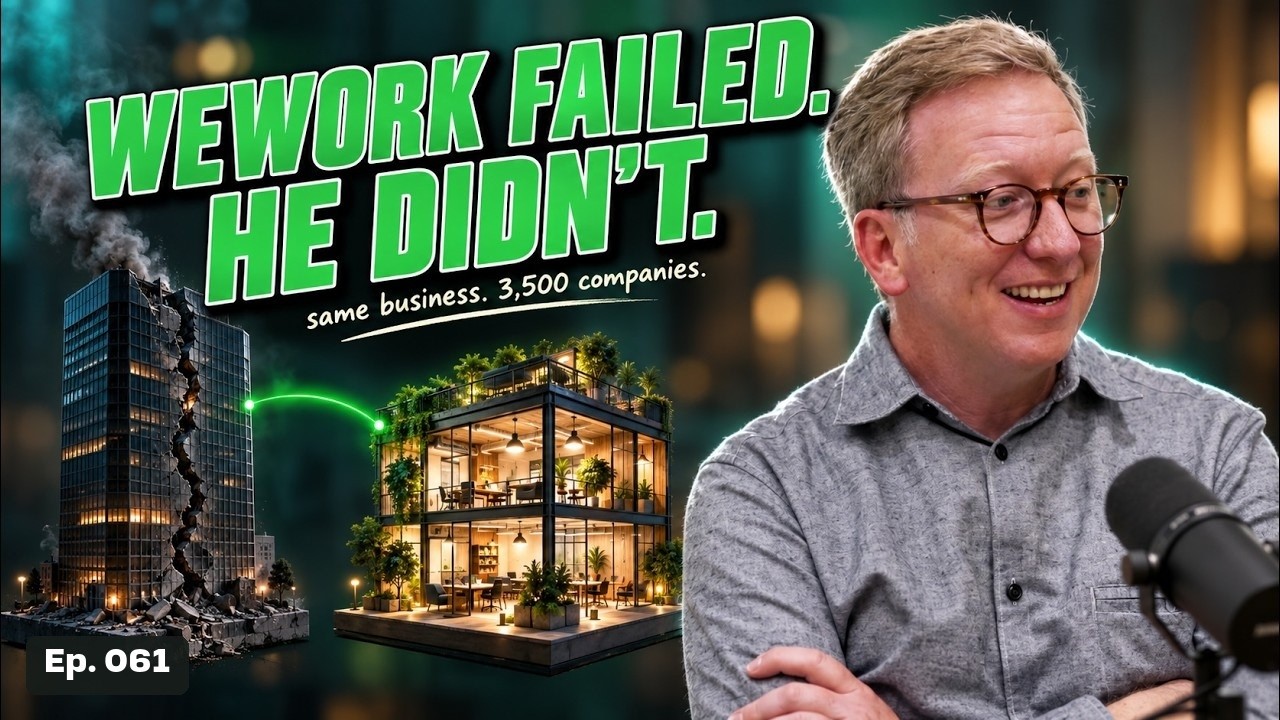
Arian Lewis grew up in Provo watching his single mother turn a 12-kid daycare into a 320-child center with 50 employees. Today he is co-founder and CEO of Kiln, the hospitality-driven flex-office company with 24 locations and 3,500+ companies in its spaces. He walks John and Tyler through eight years at Pulte Homes, an Oxford MBA at 32 with three kids in tow, building coworking for Barclays across London, New York, Tel Aviv and Cape Town, and coming home to build "WeWork that works" — including what WeWork actually got wrong, why Kiln is really a financing solution, and why he tells founders to leverage their gifts rather than follow their passion.
Arian Lewis is the co-founder and CEO of Kiln, a hospitality-driven coworking and flex-office company he started in 2018 with Leigh Radford. Kiln now operates 24 locations with 150 team members, hosting more than 3,500 companies ranging from day-one founders to Mastercard, Intuit and Siemens, and expects 37 locations by the end of 2027. Before Kiln he spent eight years at Pulte Homes, earned an MBA at Oxford, and spent nearly five years at Barclays as Director of Open Innovation, where he built the bank's global fintech coworking brand across London, New York, Tel Aviv and Cape Town. He was named one of Utah Business's CEOs of the Year.
Show full transcript
It's really important for anybody who's who believes that they're going to start a business in their future to be building trust all throughout their life with the people they're with. So when we came across this problem, how do we get these startups and these bankers come together and build stuff? I said, you know, why don't we create a little co-working space? So we partnered with the best co-working brand in the market at the time, Central. [music] Rock bike next rock. [music] >> Welcome back to the Startup Ignition podcast. Thank you so much for watching the last episode. We have a banger for you today. I'm Tyler Richards. This is John Richards. We are your co-hosts in the Startup Ignition ecosystem. But today we are joined by a very special guest who I'm very excited to sit down and talk to because Aaron, I don't think I've actually sat down and heard your backstory or where where what your history is or what your entrepreneurial past is. So I'm very very excited. >> It's amazing. It's a great one. We're like eight years into the relationship. So I'm really excited to be here. >> Yeah. >> And uh I know you have a great a great community that's surrounding you and >> that you've helped hundreds of people start business. part of that story. I mean, we do our boot camps out of your facilities. I think we've probably held at least 30 to 40 boot camps in your guys' co-working spaces. So, but we I have to introduce you officially. So, Aaron Lewis here, the CEO and founder of Kil Co-working Spaces is here in the building. So, Aaron, that's your official name and title. But I also have a bio for you and hopefully this is right. So, correct it if it's not, >> okay? But I have a bio that I tked chat GPT to put together for me. So we'll see how accurate this actually is. Um, so Arian Lewis is a co-founder and CEO of Kilm, a hospitalitydriven co-working and flex office company that now operates in more than 24 locations. And pre-podcast you were just telling us you have soon more to come. I don't know if that's public information or not. Or breaking news here. You heard it here for >> here for the first time. >> Yeah. Um, you grew up in Provo, I saw. Yes. Um because your path to kiln started way before kiln. Um you your mother was a single mother. You watched her build businesses and you've always kind of been entrepreneurial. That's what I read online. Y >> um in your 30s you moved to England to do an MBA. I saw where where was that at and why England? >> Uh I think they made a mistake and I was the benefactor of that. Yeah. >> But I did go to Oxford for my >> That's really cool. That is so cool. Oxford is very prestigious. Um, and then after moving your family out for to England, you launched Tech Capital, which I'm not super familiar with. What is Tech Capital? >> Yeah, I was I would I would call myself a junior co-founder. So, I was a >> Um, but the real genius behind the business had had built businesses like this previously >> and it's even today it's a public company on the London AIM market. So, which is a smaller exchange on the London Stock Exchange. Um, and it trades university IP to uh private companies. Wow. So, >> yeah. >> And that's still going today. >> Still going today. >> That's cool. >> That's amazing. And so, why did you leave that then? >> That's a great question. [laughter] Um, it had kind of come to a point and a juncture where I realized >> I'm not actually the best person to do this. >> Yeah. And uh at around that time I bumped into some executives at Barclays and I was fortunate enough to get picked up by Barclays and started a new journey with them. >> Another opportunity you couldn't say no to. So yeah. >> Yeah. >> Which led you to where you are at today with Kiln and Correct and and figuring out the that real estate play and doing everything there. >> I think at Barclays you got a taste of that and saw some things, right? >> I sure did. I sure did. I worked under Derek White who um was an executive there and is now uh a fantastic founder of a new AI company here in Utah. >> Yeah. >> But um Derek and I didn't know each other previously and he was the chief design and digital officer for Barclays and he gave me a lot of freedom and a lot of support to go out and build something cool for Barclays. >> Yeah. And I think that obviously leading you to Kiln. I think Kiln has such a special piece of the ecosystem here in Utah and beyond now with 24 plus locations. I remember going into killing the very first location you guys dropped and just remember seeing the design and the community that was already there almost from like week one. And you got I feel like you guys are very particular about the way the whole design and the uh programming and the community come together in all your facilities. >> We try to do things very thoughtfully and with purpose. >> Yeah. >> So it's more than just renting a seat people. It's like actually the community and the events and the things that you're participating in when you're a member of a kiln, right? >> Correct. Yeah. We can get into the detail on that. >> Yeah. >> Here, I'm just pushing your product for you. You know, I love it. I'm a huge believer. We always do an icebreaker on our podcast. I want to play this game with you. We play a quick like two, three, five minute game here and I just spring something on you and it's just to get your quick reaction on things. Great. >> And I'm going to have you play too. >> Okay. So, both of us. >> Yeah. Here we go. So, we're going to do an icebreaker real quick before we get into the podcast. So today I have are you going to keep it or kill it? Okay. And I want to know just quick reaction knee-jerk reaction if you would kill or keep this thing. Okay. And you're you're playing too. >> Okay. >> First prompt. Ready. >> Open office floor plans. >> Kill it. >> Isn't okay. Hold on. What? How about you? >> Kill it. Okay. Why >> very specific? I might use it for one thing, but most of the time no. >> Wow. You guys are closed door like get out of my face type of people, huh? >> Yeah. Why? Productivity or what? >> No, I don't think it's that. I think that when you say open office concept the prior So what happened was you went from an office model that was driven around cubicles and offices. Okay. And then you went to open office which was really in the late 1990s and early 2000s and sort of into the mid 2000s. And the idea with open office was, hey, we want all our developers to be in the same spot, two pizza teams, everybody together. But now we've kind of realized that there's this neurodeiversity that needs different kinds of environments to be productive, right? >> And so it's not just about having a big open space. It's having different kinds of spaces for different kinds of people doing different kinds of work. >> Yeah. So yeah, >> that's what I would say. So that's why I said there's exceptions. I I think it's more important to have flexible space that you can do and meet the different needs of different people. Exactly what you just said. >> Yeah. >> Yep. >> Okay. Office dogs. >> Keep uh keep them. >> Keep them. >> Um I I'm indifferent. I can't I not for them, not against them. >> You were going to say kill them, weren't [laughter] you? But you can't say kill a dog. That's kind of That's kind of brutal. Okay. Yeah. But don't have them >> cuz you're running for some political officers. [laughter] >> Yeah. So keep them. Do you enjoy the animals in the workspace? >> Uh, I do generally, not not in every case, but I do. Here's the thing. >> Innovation is comes after safety. All right. So for somebody who's young and and or old and working to kind of regulate their nervous system and be in a safe and comfortable place um mo mentally and emotionally, dogs can actually be very helpful and they can put people in a mental and emotional state where they actually do their best work. >> So for certain people that can be a very helpful thing to have their dog in the office. >> Love it. >> Yeah. And then they're not stressing about, you know, their dog tearing up their couch at home or something like that. You does Kiln allow >> Oh, yeah. We have hundreds of puppies that are members of Kiln. >> Yeah. >> Wow. Dog, I should say dogs. >> Are they paid members or are they uh adjointed members? Free members. >> They they're they're loafers. They definitely um they definitely back off. They're mooching mooching members. >> Yeah, >> the mooch pooches. Okay, how about the next one here? >> Free lunch, dinner, or food in the office space? >> Keep it. >> If it were feasible, keep it. >> Yeah. How about you? >> Yeah, if it's financially works out, >> I feel like there was a huge movement and we even talked about this this morning at our breakfast because you were reminiscing about your Google days, but about how Google has like nine restaurants on their campus and >> it's nine restaurants in a building. >> Oh, in a building. >> Like their San Francisco one on the Bay Bridge. It's crazy good. >> Yeah. And you go down, you [laughter] just swipe your badge and you can eat in anything and everything. And >> you don't even swipe it. Just show. You walk out, you get free food all day long everywhere. >> It's crazy. [laughter] But the thing is behind >> I knew Google employees that would have food prepared for them to take home at night. >> Yes. It's crazy. >> That's insane. Yeah. It's obviously that's also about just keeping the worker in the workspace and getting the most as you can as out of employee or is that what what is your thoughts behind like the >> I mean yes there's a a friction factor so you're reducing friction so that somebody is not leaving the office and coming going but you're also encouraging cross cross collaboration organically. So hopefully somebody goes to the cafeteria or whatever, sits down with somebody from another department that they don't know and sort of finds common ground and has an interesting conversation that ultimately results in a good thing for the business. >> Yeah. But a company that can afford it, so this is for the startup folks here, a company that can afford it, a company that um they is trying to be a pretender and think they're farther along than they are and trying to look a certain way and do that. It's really tough. I mean, it's it's it's expensive. >> Yeah. I I mean, in all my operating companies, I we never got to a point where we're offering free meals for people, but uh you know, the snacks and you know, the drinks. >> I remember you got the uh what are those Coke machines called? The what? There's a name for those, but >> Oh, the freestyle Coke machine. You got a freestyle mountain. That was a big deal. >> Yeah. >> All right. [laughter] These last ones, I just want you to pick this the this or that out of them, okay? Just to get you know you a little bit personal and then we'll get to the podcast. I I swear this is not going to take that long. Mountains or beach? >> Mountains. >> Skiing or cycling? >> Skiing. >> London or New York? >> London. >> Early morning or late night? >> Late night. >> Ooh. Coffee shop or hotel lobby? >> Oo. Coffee shop. >> Coffee shop's an Aryan jam. I like it. Okay. Work from home or work from kiln? >> Kilm. >> I got him. All right. I knew that one. Okay. Thank you for playing our icebreaker. This has been great. Um, we always start the podcast and I don't know where you want to start. >> I just like to know where you So you went which high school did you go to in Provo? >> Provo High. Okay. >> A Bulldog. >> So, and I'm a resident of Provo, so I know that. Well, um, so just take us from being at Provo High, graduating, and where'd you go from there? >> Well, and I read online that you're you tout kind of and tell the story about your mother being a single mother and growing up in her household. And I don't know how much you want to share, but like obviously that was a huge impact on your upbringing. >> Yes. >> Yeah. Well, first of all, I just want to say I have two wonderful parents. >> Yeah. >> Um but it just so happened that for a lot of my youth and childhood, I was with my mother. She was a single mom and finances were tight. >> Yeah. >> And she had to figure out how to make ends meet. And the way that she did that was by starting a a daycare center with it had 12 kids at the time. And ultimately she grew it into a childcare center that had about 320 kids. She had about 50 employees and and she ran an operation. It wasn't this was not buucks, you know, this is a business you do because you love it >> and because it allows you to kind of raise your kids while you're doing it to a degree. >> And so I grew up in that environment. So I was I had lots of different jobs there. I was a handyman. I was a teachers aid. I did everything that you could do as a kid. >> Just helping around. Yeah. open around and I learned what it means to carry the weight of building a business that your family depends on and how complicated that was for my mother as a divorced woman in the 1980s in Provo, Utah. >> Yeah. >> I mean, very similar to my dad's story, right? I mean, I don't know if you've ever told your story on the podcast, but you know, he was raised by a single mother as well and very entrepreneurial. Yep. Pray raised from age eight. Parents got divorced. Wasn't a very happy divorce, good divorce. Uh can't say my dad was a great guy, but my mom was a great mom. So, and I lived with my mother and was raised by her. >> And a lot of the reason I think a lot of our Richard's family is entrepreneurial. It started with his mom, my grandma. So, >> she had to Yeah. First month after divorce, she can barely afford food and she had to do something. >> Build a business up. Yeah. There you go. >> Her own business. >> So, I call that a necessity entrepreneur. Yeah, >> necessity is a great impetus for >> Mother of invention. >> Yeah. >> Constraint breeds creativity, right? So, that saying goes a long way. Uh, yes. Okay. So, you born and raised in Provo. Yep. >> And then went to school where university >> um Yeah. Did did a two-year uh mission in Puerto Rico went to BYU. Kind of traditional >> especi So both of us. Guara Paraguay. Oh, that's great. >> Yeah. So, Puerto Puerto Rico where is the uh safe haven for a lot of the uh people of uh >> with the tax. Sorry about the 4% tax. >> The 4% tax. >> Okay. Now, we got to explain to our viewers and listeners that if you uh >> spend enough time in Puerto Rico before and after your liquidity event when you become rich and famous, you can bring your total federal income tax down to 4% on the entire amount. >> Very pretty amazing. Yeah, >> I have known several founders that have done that. >> We know many other families. There's a whole enclave of Utah. >> That's what I was going to say. There's a lot of >> Utah entrepreneurs down there in their own little gated community. [laughter] >> Yeah. Purepa. >> Yeah. My son just came home from Columbia as well. >> Oh, very cool. >> I I love Puerto Rico though. The water when you swim so warm. I mean, it's like 90° bath water. >> Blue. Nice. It's awesome. >> So, then you came back to BYU, graduated. What did you graduate in? What What was your degree? >> I studied international studies and did a minor in business and studied a little of economics. Nothing impressive. >> Yeah. But still economics. That's a that's a tough degree. >> Did you take economies? I did take econ from curl. >> Uh I did not I decidedly did not take it from curl. [laughter] >> He was the GPA destroyer. >> Yes, that's right. I needed all the help I could get. >> So what do you do? What do you do after school? Did you you know I went into uh the home building industry. So I worked in Nevada and I worked for PY Homes, a public uh one of the largest public >> home building companies and we built large communities specifically for retirees called Sun Cities. And I worked in that product for eight years. And it really taught me some important fundamentals um around uh creating community and dealing with real estate and sales and marketing and those kinds of things. And what I would say any anybody who is considering becoming an entrepreneur, I I think that being in an industry for a number of years can be very helpful >> because I think that um you may have it in you to be a great entrepreneur, but you really need to become a great practitioner at something >> in order to apply that entrepreneurial spirit to something and really be an expert at it. So right, >> you know, I spent eight years with one company that allowed me to go pretty deep with that company and kind of grow up through the company and it was a it was a a Fortune 500 national company and that meant that they had great systems and training and culture and I was the benefactor of a lot of that >> and nowadays we call that founder market fit and founder market fit has a very high correlation to success for startup ventures >> for sure. Yeah. you really know the market, you can apply your >> and then of course Michael Gerber in his book the email revisit though warns about the technician entrepreneur that because they're a good widget maker doesn't mean they're a good widget entrepreneur. So you do have to also pick up your entrepreneurship skills. So yeah, it's kind of developing both sides. Having great founder market fits awesome, but you also know how to work on a business, not just in a business, right? Clearly, you're you're the expert on this, but um [clears throat] my gut is that it's hard to train someone to be an entrepreneur if they don't have certain qualities already inherent in who they are. And some of that is just real persistence and grit. >> And some of it is um kind of a little bit of naive >> of a willingness to try something >> and think to yourself, how difficult could it be? >> Right? and just risk tolerance. >> Yeah. Tolerance for risk. So, um >> yeah, you know, coming from a background where you didn't have a lot, you kind of feel like you aren't risking a lot. >> Yeah. >> Um because things can only get better in some ways. So, that can be a blessing to some folks. Y >> coming from a background where you've seen a lot and you've had a lot of blessings also means that you have been given access to many resources that if used wisely can actually really propel you as an entrepreneur as well. >> So do you do you think your time spent with that home builder played into what you're doing now? >> Absolutely. Yeah. >> Really? Yeah. >> Yeah. Very much. >> Because there's a lot of time and a lot of things between those two different stints in your career, right? >> Yeah. But it's a real real estate development place. >> Yes. And we were building community in a very unique way. These were 5,000 or num 7,500 homes like in one community where people came and they purchased the community and they got a home with it. >> Yeah. >> And very similar concept with Kil. You come for you want the experience that Kil has to offer and then you simply pick the product or the office that works for you. >> Yeah. Um, so >> very good or similar principles. >> So how do you get from there to then how long were you at that development home building company? >> Eight years. >> And did you do your NBA after that? >> I did. >> Okay. So eight years at PY Homes, big huge public company home builder building massive communities. >> I was a late bloomer in it when it comes to the NBA. >> So how old were you when you went into the NBA program? >> 32. >> Wow. So >> I mean Yeah. That's kind of like a reset in your career. Like >> total reset. >> Yeah. You're like, "Hey, I'm just going to go get my NBA." >> So you apply. Tell us apply to Oxford. What made you want to do that? And how in the world did you get in at age 32? Is that a normal thing? >> Uh yes, it is. And I'll explain what happened in my case is so my cousin went to Oxford and and so I was always admiring him and he was a mentor of mine and so he kind of helped me in that process. Oxford has Oxford has a very unique executive MBA program which lasts a year uh sorry it lasts two years apologies but it's done in class so you actually physically go to Oxford >> right >> and you don't get an EMBA you actually get an MBA >> okay >> but what happened was I started going there and then I quickly realized that I was a fully metriculated member of the university and I could take MBA courses because basically in their program I was able to kind blur the lines between EMBA or MBA. So, I actually moved to Oxford with my family and started going full-time. So, I took the full-time courses, I took the executive MBA courses, and I did graduate with an MBA. >> Um, but my path to getting through that process was not conventional, I'd say, which is sort of typical of my life, honestly. Like, I I was not a standout student academically. I was good, but I wasn't stand out. But it's my persistence and sort of willingness to keep trying and that has helped me get through certain stages of my life. >> No, but you're you're definitely intellectual and smart. Like even the way that you articulate and form your words, I can tell you think about everything that's going on around you. So like >> maybe Yeah. >> I I definitely wouldn't I would say the same thing about myself, but truly that way. I'm definitely not very book. >> I can also see your tolerance for risk. I mean launching Kil and you know I conferred with you in the early days and you're a co-founder and we and I was so excited for what you're doing and seeing you do it but that was risky. You took risks. >> Yeah. Well it a lot of people have the kind of the they think the idea is really fun and so they'll go start a co-working space. Um and 70% of our industry is is mom and pop or individuals that have just decided you know I'm going to go start this because I love >> small shops. Yeah. But to sustain it over a longer period of time and scale it is really complicated actually. >> Well, I want to really get into this because there's so much been talked about. But so let's take you from the eight years at PY then Oxford for two. Well, I want to hear more about England. What was that like? How was living? >> It was phenomenal. And you had total reset for my life. >> You had a wife and children there and >> Yeah. I brought them with me. >> How many kids at the time? >> Um yeah, Jill and I have four kids, but we had three when we moved to England. >> Wow. >> Yeah. Okay. So, and we had one while we were living there and we lived there for just shy of four years. Um, and during that time I worked on a startup. Um, and then I went to work for Barclays and Barclays hired me to work on a strategy to to develop new products with financial technology companies along with a they eventually built a venture fund and they also had really the the best-in-class fintech accelerator in the world which they did with Tech Stars. >> Well, tell tell our audience who Bararkclays is many of them. >> Barclays is is the fourth largest financial institution in the world. They have over a trillion dollars under management >> headquartered in London. Um probably the most iconic well you'd say like Barclays and Lloyds are the most iconic old British banks. Barclays is a 326 year old company or at least it was at the time. Now it's probably 335 or something like that. >> But it's it's very old. At one point in time in the 1800s it was the largest company in the world and it owned the national debt for many countries. And it was it's very interesting. It's very interesting to be in a business that's over 300 years old, the same company. >> Yeah. >> It's fascinating. >> Yeah. >> And the British are um incredible with process and uh regimen and they're just um they're they're there's a reason why great banks came from Britain. Um but they struggle to innovate and uh and migrate their business. Mhm. >> And so what we were trying to do is bring startups and fintech entrepreneurs through a process where they would help transform the bank. And we did this very successfully. Over well over a hundred companies did projects or joint ventures with Barclays in some form or fashion. >> And that's what you were hired to help out with was that program. >> Yes. To build the strategy and then to execute it. Yeah. And we did this um all around the world in fact. And part of what we had to do is figure out a place where to do it. And so I had studied co-working >> as a student as an MBA student. I had studied it in a real estate class um just as a little side project basically. >> And uh so when we came across this problem, how do we get these startups and these bankers come together and build stuff? I said, you know, why don't we create a little co-working space? So we partnered with the best co-working brand in the market at the time, Central Working. They were excellent in London. They they were right at the forefront. We work was only five locations or something at that time. >> Yeah. What years was this? That's what I was going to ask. >> 2013 20 I started studying co-working in 2011, but yeah, about 2013 2014. >> Yeah. >> So, um, we built a co-working space in East London in a place called White Chapel, which is actually kind of a dodgy part of London. It's not not fancy by any means. And we had great success with uh >> you guys made your own co-working space. Barclays did. >> Well, yes. Yes. Barclays did in partnership with this other company that doing it and I kind of led the project from the Barclay side. >> And this wonderful company had a great designer named Lee who is now co-founder of Kiln. So all of the beautiful, creative, magical parts of Kiln are truly from Lee. Okay. >> And I just on occasion get to talk about them. Yeah. Um so we met there. Um but that was an amazing space. I mean we we hosted one of the very first meetups for um Ethereum with Vitalik. It was very early days of uh crypto and we had some of the leading people that people know now there and literally companies that were based there are now worth many billions of dollars. >> Yeah. Yeah. Did you stash away some Bitcoin? You know, I didn't. >> But there are a few people in Utah that were at some of those meetings in London, believe it or not, >> and have made a tremendous amount of money in crypto, tens and tens of millions. >> Mhm. >> And um I just truly didn't understand at the time, you know, it was it it didn't it wasn't clear to me what it was going to be. So you basically >> and as an employee at the bank, I had some some constraints around how I dealt dealt with that. >> Yeah. Oh, getting into it or dabbling with it or >> I just Yeah. There were enough restrictions at Barclays that I just felt wasn't a path I wanted to go down at the time. >> Right. Right. So where So the co-working space with Barclays was in London. >> Yes. >> And so like how big was it and I was scope of it? >> It was 20 25,000 ft. But eventually we built similar locations in London and New York and Tel Aviv and Cape Town, South Africa. >> There was a name for it. >> It was called Rise. We actually created our own brand eventually. And um it was an amazing adventure really. We we we launched fintech focused co-working spaces and accelerator programs in Africa, India, Lithuania, Israel, the US, England. And it was a almost nearly a five-year journey for me and lots of air miles and lots of learning. And >> so you mentioned we work. Can I ask some questions just because that did we preede kale? >> It did. Yeah. Yeah, very much. and and and so we we work you studied it as an NBA student. You're saying the beginnings of weiwork. >> I did. Yeah. In fact, >> and then and then Barclays started Rise with you at the head involved in being a leader there. >> Yeah. >> And then and we work was starting to go because we just had breakfast somebody who worked at SoftBank during the Wei Work days today. >> Interesting. >> Yeah. And he told us >> stories because the Wei work story was is crazy. >> We asked him, "Hey, did you watch the the documentary?" He said, "No, I lived it. I don't I don't need to watch it." >> Watch. Cuz the documentary for We Work and the um dramatization version of it >> TV show very >> made me sick as a entrepreneur, professor, teacher, mentor >> because it sort of depicts entrepreneur in the worst light. >> It was unbelievable. I You're watching going what is going on here? And it literally made my stomach turn. >> Look, I met with Adam Newman and Miguel McKelby in a couple different groups. >> Really? >> I'm sure they don't remember me. They were brief meetings, but they were they were nice conversations, and I was impressed with them. >> And um >> you know, there's some dramatization of of how extreme things were, >> but there's truth to it. And and >> well, this guy this morning claims to say that Soft Bank, he saw it unfolding and it was really bad. He went against every rule in the book. And so >> and I mean, just to see the Soft Bank, the money they poured in. So, which brings up and I'm curious what you think of Weiwork and what you observed and what you think in hindsight now and at the time. And then it also makes me think about >> you going to start Kil and I always you know what my slogan's been about kill I say it's we work that works. Okay. That's basically that's you did it right. >> Good. I like that. >> You did it right. You know >> hopefully it's it's profitable. That's when we say works we say what we really mean is it has gooda. >> Yeah. Yeah. And so I'm just saying and you seem to be doing it and executing the right way that that business should be done is what I'm looking from the outside but >> like so comment on what you thought of we work at the time what you think in hindsight now and then the capital intensive nature though of starting these it's a capital intensive thing to get off the ground and how did you pull that off? Okay. So, I'll start with the end of what you just said, which is at the at at the end of the day, Kiln, believe it or not, is a financing solution. >> We are a capital intensive business. And basically, we secure the financing to build out a an office that you would normally only gain access to if you worked for Google >> or you worked for something else. And now through this micro consumption model, you all of a sudden have access to a highly capital capital intensive product >> because of the unique um >> the economics behind it. >> Yeah. Econom Well, because of the fact that we've chopped it down into little slices and everybody can participate. Yes. >> But if you really looked at it, you'd say, "Oh my gosh, like we're providing financing for office." If you really thought about it, now >> what we were got wrong is they got the wrong kind of financing. >> Okay. So, real estate dollars and venture dollars are two different kinds of dollars. >> Yeah. >> Real estate dollars look at cash flow. They look at unit level economics. They're patient and they want consistent predictable returns. >> And really usually cheaper are is it not or no? >> I don't think I would describe the capital as cheaper. >> Yeah. I would just describe it as oriented completely differently than venture capital, >> right? >> Venture capital counts on um massive returns because they also count on massive failures and losses. >> So in order for their model to work, they have to have every investment they make has to have potentially a 20 times multiple on their return, which you guys know very well. >> Um and as such that capital drives different kinds of behavior. My capital says, "Hey, Arian and team, we want something dependable. We want it to be predictable. We want it to be consistent. We want it to be quality. We want it to be durable." >> Yeah. >> His capital was saying, "We want fast, high growth. You know, we're we're very high highly risk tolerant." So that's exactly what we kind of explain as unicorn versus elephant building where elephant is hardy, stable, slow, but >> working towards profitable. >> I want to build a cow. >> You want to build a cow. >> I just want this to be more of a cash. >> Okay. So you're smaller. Yeah. You're okay. >> So I'm fine. I don't need to build a cheetah or a, you know, >> a unicorn. Unicorn. Yeah. >> Yeah. I I think that's effect. Look, Adam Newman, you know, also raised by a single mom, uh, no real formal education, although he ultimately did get his bachelor's degree from Yeshiva University in in in, uh, New York. Um, but Adam was not a student. He had no real job before he started Weiwork, although he had founded uh two different startup companies. Mhm. >> Um he was just somebody who truly leveraged his god-given gifts and made something magical come from them. But you can't fill a Ferrari full of tequila and then get mad that the kid who likes tequila drove the Ferrari and wrecked it. >> Yeah. >> I mean that's I Adam is actually a very bright person. Maybe, you know, his morals we could debate and should be debated, but effectively the investors were the ones that were ill. They they were unwise. They were away. They had the education. They had the experience. They had the knowledge. Adam hadn't even worked at McDonald's. >> Yes. >> He he had been in the Israeli military, >> but he had no track record. And then he was given a bunch of cash and he genuinely did his very best to grow that cash but but the cash was irresponsible and as a result the behavior that followed the cash was also irresponsible. >> Yeah. I I view it also a convergence was something unique around the time the 2010s as it got closer and closer to the 2021 apex year of the bubble. >> Yeah. [snorts] Um, there were a lot of regular kind of non venture type companies getting venture capital because they were packaging themselves as a tech company. Correct. You know what I'm saying? So, they were putting on, this is my viewpoint, they were put on a mystique of being a tech company when they're really not a high growth tech company. >> I was I think what you're really saying is they put on the idea that their company could scale like a tech company. Yeah. But my business doesn't scale like tech company. My business is a unit byunit, highly capital intensive, >> very thoughtful and methodical. Slow growth leads to better outcomes kind of business. >> But there's even examples. I'm not going to name them on this podcast, but there's other examples in Utah that took advantage of that because one time there was a company that almost got to a billion in valuation. I'm going that's just a standard company we've seen for decades wrapped in this bubble because it's 2021 around being a tech company. >> I look I think I the story of we work is fascinating and we could vilify uh Adam Newman or we could learn and kind of take him >> for who? >> Well, it's just it's just a case stud. >> It's a case study. But let's get let's >> but what I would say is really important for for any entrepreneur >> is always be honest about where your company is really at. >> Right. >> If something's not going well, say it like it is. >> Yes. >> And if you take capital, know that you are going to you are signing up >> for accountability. >> For major accountability. Yes. And I don't like raising capital. >> Yes. But that's part of the reason why people do trust us with capital because they know that we will behave in a way that's extremely responsible and cautious with their capital. >> Let's talk about that. Okay. >> Well, no. Yeah, I was going to go into the >> Okay, now got we work. That's awesome. And but again, if you want a wild experience, watch those documentaries. But um >> Kilm, so you're at Barclays. You and you met your co-founder at Barclays, it sounds like. And then you how did you >> he ran his own design firm but yes >> okay how did you okay how did you decide we're going to do kiln we're going to do it in Utah and you open up the first one in the fastest growing city around at the time Lehi Utah >> so this process was years in the making okay >> and and you should know that >> it didn't I didn't come to the conclusion lightly and it basically there was a moment when I felt deep in my bones you should do this >> well well you you had established it and seeing it from the inside with what you were doing. >> Yeah. And I knew how difficult it was. It's not. And actually, to be honest with you, I thought I knew how difficult it was. I didn't. >> I have since learned how complex it is. Yeah. >> And I'm still learning about that. >> Oh, you're saying the 300-year-old massive bank behind you was a nice support system for you. >> Yeah, they are a great support system. >> Crazy. Crazy. I think he's about saying something you love to say that I've I've said over all the years too is that you came to a moment though where you could not not do it. You were you felt compelled to do it. >> I I would say that I felt deep inside that it was the right thing for me to do. Okay. And I still feel very much that way today. >> Do and you always knew Utah Oh my gosh. Sorry. You always knew Utah is that you're like I'm going to put it in Utah. always knew no Utah and even to this day Utah is not probably not our best market. There are other markets outside of Utah that will they appreciate and value what Kil brings to the market much more than Utah does. >> The old slogan is if you can sell in Utah, you can sell it anyway. >> Sure. I think there's [laughter] truth to that actually. But I think that I wanted the homec court advantage. I was from Utah and I really care about this ecosystem. I wanted something that would genuinely add value. And I'm I'm I'm glad to say that I think over the last eight years, Kell has supported this ecosystem. >> That's what I was going to say. 100%. You made a huge impact. >> Big huge. I mean, it's I'd call it a pillar in our ecosystem. Yeah. >> Yeah. Thank you. >> So, was it because you raised some capital here in Utah for Kil? >> And that was part of it. It was also that, you know, I wanted to come back here. um and I saw what was going on. So I saw a similar thing happening in Utah that I had seen in London um or in Vnius or in Tel Aviv or in Cape Town where sort of the blossoming of an ecosystem was occurring >> and I could see that it was happening and I came right at the right time 2017. >> Yeah. >> Um it really apexed in probably >> you started in 17. >> I started in 17. It took a year to the first kill location opened in November of 2018. >> Well, why do I feel like it was around so much earlier than that? >> Well, I should caveat there. We did a popup beta test of Kil in May of 2018. >> Wow. No, I felt like when I was doing my Dev Mountain business, I felt like I had run into you and >> in the days that I was actually operating and building that, but no, that's not true. That's really crazy. I had that in my head for some reason. So, so how so this capital intensive business how did you as an entrepreneur and you so you decide to do this you decide to do it in Utah how did you go about it as an entrepreneur you had to find a site a location you had to raise capital how did it all come together I mean it see it makes me a little tired because I this way harder than a software business in my >> I mean I'm more tired I'm pretty tired that sometimes um >> you know what I would say is that it's it's really important for anybody who's who believes that they're going to start a business in their future to be building trust all throughout their life with the people they're around. Because um every time you treat somebody with integrity or or you're kind or you're or you or you acknowledge that you made a mistake or you got something wrong, you build layers of trust and those those layers they those relationships come back in unique ways that you don't ever expect. And so I would say that I didn't know I was never doing it intentionally, but I but what really happened was I eventually um was able to go back to relationships that I had built, not family relationships, but relationships outside of family and was able to raise capital and start the business because of those those relationships. >> Yeah. >> So I I'm just going where my brain takes me a little bit. So over the years you've been tell So the first one how that went but >> and adding more as we've had supply chain and cost go up in construction that's got to be an impact but before we maybe get there >> the first one how did it go were you happy with it and then when the second one was probably a real big jump >> take us in that vent that's a startup thing you're a startup right >> like so yes as a startup you're always you're working on your proof of concept yeah >> you're trying to establish product market fit And we did that in two locations actually, Lehigh and Salt Lake almost simultaneously. And we really started to figure out, okay, this is where the market sits. This is the kind of product that works. This these are the ones that don't. And um and then the pandemic hit. >> So we were kind of at a really great place at the end of 2019. All of our our two early locations were full. We were really excited about the future. We were starting to raise capital for more locations. >> All the numbers were working. were working, things were looking good, >> and then the pandemic hit and >> and what a business to be in for that, right? >> Yeah. Flex office in a pandemic is not great, you know. [laughter] >> Oh, I remember holding the boot camp in your spaces during the pandemic and it was very >> intense mask and everything going on. >> But I I imagine but you seemed what did you weather it better than most? It seems like I don't know. How did you pull that off? I think [snorts] I had some great again this goes back to your capital. Okay. I had really wonderful investors and adviserss that called me and they said look >> don't try to make money try to keep the business >> alive. Yeah. >> Be there to to to scale once this is over. And and they said to me, you know, Arian, our capital is patient. do whatever you can to preserve the capital, not to lose the capital, and make sure that you just stabilize. And so what we did, which is very unique in our industry actually, is we proactively called all of our members and we said, "We know you haven't asked for a discount yet, but you certainly will be questioning whether you want to keep your flexible office at this time. How can we structure something that works for you?" you know, and our competitors or others in the industry sort of responded a different way, which is they they went back to their contracts and tried to hold people their contracts, >> right? >> And they tried to um kind of only address issues as they came up. And in our case, I l we gathered everybody around a table and we had sheets and lists of people and we just started calling everybody and we cut prices and cut prices. Now, in a few cases, and there's a few companies here in Utah today that that we still just are so grateful for, we had a few companies say, you know, thank you for the offer for the discount, but we won't take it. We actually want you to be around when this is all over, and we will continue to pay our full rate even though we probably won't be using Amazing. >> Amazing. Amazing. And and some of those are those folks are still members of Kilm today, eight years on. >> Wow. Yeah. Because the beauty of Kell is the flexibility of it. They can basically upgrade or downgrade as they want with space and quantity of desks >> but when your customer cares about your success. >> Yeah. >> That that means you you've you've got a new stakeholder that's pulling for you. >> You've also got product market fit. >> Yes, you do. Yeah. To a degree. Yeah. Absolutely. So for all the aspiring entrepreneurs and founders out there, would you say that your time spent prior to this point in your career because you keep talking about the relationships that you're leaning on that was built in the past and your experience at Barclays and at Oxford and prior. Is that like almost go-to thing every founder should be doing is gaining experience and relationships? I would say that the there's been a lot of fervor around things that people think will get them rich quick. >> Yeah. >> And entrepreneurship sometimes comes across that way, but it's not. >> Behind every overnight success is years of toil usually. >> Yeah. And it starts often in someone's childhood. And it could be that they went through something traumatic and they built resilience through that process. Mhm. >> It could be that they were given extraordinary opportunities to grow and learn as a as a child. Whatever it is, but it is not a slow it is not a fast process. Kil Kil does not believe in fast growth. We believe in really smart and sustainable growth. And I would say looking back, my entrepreneurial journey was not fast. And it was it was not um lucky. >> I would say we're all blessed. We're all lucky. There's a reason why we could talk about that. But it was based on thoughtful steps I took in my life and then fortunate timing. That is luck and a lot of kind and good people that supported me along the way. >> Two adjectives that come to mind in my knowing you, you know, I mean, we're acquaintances, friends, but not like buddy buddies, right? But is deliberate and pensive. I think of you being a very pensive person and then very deliberate. And that's kind of what you're describing right now. And I and it's I think it it >> and that means people can trust you and depend on you and believe in you. >> I have I >> I hope so. It's not I'm not uh you know one of the things I've also learned about being a leader in a business is you make a lot of mistakes. >> Oh yeah. >> And you get things wrong a lot and you got to be really willing to swallow your pride at times and just acknowledge that you messed up. >> Yeah. That's a great attribute of a leader. How about this whole AI era? this rush of like AI >> extraordinary time. We can compare it to obviously I'm a I don't know how young or old you are and I don't want to date my dad over here but he's older. He's older. Okay. So he's been through a lot more eras than I have but like the internet and you know the dotcoms and the sasses and you know now leading up to AI right but this is kind of like one of those moments in history right >> we we live at truly the apex and most extraordinary time in human history. And I I was I was back in Oxford this summer and I attended a lecture and the lecture was from this wonderful economist named and he had looked at 2,000 years of GDP and economic history and the chart is extraordinary in that in the last 2,000 years basically the last hundred years average GDP per person globally >> has just skyrocketed. >> Yeah. And we all live, all of us, no matter who's listening to this, we all live in extraordinary, extraordinarily blessed circumstances, >> right? >> Just because of the time that we came into this world. >> But AI changes all of the rules of the game because it's no longer about access to intelligence. And it's a very important democratizing feature because it used to be that only the you know it used to be if you were wealthy you had a library and that made you very unique and give you had an advantage. >> Now you can gain access to really impressive intelligence. Um, most people can >> on your phone. >> Most people [laughter] can. There's still a huge part of the world that can't. But as soon as the internet and what you know what what's happening with the internet is really fascinating. But as soon as that hits total penetration of the world, so you can access it through any cell phone, we're going to also see amazing things happen. Yeah. That's the other big kind of step change thing because there's still a huge amount of the world that doesn't participate in the modern economy. >> Yeah. But um it's all now about creativity, design thinking, problem solving, collaboration. Uh those who will win this game are going to be those who can think unconventionally. >> Human human connection, human >> human the that can extract the very best creative problem solving out of their team, >> right? >> And it is a team sport. So AI, you know, there will be some individuals that'll kind of do something magical and and and have a little win, but overall this is a team sport and you're using you're leveraging the intelligence built into these uh technology systems to create something that could not previously be imagined. >> And the real question is who's going to imagine it and build it? >> Yeah. So the retention and access of knowledge is important because you think about human history. When we only had people around a fire telling stories to pass on to their next generation, a lot was forgotten and that went slow. Then they did the printing press and we could put >> facts and knowledge on paper that would last more than a little while and they could pass those books down and that you know Gutenberg and all that that made a thing. And now then we get up to the internet and the digital age where you can pass around that knowledge even faster. But now the recall and analysis of information and data is now commoditized. Not just access to a book or a digital version book, but now you literally in seconds can have it's crazy. As long as you have the smarts to evaluate that, of course, you've got to react that way. like you're saying, [clears throat] it's going to democratize lot because as soon as right now a lot of the poor countries are building cell phone in infrastructure because they never had copper wire, right? So now it's wireless. As they get access to this, there's going to be lots of new inventions, lots of new things done, somebody's going to do things in pharmaceuticals, somebody's going to do things in healthcare and and >> they could leapfrog us. Yes. >> In that they aren't they aren't married to legacy infrastructure. >> Exactly. So if they are able to sort of I saw this in in India they didn't have personal computers they didn't have laptops and desktops and the things that sort of we grew up with. So their original adoption of technology was through smartphones and they were very basic mobile smartphones >> and they came up with apps that scaled extremely fast and created >> really amazing enterprises throughout India because >> they weren't tied to legacy infrastructure. >> Exactly. >> Yeah. And and it is what you said earlier about how the GDP per person that the blessed time that we're living and I think a lot of entrepreneurs entrepreneurs need to understand that most of the world hasn't even touched AI yet. Right? If you actually look at the statistics it's people who are actually utilizing AI to build and be creative and push innovation forward and build startups and companies and businesses. It's a 0003 one% of the world, right? So we're all pushing that way. And if you feel oh man there's not an idea that had we've come across yet in the world or I don't know what to do with my business or how to be entrepreneurial there's so much creativity left right >> yes >> but where the the scarcity that is going to be >> a part of our lives >> is that where information and content are abundant attention is scarce. >> Yes. So to be a really good founder, you're going to have to understand how you're going to gain the attention of your audience or your customer and maintain that attention, right? >> And that is a new I mean, we've always been doing that through marketing, but the dynamics have shifted. It's different now >> and the attention economy is just getting started. >> I I want to make sure in the last little few minutes we have that we get back to Kilm. I want you to brag a little. I want you I you know I want you to tell us you started with one then couple years later you did your second one or maybe a year and then you hit the COVID era which you know was like a two-year pause button basically >> and now it's in the 2020s and you're now at 24 of these incredible facilities in eight 10 states or whatever it is. I can 24. We have We'll have >> three that deliver between now and the end of the year and we'll have 10 that deliver next year. >> So, you're going to be over 35. >> Uh yes, we'll be Yeah, we'll be >> by end of 2027. >> We'll be at 37. >> And And so, you've got it down for raising capital. It's now kind of getting on. You know, how to crank the machine. It sounds like >> I Some things are working really well. >> Yeah, >> I will say that. And the most important thing that's working really well is our team. So now we have individuals in the team that have years of experience in the business. They're really applying that knowledge and experience. They're building amazing things with AI. You guys will be shocked to see some of the cool stuff we're coming out with that will support people in the daily functions of their workday. >> Um uh but yeah, we have a a really world-class team now. >> What what is the size of that team now? Give me the >> We have 150 team members across Kllin at the moment. um and about 50 people that sit within our support team and drive our growth functions and some of our central functions >> as the technology that runs kiln like access and just memberships. It seems like software and technology is keeping it so you don't have to have these massive numbers of employees that you keep it under control a little bit. >> You know, I would say yes to a degree, although we are probably the most peopleheavy >> really. >> Uh 150 doesn't sound like much for 24 locations to me. >> Um you know, it is it is actually in our industry. It is, but it's a part of a key differentiator for our business is that we're human at the core. >> Yeah. >> And there are certain things we want done in a human way. and that we won't outsource technology. >> So tell us how it works at Kil. So what can you get? We have entrepreneurs listening to this. This is from around the world and the country. We get people listening might not have heard of Kil and maybe they didn't even know a kiln was in their city. >> What do you what what's the offer to us? >> Sure. A budding entrepreneur. >> Okay. So at a very simple level, Kil provides a shared office environment that works for individuals or teams of up to a hundred. Um for example uh we have Mastercard with us um and they have over 75 team members just in one of our locations. We have in it with us and they have smaller offices but in I think seven locations and growing to 10 locations and we have um >> literally day one entrepreneurs that are going >> we have Nvidia with us. We have Seammens >> So you have all these mega corporations using your fac cuz they're saying this is more economical and financially smart. >> Correct. >> Than building our own building. >> Correct. >> Or go renting a 5year lease on something. >> The CFO is saying, "You know what? I don't want to sign a lease." >> Yeah. >> I'd rather have an operating agreement with this business >> and it doesn't hit my balance sheet as a liability on my balance sheet. It hits >> uh P&L as an overhead. Yep. That's >> And it's much better. And I'm not shelling out a bunch of cash to build out the space. And most importantly, my team is actually coming to the office. >> Yes. >> And they're enjoying it. >> Which brings up another thing. So I want to say how I promote you a little bit is I tell all the entrepreneurs say here's what I see constantly in the emerging company world is they rent an office for and they get tied into a multi-year lease. >> Yeah. >> And they two things happen. they find out they really didn't need it or they outgrow it and they're stuck with this lease in which that's led to a lot of dark space, right? A lot of that when instead during these first few years having the ability to be flexible in a space like yours gives them optionality that they lose the minute they sign some long-term lease. I is that an accurate way of describing it? >> Totally. Except for you're missing one big part of the story. >> Okay. The real loss isn't actually in the real estate. Although you're totally right. >> Yeah. >> More than 50% of companies that sign leases regret it about a year later. Yes. >> Because their strategy change, their plan changed. And in the world of AI, the most important feature >> for a company is to be agile and to be able to pivot. Yes. >> Okay. So, locking yourself in, locking your talent plan >> uh on a five or 10 year basis, not a good strategy. But the real loss is actually found in a different side of the P&L which is um the most significant side of the PL which is people. So most startups 90% of their spend is on HR on their people. What they don't realize is that by putting your people in a subpar environment be it Uncle Joe's back office or cheapy skate office somewhere >> you think you're saving money but you will actually spend 5 to 10% more on your talent. What I mean by that is if somebody comes into a cheap scrappy startup experience, particularly if they have experience they're bringing with them, they will either expect more equity because they they're like, "Look, I'll I'll slum it. I'll sacrifice with you. We'll get down in the in the dirt and build this thing, >> but I want a real slug of equity." or if they're not that person that you're going to give a lot of equity to, they're going to be com if they're top tier talent, they're comparing you >> to another top tier operator. >> Yeah. >> And the experience they have on a daily basis will need to be >> compensated for in their cash comp. Yeah. >> If you aren't giving them a good daily experience in their environment. Now, when somebody comes into Kil and they interview at Kil with their, you know, potential team that they're going to join, >> they that team immediately gains a 5 to 10% advantage. buy that. I buy that. >> I was just going to say I kind of pick up what it's I don't think that's just you trying to sell the concept. I think that's true. Yeah. >> And and I want to ask you about remote then because we didn't cover this because this is a big deal. Tyler and I have a belief and just my ecosystem for years has done this and I've just seen it and Steve Blank, the father of lean startup agrees with it. After COVID, a ton of research has shown that teams that office together and go to an office and work together grow three and a half times faster than teams that are remote. >> So what what is you should Yeah, you probably are an expert in this field. I'd like you to elaborate anything you know about that. >> Okay. So the the the reason why now I will say there is a caveat to this because sometimes when you're building a company you need to access rare and specific talent. >> Yes. And that is a great use for remote work. Like if you need to hire somebody has a very rare skill set. Yeah. >> And you can only find that person in London and you're based in Utah, then by all means hire that person in London, right? But probably stick them in a co-working space, which we could talk about more, but I'll go back to this reason as to why the companies grow faster if they're in person. And it's all around decision-m. So it takes longer to make a decision when you're a remote team. And the reason is simple. information and you're like, "Well, what do you mean I can exchange information over a Zoom call?" No, actually, you're only getting about 20% of the information you would get if you're in person. >> What I mean by that is like when you're having an inerson conversation, there's a momentum, there's an understanding, you're reading something, body language, >> attention. Yeah. >> And guess what? >> To make a decision and propel a company forward isn't actually about the logic. It's about the buy in. Y >> So if you want to get your team fully bought in on something, it's very hard to gauge whether that is really being accomplished over Zoom. And this is why I say like if you want to go fast and you only have a a limited runway, you cannot afford to work remotely. You really need to be in person. >> Yeah. The the biggest argument more in the Zoom is the software Slack. A lot of them go, "Oh, we can just Slack. We're we're just like we're in the same office. Slack." I go, "It's analog." But but yeah, and Slack doesn't even get the voice inflection that you get on Zoom. Right. So, I'm just saying I tell them, >> "Yeah, but you do a question to somebody in Slack and then they don't respond for eight hours. You could have flipped your chair around and got the thing solved in five minutes." >> There is an old guy there's an old guy skill set. >> Yeah. >> Which is I don't know if you know many old guys, but they like to like pick up the phone and call somebody, talk to them. >> Yeah. And that skill set is lost on some of the younger generation that have just done so much communicating through text. >> Yeah, >> you can transact through text, but if you want to build strategy, if you want to solve problems, if you want to be creative that com there needs to be at least a conversation and ideally one in person. >> It's the same thing. You've now got at least a 19 or 20 year old it sounds like. But as I raised like my daughter one time when the early days of text one was just regular phones and she could text without looking at it, you know, and and I and then they would have sometimes >> little arguments with friends over text. And I said >> there's a rule of thumb. You don't argue, you know, indirectly this way. You got to get in the same room to resolve problems. You don't ar like arguments and heated discussions over text. >> Breaking up with somebody over text >> is not a good idea. Yeah, but but the whole thing is in business, same thing. Slack, text, whatever. That's not how you resolve problems. Needless to say, we are team in person 100%. >> And and by the way, >> countless are the founder CEOs >> that kind of thought I was just an old guy being crotchety, you know, about this topic until their company is along a certain way and it starts taking off and they seeing what success is. Invariably they come to me and say, "John, you were completely right. I will never do remote again because they hung up for remote." It's now we we have even if a great person says they want to work remote, but I say, "Nope, I'm not doing that again." Because it held us back too much. The I can think of one co in particular that's learned this lesson. He said when he made a policy, we're all going to be in the same office. Their company reflection went like this. >> You know, we have a club membership model. So you can I mean you can get private office, you can get a large studio for 20 people or you can get an office for four or five people. There's lots of variety, but >> our entry level membership >> um right now is Kil Access. It's $49 a month. >> Yeah. >> And you can at least come to Kil a couple days a week and you can also book some meeting rooms. It's pretty amazing. >> Yes. >> But the next step up is 250 a month or 275 a month depending on where you're at. But in Provo, I did an analysis once where I realized like there are a lot of startups in Provo that were like starting in their apartment. I was like, "Guys, it's 11 bucks a day to be at Kilm and you get snacks and drinks included. You're already consuming 11 bucks a day in snacks and drinks." >> So, just come to Kil. >> And they're like, "It's too expensive here." >> I'm like, "You have no idea how much money you're losing by having a subpar experience every day as you're building company." It's hard enough to build a >> Yeah. You don't want to build a company in your back in your in your apartment where you you know everybody's raiding the fridge and that's the only amenity that's there. >> This is completely organic viewers. This is not like I'm plugging kil but another thing is the concept of collisions which I've talked about for years. It >> you cannot eat in your apartment randomly. >> Yeah. reason universities are a bastion of innovation is because you get a bunch of undergraduate students who are like you said a little naive >> and then they start colliding with people a year or two ahead of them start learning faster and all of a sudden these collisions turn into Google or they turn into whatever company right and those collisions are important what kiln is also for that case you were just talking about they need to go there to have these collisions with other humans and where their hunches collide with other hunches to form incredible ideas. >> Yeah. I oftentimes hear like, well, Steve Jobs started his company out of a garage. >> The truth is, if you really study his life, his life was all about collisions as well. >> Yeah. Yeah. >> And those happened outside of his garage. It's just that Kell didn't exist when he was >> he was just getting out of the building more than >> he went out and he went out of the office and talked to customers and collided with them where he could more than all sorts of great thinkers. >> Yeah. So where give the viewers a little bit of an idea where are the you know give us five locations of kils because I know it's very concentrated in the inner mountain west and west >> so we're we have uh two locations in Seattle that we've announced and a third one that we're about to announce that's where we're from >> we're from originally >> we're Fremont Seattle >> we are going into Belleview Seattle >> and there might be a really fun little place that starts with wood and ends with bill too >> in Seattle that we're going to go you. Um, we are in Bend, Oregon, we're in Seattle, we are going into Napa, we are down in San Diego, we're going into LA into Manhattan Beach. Um, there's another one we're working on just north of Manhattan Beach. >> Okay, maybe a better question. What's your favorite kiln location outside of Utah, of course. >> It's whatever one I'm in at the time. >> Okay, how about this one? What's the dream city for a kiln for you? >> You know, for many years, we avoided downtown locations. Um, I would say my dream would honestly be to go back to London. Yeah, I was gonna say I loved I loved London and >> uh Lee of course did a lot of things in London, still has a home in London and he's that's that's his home. But >> London is a very special place and it's the mecca of co-working right now. >> Yeah. >> Blackstone, Groveners, British Land, they're all they're all engaging in Flex Office in that market. >> Yeah. >> You've got my mind going now. I'm gonna You listed out all Seammens, all these mega corporations. Okay. Are they going to kill? I'm sitting there thinking because a lot of these companies don't know how to do skunk works or how to treat a new product development as a startup. They keep it too close to the corpus like >> they're not using kilm for that >> because I was wondering >> and I would actually encourage them not to use kilm for that >> really. Okay. Yeah. Because I think it's really important if you're trying to do that to keep it as close to the center of the business as possible. Okay. >> Unless you're going to truly spin it out. >> Yeah. You know. No, but I mean it's just this >> is like satellite solution for these tech companies or these corporates. >> Is it for overflow on space? >> No, really what it is is they've realized, okay, we need a headquarters and we're going to doll it up. We're going to have our logo on the top of it. We're going to do all sorts of cool things inside of it. But with our satellites, we need a more flexible, agile strategy. Yeah. >> Because we might need x number of people in San Diego for a while and then those might shift over to New York and depending on the needs of the business. So, so you can take care of mega billion dollar corporations all the way down to the guy leaving his garage. >> Yeah. >> And we do it for over 3,500 companies on a daily basis. >> Wow. >> All right. Let's make this tactical for the very end here because on every podcast episode, we always ask at the very end, you know, what's the number one thing? So for the entrepreneurs that are listening right now that might want to get into the same space you are or not or software or AI doesn't matter CPG what's the number one tip what's the number one piece of advice you're saying this is what you should do or this is what you should concentrate on or here's what I wish I as an entrepreneur >> what's the number one thing >> I think you have to be very honest with yourself about what you're truly what you really feel you are gifted at and make sure that what you're going to do is truly aligned to that. So you might love something, you might be truly passionate about it. And a lot of people say follow your love, follow your passion. I would say understand what it is about your unique gifts and talents that position you to do something really special and leverage those. It may not be the thing you love, but you will love being really good at what you do, >> right? >> Yeah. >> And um this other idea that's again going back to the same idea of a lot of people follow your passion, do what you love, all this. I don't believe that. I believe that you should do what you can what do what you can do in a very unique way that will really contribute to society so that when you go home at night and you put your head on the pillow you you know that hey I might not be perfect at this but I know it's doing some good in the world and I'm really clear that this is what I want to do because you you will question yourself at night on your pillow at times and the answer needs to be very clear to you keep going this is what I want to do. Yeah, >> particularly if you take somebody else's money. You're going to take somebody else's money. You need to be really clear that you're very committed to what you're doing >> and it's got to see itself through through ups and downs and not waver. >> Yeah. And that's exactly what you did. It wasn't just some random idea. It was honestly like decades of building together the resume to actually culminate into this moment in time into this product into this. >> What I'd say is everybody probably has something like that. Yeah. >> If they can figure it out and dial it in. Yeah, >> that's great. This has been great. >> No. Yeah, thank you so much. So, honestly, Erin, thank you so much for coming on. We really enjoyed the conversation. If you enjoyed this conversation, go to a kiln. I think you can go there and visit for free. You can get a free day pass >> place in the west. You can say, "I saw some slightly pasty guy with glasses >> on a podcast somewhere." >> He said, "Come in." Yeah. >> So, please come and check it out. >> But yes, thank you. Like, comment, subscribe. Go follow K on social media. Go follow.com. kiln.com is the website. Yeah. And >> go find an existing problem that you have some experience with. Take Aren's uh tips and tricks and advice to heart and go figure out what it is you want to do. And I think that's really key. Founder market fit is what we call it, but that's exactly what you're explaining. So, thank you so much Aaron for coming on and this has been a great episode and we are out. [music] Rock bike rock. [music]
New episodes drop weekly. Subscribe so you don't miss the next conversation.