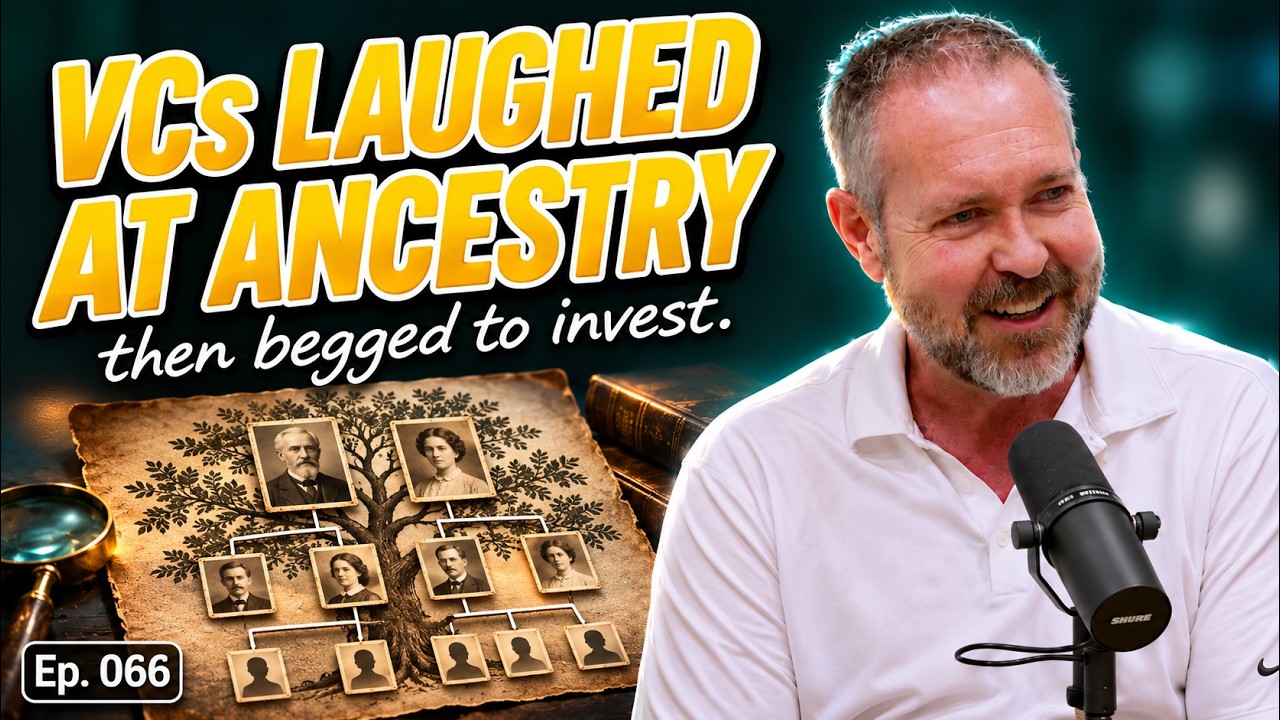
Paul Allen put $400,000 into Ancestry.com with Dan Taggart, made nothing for ten months, then sold 55 subscriptions at $49.95 on day one. That was April 18, 1997, and it was the day they knew they had a business. What they could not get was venture capital: Paul went to Sand Hill Road needing roughly $100 million to digitize records faster, and found what he calls negative interest, because the people writing checks could not see why anyone would dig through courthouse records for dead relatives. Then he had a dream about a private website for every family in the world, and every VC wanted in. That became MyFamily.com, which grew to 20 million users and raised $75 million, filed to go public at a billion dollars, and ran straight into the dot-com crash. A down round and a syndicate of Utah investors kept it alive; Ancestry went on to years of profit and MyFamily took the blame, and was shut down in 2015. Paul walks John and Tyler through all of it, and through what came next: FamilyLink's We're Related, built on Facebook with Jason McGowan of Crumbl, which hit a million users in 29 days, grew by a million a week, emailed 19 million people that Barack Obama had confirmed them as a relative, and then watched Facebook cut off third-party apps. When he asked why they would not just buy the company, the answer was that they did not need to. Now 60, he runs Soar AI Studio, where a project called Daily News made more ARR in 17 days than Citizen Portal did in four years.
Paul Allen co-founded Ancestry.com in 1997 with Dan Taggart and was its first CEO. He began as a Russian major who wanted to be a Kremlinologist, took a $9-an-hour job doing data prep at the search company Folio, and co-founded Infobases, which put more than a thousand religious books on CD-ROM in 150,000 homes and sold a $99 genealogy disc that made $1 million in five months. Ancestry grew out of that work, followed by MyFamily.com, which reached 20 million users, raised $75 million and filed for a billion-dollar IPO before the dot-com crash forced a steep down round. He later founded Provo Labs and FamilyLink, whose Facebook app We're Related reached a million users in 29 days and more than 100 million in total before Facebook closed its third-party app platform. He spent five years at Gallup, where he worked on the CliftonStrengths material that gave his current company its name, and now runs Soar AI Studio. Its Citizen Portal transcribes public meetings across the country, and its Daily News project aims to restore a local newspaper to all 10,263 US cities using AI agents supervised by a human editor-in-chief.
Show full transcript
And it was frustrating because we knew we needed like 100 million dollars to digitize more records like this was a race. We had to go do this fast. So we went to Sand Hill Road in Silicon Valley. Zero interest, not just I mean, it was negative interest, like because the 20s and 30 year olds that are doing venture capital, they invest in things they understand. They thought, why would anyone ever do this? They just make no sense. Welcome back to the Startup Ignition podcast. Thank you so much for watching every episode. We are really into it now. We are on episode 66. So today's episode 66 and you have tagged along with us on every single one of them. Thank you for sharing. Thank you for liking. Thank you for commenting. I'm Tyler Richards. This is John Richards. Say hello, John. Hey, hello, hello. And we are your father and son in entrepreneurship, telling you everything about startups, venture, and how to start a business, what to do and what not to do. And today we have a special guest today. We have Paul Allen on the podcast. Say hello, Paul. Hello, Tyler. Hi, John. Cause we have audio listeners and we have video listeners. So I want to make sure that they know you're here in studio, but yes, he's here live and in studio. Paul Allen is a huge entrepreneur in the Utah ecosystem, all over the United States. Even he's created brands that have gone public, that have gone millions and millions of dollars in revenue. You've raised a ton of venture capital. You kind of done the whole gambit when it comes to entrepreneurship. So I'm really happy that he's here. It's definitely one of the most prolific startup guys in the history of Utah for sure. Well, when you said do what to do and what not to do. I've got a lot of what not to do stories. Some of those are famous. John, you've taught a lot of people what not to do based on my venture experience at Ancestry. So thanks for having me, you guys. No, no, that's a key part of it. A lot of entrepreneurs don't know. It's not just about understanding, Oh, Hey, how did you do it? It's like, okay, wouldn't you do long? Like that's like, that's a big part of entrepreneurship and what will we talk about with friends? That's what mentorship is about. Mentorship is about mentors helping the next generation, not repeat the same mistakes. Do you guys remember Eric Ruff? He had a first company that failed. And then he gave a talk in like 1995, 96, when I started going to Utah Valley Entrepreneur Forum, and he gave a list of 14 things I made mistakes on the first time around that I'm not going to do this time. Yeah, it was awesome. For me, I was like, exactly. Oh, so powerful. Yep. That's the second podcast in a row, the Utah Valley Entrepreneur Forum. It was mentioned, we haven't aired it yet, but the podcast will air just before this one talked about the Utah Valley Entrepreneur Forum, how it gave birth to Utah Angels and a lot of stuff in this area. So, and that's where you first started going, huh? Yeah. Our previous podcast was with Scott Frazier. That'll be coming. Oh, I talked to him last week and he's working with, I love this father son combo is so awesome. He's working with several of his kids. No, David was here with them. Oh, he got a whole father son. Oh, that's awesome. You guys. Yeah. I've got three kids working for me. It hasn't aired yet, but it will by the time this one airs. Exactly. Okay. So we've got to read your bio real quick here. Paul. So Paul Allen is a serial technology entrepreneur, best known as a co-founder and founder and founder of Ancestry.com. You were the CEO. I was, I was the CEO. Okay. So we got to put an CEO in there. I knew that I didn't have it here in your bio, but your entrepreneurial career started back in 1990 with Infobases and electric publishing company built around putting huge libraries of searchable information. Onto CD wrongs. Then when the internet arrived, that work evolved into Ancestry.com and later MyFamily.com one of the earliest major family social networks on the internet. Um, Paul later founded FamilyLink. Who's were related Facebook app. I know from my dad's story was huge, had a hundred million, 130 million. Okay. A hundred, I can't cut back to 30, 130 million users. And you spent five years with Gallup, helping expand the global Clifton strengths movement today. You are the founder and CEO of Soar AI studio, where you're building multiple AI companies right now in this AI era, including Citizen Portal, which I've heard a lot of from you, which seems to be going amazingly well. Um, and across his whole career, Paul has founded tons of companies. Again, we talked pre podcast, or maybe that was even on podcast. You've done a lot of venture capital. Um, and again, you've ran the whole gambit when it comes to being a founder of a startup. So I'm really excited to have you here in studio. So once again, everybody, welcome Paul Allen. Thank you so much for coming in. We're super excited to, thanks Paul for making time. We know how busy you are. I know you're super busy. You don't even live here in Utah, but you know, we got him here in the studio in Utah. So it's a great thing to have Paul, super special. Um, Paul, we're going to do an icebreaker. Okay. Okay. Just see you in the flow of the podcast and do a quick little thing to get to know Paul Allen a little bit better. Really you an icebreaker and it's going to, it's called Paul Allen search history. Okay. We're going to get to get to know you a little bit better and it's not as bad as it seems. Okay. So here we go. I'm going to give you a search query and you're going to tell me the result that would come up from the search. Okay. Okay. Hey, here we go. It's really simple. I know he's, if you're here in studio, he's like, if you're just searching on Google. Yeah, yeah, yeah. Okay. So what is Paul Allen's favorite book? Brothers Karamazov by Fyodor Dostoyevsky. Oh, what is that? Okay. So brother Karamazov, the greatest novel ever written. Uh, it's about a family. There's a fratricide. Um, one of the, well, the father is killed and there's four brothers, including one, uh, illegitimate son. And, uh, it's kind of like, uh, uh, I think Russians, Russian novelists, like Tolstoy and Dostoyevsky lived through horrible suffering. And when you go through so much suffering and you understand, and you still have faith in God, you have a way of describing life and the purpose of life in a profound way. So, uh, brothers Karamazov, um, I think is the greatest novel ever written. There's a chapter in the book called the grand inquisitor. That's probably the finest literature in the history of the world, like 20 pages that I like to read every year or so. But Dostoyevsky understood the human soul and the human psyche in a profound way. And it affected me a lot when I was a teenager. Wow. You first read that as a teenager in high school. Yeah. Wow. It was it assigned to you? Uh, I was able to choose any novel. And then, um, because of Russian literature, Tolstoy and Dostoyevsky, I majored in Russian at BYU. That's, that's the thing that drew me into Russian literature or Russian language was their literature. Wow. Interesting. Okay. Who is Paul Allen's favorite historical figure? Oh, I have so many, I have 7,000 books in my library. Um, and I think Benjamin Franklin is one of my favorites, the latest biography by Isaacson on Benjamin Franklin. He calls him like the best American, um, you know, the greatest American inventor, business guy, you know, uh, news and publisher, printer, uh, postmaster general. Like the, the statesman at the constitutional convention that said, let's pray so that we can get past our gridlock. Like we wouldn't have birthed the American nation without Benjamin Franklin. So he's definitely one of mine, but I've got, I think I've got hundreds of favorites. Franklin's a good one. Yeah. I like Benjamin Franklin. I just saw it in the young Washington movie and he was a character. Oh, right. Yeah. It was really shout out to Benton crane, my friend. Who's the executive producer of young Washington. Oh, really? That's great. Yeah. And just, it's always fun, that character and the way that he came off. I, it was fascinating. Yeah. It was when he was younger and publishing a newspaper. Okay. Next search query here. What's the answer call? So one company, Paul Allen wishes he had found it. What's one company you wish you were the founder of? Um, Gallup. I think Gallup is the finest privately held company on the earth. Why? Because at a, they invented modern polling in the 1930s, Dr. George Gallup invented a random sample public opinion polling, and they've been sampling, they've been opinion polling for 80 years, uh, as a nonpartisan, independent, valuable service. So George Gallup said, if, uh, if democracy is to, is to implement the will of the people, you should find out what the will of the people is. So modern polling is a big deal. And so, and then they started a world poll, uh, Jim Clifton, the chairman of Gallup, uh, he heard, uh, I think, uh, uh, secretary of state questioned about, you know, the public, the polls in Iraq or something like that. And he's like, uh, well, it's not like we can take a Gallup poll in Iraq to find out what people think there. And Jim Clifton heard that and said, oh, we've been polling America for 70 years. Why don't we pull the whole world? So he started a 100 year commitment to poll, uh, all the countries in the world every year, statistical sampling. And they come, they got a bunch of Nobel prize winners, about 20 brilliant people to say, what questions should we ask the world every year for the next hundred years? So if you actually think about caring about humanity and what people think in every country, Gallup can measure, uh, thriving, suffering, and struggling in every country every year, and then give insights to leaders about what makes a good country with good outcomes. Um, and then that's at the, that's at the high level, uh, understanding humans at scale. But then Dr. Don Clifton invented the strengths finder assessment later renamed Clint Clifton strengths. And 37 million people have taken this 177 question quiz to find out what your talents are, what your strengths are. Um, his, uh, definition of a strength was a naturally recurring pattern of thinking, feeling, behaving, and of who you are, what you think, what your habits are that can be productively applied. And so if you think about knowing what your God-given talents are, and then living your life, playing to your strengths, Gallup nails, both the human wide, uh, measurement and the individual potential, like nobody else in the world, they, they can help every individual realize how much potential you have because you're unique and you have strengths that no one else has all based off of the original 1930 stuff. No, the, the, the Dr. Don Clifton started in psychology in the 1950s. And when he was getting his PhD, he saw that almost every book on, uh, psychology or psychiatry was about what's wrong with you, you know, lay down on the couch. I'll tell you what's wrong with you. Like, well, we'll diagnose you and fix you. And Don Clifton simply asked one question and for 50 years, he tried to answer this question, what would happen if we focused on what's right with each person? And so he built a taxonomy of human talents, uh, by interviewing hundreds of thousands of people and listening for clues to their innate talent. These are things you aren't taught. They're not knowledge or skill. You, this is what you're born with. So I think Gallup, I never founded Gallup, but if I could, there's, there's no better company on the earth that measures humanity at scale in every country every year, but also helps individuals find their greatest potential. I wonder sometimes if the younger generation, like our generation and older, when you hear the word Gallup, you think polling. In other words, it's like Kleenex tissues. We say, I need a Kleenex, but it's really a tissue where I need a bandaid. Yeah. That's really bandage. Right. So when your company name becomes synonymous with the actual thing, like, yeah, let's do Gallup. That means let's take a poll. You know, I mean, that's just kind of almost the status. Yeah, I know. Yeah, but, but Gallup, when you hear the word Gallup to me, it's instantly plus or minus 3% of the American public, you know, it's the Rolls Royce of polling. They've been methodologically pure for a long time. It's harder to get good poll results these days because cell phones are hard to reach people. I think sometimes one to 2% answer rates in the seventies and eighties, when Gallup was a household name, uh, 70% of people would answer their landline and be like thrilled if they could participate in a Gallup. According to Gallup was a very, newspapers would all say, according to Gallup, you know, you ever listened to the all in podcast. They were quoting Gallup this week about usage of AI. Gallup is still the world's best brand for polling and all the leaders in business education, government faith will cite Gallup polls to find out what people are really thinking. Very cool. All right. So, which leads me to the next prompt for you. What is Paul Allen's current rabbit hole? Like, what are you like, like wasting time on going deep into and like super curious about? So if you think about the history of our country, we talked about Benjamin Franklin being a printer. He published newspapers. He wrote anonymously, he kind of covered scandals and created scandals, but he was witty. He was smart, but the newspapers is what, um, helped the United States, uh, become such a great country. Every city had one or more newspapers. When president Lincoln was elected, there were 11 daily papers in Chicago and the freedom of the freedom of the press. We had a literate population. We were reading, uh, Lincoln Douglas debates for hours. They were all printed in the newspapers. And so we became an informed, uh, populace in the last, uh, 40, 50 years with the rise of technology, especially the rise of the internet and smartphones, um, thousands of newspapers have shut down. And I've been deeply considering what newspapers meant to our country over the last couple of hundred years. And what happens if there's no, no newspapers left? And so we are actually planning to resurrect a local news site in all 10,263 cities. Thousands have lost them. Thousands are at risk of losing the daily news. And so I've been kind of looking at every part of the news. Like what, why do people read it? Why would they read it today? If we're on Tik TOK, or if we're on short format video and just scrolling for six, seven, eight hours a day with short format video, I don't know. It's kind of dumbing down our brains, but a lot of people still crave the written word, syndicated columnists, like great insights from great authors and thinkers. So yeah, I'm, I'm diving deeply into, uh, launching daily news in every city and town in the United States. Hoping newest. It's the newest adjacent product to Citizen Portal, which has been going for four years, publishing 20,000 news articles a day all year, but very few readers and hard to monetize. And it turns out if you go adjacent and say, we're going to do all the local news, not just political and government, but sports and, um, business, local business, education, culture, arts, all the things that were in the newspaper, including comic strips. If you go that direction, we're seeing more success and more ARR in two weeks than we've done in Citizen Portal in four years. Wow. Yeah. I mean, in Franklin's day, they bundled all that, that information in a newspaper. We kind of do the same thing with Tik TOK and, you know, uh, X or all the social media sites. That's where I get all my views. Yeah. X is my private source. So you just said like where you've done this research. So right now the American public, what's the number one, two, and three sources where they get their news? Well, for young people, it's definitely Tik TOK. Um, and then just scary a little bit. Yeah. I mean, I think, uh, well, just the fact that you're watching and listening, not reading, there's something powerful about the written word. First of all, uh, Tim Sanders wrote a book 20 years ago called love is the killer app. I gave it to dozens of people. It was one of my favorite books. He not only taught you how to care about people in the workplace and treat people with dignity and even love them, but he also taught you how to read a book. And, and I've been following his advice for many years. He said 80% of your information diet should come from published books, not newspapers, not Tik TOK, not Google searches. Why? Because the editorial process that an author goes through to publish a book, fact checking, careful rewrites edits, the quality of or is so much higher. It is the same today. Oh, I'm positive of it. I know some really, really uneducated people that are publishing books and are pulling out their words and saying their thing. And, you know, 95% of it is just AI written. Oh yeah, no, I'm not saying all books are good, but if you get the best writers in the world and you, you, you're saying you should, as an individual consume 80% of your time spent learning is way better served if you read a book that's written by a brilliant expert who has editors and a quality well-vetted book. It's a well, that, yeah, exactly. So be very careful about what books you read. But, you know, I, I think that, I don't know, there's a dumbification of the human mind if we're just using digital all the time. And since you told me about your new deal, I've been asking a few people older where they get the news. The young people do get it from TikTok or things like that. But it asked AI what the age specific numbers were separating like news from books versus news from social media. And it's thinking right now. But X.com is where, even you said you get a lot from X. Most of my news. So there's a difference between history and literature and kind of understanding a field by reading a foundational book and then getting up to date news. Like if a foundational, if a frontier lab or Grokbot announces something today, it's not going to be in a book for three to six months. So the newest stuff, the cutting edge stuff is in X for me. And I'm sure TikTok is that way as well. But the, I'm getting an understanding of a field. I mean, Elon is a, is a rocket scientist because you read books. Like Elon's got an insatiable appetite to read scientific books and all the things he's done. He hasn't done it from TikTok. He's done it from reading books by the world's best experts in his field. All the AI models and those labs are basically purchasing books and just ripping the books apart and scanning them and putting them into their, their, their repositories, right? Cause it's just like, we just need air. And also there was that law that was passed that they had to have a one for one. If they wanted to have the books and their models, they had to purchase them, buy them, scan them in. They might've already scanned them in they're buying the book to prove that they have the book. I'm just saying that reminds me of VidAngel back when they had a DVD for every rental. My son wrote their software for managing their inventory. So if they had 20 copies of Revenant, they could stream 20 copies of Revenant. They would sell it to someone and then let them stream it and then sell it back. But anyway, there's didn't go so well. No, there's didn't go so well, but thank goodness for the Harmon brothers, uh, resilience to, to build what's now becoming angel studios. Talk about them to a few guests. I just, they're, it's amazing what they've pulled off and I think they're making good movies now. So young Washington. Yeah, for sure. Okay, here we go. Now that you're really all in on AI, this is my last prompt for you. And then we'll get over the icebreaker and actually into the podcast. We're spending the time on it, which is great information. The last one, what is Paul Allen's, uh, best or most used or most innovative technology of your life? What's been the most impactful, like life changing tech. Is it this AI era? Is it something previous in your career? What is like, when it comes to my standing your life? So my brother, my oldest brother, Kurt, um, worked on a search engine in the eighties called Folio. And I got my job, my first part-time job scanning books and doing data prep to create Folio Infobases. And so I would say for the first 22 years of my entrepreneurial career from 1990 to 2012, every single thing I wrote, said, heard, copied and pasted from the internet, I put into my personal knowledge base, my Folio Infobase. So I had a perfect recall of everything I'd ever come across. I had 300 megabytes in one file. And when I got a new computer, I would copy that computer, install Folio and have a searchable, it was my brain. Today you got Andre Karpathy and others teaching you how to build a brain with AI. But I have had one, I had one for 22 years. Unfortunately Folio Views did not support the migration to like windows XP. And so I've not been able to use Folio Views ever since. And so for the first 22 years of my life, everything, every note, every meeting, every phone call, all my notes were in one searchable Infobase. That was an unfair advantage. Now, anybody who does a second brain, it will have that kind of same superpower where everyone you've ever met, everything you've ever said, anything I've ever been said to you. So that would be the, to me the top tool that I've used in my life is a search engine of all of my content. And now my second brain is finally coming around to where I was with Folio back in 2012. Yeah. And it's so funny that a lot of this, like I'm searching and repository and data basing has been around and existed for so long, but it's, I think it's finally become fast enough with AI, right? And variable enough. Yeah. Do more search and more research in one go than it's ever been. And that's why AI it's taken off since, you know, 2022, 2023. And the hardware and what's happened is, you know, software has actually been ahead of hardware all these years. Hardware, I mean, excuse me, versing hardware's always been ahead of software. I said that backwards and the hardware is just gets so powerful right now. Today's chips are so powerful. There's still a long ways to go for software. Now AI writing software, maybe we'll start unlocking the full power of that hardware. Like these chips that are being built are. Well, Apple's strategy seems to be make the chip so strong on your phones and your mobile devices that you won't need to rent AI in the cloud. You'll have your own LLM on your own. I think we're one or two years away from anyone being able to run as many tokens as they want on their phone, their laptop, and then you can own and control your own stuff. So the other thing, an extension of my answer about Folio search was starting recording all my calls and meetings four years ago with a product called scribe, which, which Richard software built. And I've had over 9,000 calls and meetings recorded and everything I've ever said, or anyone said to me, I can search that now. And we've integrated that in with grokbots. So I can ask my chief grokbot, what did Steven Covey say to me on a call, you know, two years ago, and it will find the clip, play it for me, either audio, video, or just text. So, so that second brain thing now includes everything I've said and everything people have said to me, it really is powerful to have that knowledge repository at your fingertips. Are we going to go back now? Okay. Trying to start the real podcast. That was so good though. Very good. And we would want to hear more at the end too, about the Staley news thing. Cause I know that's what you're working on now. So let's go back to where we start, like to start, tell us about where you grew up and went to high school and give us your life from high school through college. What, what tell us about it. Orem high school. I went to cascade elementary, Lake Ridge junior high and then Orem high school. So Orem Utah here. My mom was a school teacher before she started having kids. And my dad was a professor at BYU for over three and a half decades. My dad started the manufacturing engineering program at BYU. And in the seventies and eighties became famous for the computer aided manufacturing research lab. So my dad invented software for manufacturers that would classify all their materials, all their parts, all their processes and allow them to lay out a factory to create an unbelievable efficiency going from raw material to finished good and finished goods. Boeing was his first customer and then Caterpillar, Westinghouse, Lockheed, Martin, John Deere, all the biggest manufacturers in the United States used the D class D search technology that my dad invented. And it was sold through BYU. What was the department he was in? Computer aided manufacturing research lab. Okay. Can lab. But what the degree granting department or whatever, the manufacturing technology manufacturing technology, I don't know what the degrees were. Is that part of the engineering school? I think so. Yeah. Okay. Yeah. Um, so I grew up, um, just on the BYU campus, um, all the sports, uh, from five years old and on, I went to the Marriott center to all of Chosich's games. Um, so I love BYU sports. So who's going to win this Saturday, BYU or Utah? Oh, man. It's the first time they've been both ranked in the top 10. What an incredible year for the holy war, right? Yeah. The holy war. Yeah. Um, so I, I love, um, BYU. I love education. I never even thought about going to any other university. I got straight A's in high school and, and got a scholarship, full, full ride scholarship, but I never even once looked at any other school besides BYU. It also seems like you weren't very, your dad was very technology savvy. Oh yeah. Oh, my dad is a genius. My dad is in the national Academy of manufacturing engineers and the national Academy of engineering. I think maybe the only Utah that's in both. So you studied Russian? I did. My, my mom was a, was a literature person. My, my dad, I, I inherited zero of my dad's engineering skills. Like I have zero handyman skills. I have no functional real world. My wife does our plumbing. I I've tried one time. I, I tried to fix a light bulb that was, um, had electrical wiring problems in our attic. I went to Lowe's and home Depot. I spent 10 hours studying and I couldn't figure out how to fix the lighting. And my neighbor came over and fixed it in five minutes. So if you think about play to your strengths, like I have a skills with information retrieval, kind of electronic organization, reference material, that's my strength, physical, real world stuff, zero capability. And so I could just spend all my time trying to do anything, but there are people that are so good at physical things and I'm just not. Yeah. So, okay. So how did you bridge that gap from like being obsessed with Russian going into what you've done made a career? So it was, it was accidental. Did you declare Russian literature right away? Russian language. So I started, I started language. I started in political science at BYU. I had had the best history teacher in Utah, uh, D all red. He was the teacher of the year. I had pre AP U S history and AP history. And I loved learning about the constitution, learning about American history. I fell in love with history. And then, um, that leads to political science. So I started at BYU in political science. And then I took a class on comparative governments and I thought, wow, the U S system is so different. I need to study international relations and realize that 5% of the world's population is in America, but our, our GDP, our contribution to the world is so, uh, beyond that. And there's something about the U S system that is really awesome. Uh, it encourages its freedom, but also entrepreneurship and innovation. And, and so I just, so I studied, um, international relations. And then I took a Russian class and on day one, I fell in love with the Russian language. And I obviously, uh, I, I have a faith and I was hoping someday to be able to teach the gospel of Jesus Christ in Russia. Don't know if that will ever happen, but, um, I switched my major to Russian language and I graduated. And really the path for you then is get a PhD in Russian or Soviet studies. I wanted to be a Kremlinologist. I, my career ambition at that point was to study the Soviet union and understand how could 12 people control a country as large as Russia, 250 million population back then the Soviet union was such a powerful kind of world power. How could 12 people do that? What, what was the ideology, but what was the intrigue and the jockeying for power? Like I wanted to be a Kremlinologist. I also interviewed with the NSA and I went through the path of like, I'm going to go live in DC, get a PhD and be the expert on the Soviet union. Then my brother at Folio gave me a part-time job. I got married my senior year of college, my last semester, and I had to have a job. I'd never had a job before. So my brother gave me a job running Ray Kurzweil, $40,000 OCR scanner. That's how skilled I was. I could run a photocopy machine basically all day long. And, but then six months into my part-time job at Folio, my friend, Steve Barwick decided to teach me programming. And so I learned a quick basic and then Pascal, and then I became the top data prep engineer at Folio. And that led to Infobases with my best friend, Dan. We just thought, well, Folio is the world's best search engine and it was, and we could put all the world's best books and knowledge on Folio. Where would we start? We started with scripture. Then we went to history and, and we were going to just publish libraries of books on Folio. That became my entrepreneurial first step. And I was embarrassed. Honestly, I thought business was like a lower caste. If you think about, you know, the Indian caste system, the merchant class isn't as great as the philosophical or the warrior class. Like there's all these casts and I just didn't have a good attitude towards anyone in business, anyone who was trying to make money or build a company. Like to me, it was like way down academia was way up there on the totem pole. And so I was embarrassed that I had started a company and I tried to pretend I hadn't. And for years, I would talk about the learning product I was building without really admitting that I was a business guy, that I was an entrepreneur. And that all changed in Philadelphia in may of 1996, we made the Inc 500. We were 454 on the Inc 500. So I got to go to Philadelphia for a couple of days and I was there with hundreds of the coolest people I'd ever met in my life. I'm like, these are the most awesome people. These are the builders. These are the dreamers. I loved the entrepreneurs that I met in those two days. And at that point, I thought I want to become one of the world's best entrepreneurs. I have no shame anymore. This is a great path. This is where you create products that didn't exist before. You create jobs for everybody else and you change the world. And so that's when I finally embraced that, Hey, I want to be an entrepreneur. I wish I had the license plate startup. I hadn't thought of that at the time, John, you've, you've got that startup license plate. But, um, my first investor in Ancestry, Steve Gibson had a license plate that said mentor. And so I got to be mentored by people like Steve Gibson. And I met Josh James and John Pastana. They were, they were building Ancestry's homepage after we were a few months into it. So we contracted with them. So then I went to Utah Valley entrepreneurial forum and I called Kim Clark at Harvard. I thought about going to Harvard for a couple of years. And he talked me out of it. He's like, you've already been a CEO for six years. You'll really be bored out of your mind. The first year, if you make it through your first year, you'll love your second year. But I really in 96, 97 decided I want to be a great entrepreneur for the rest of my life. So you got married the last semester, your senior year and worked for Folio for two and a half years, turned into Infobase, which launched me into starting Infobases in 1990. You were now, then you were married for yourself. So during college, you were doing kind of the academic thing, Russian and you went through a few majors, it sounds like. Yeah. Three. Okay. And then got a tech job right at the end of your college career. Thank goodness. Folio hired me for $9 an hour. And then two or three years later, Infobases. And Infobases, if I remember right, you were putting a lot of books on CD-ROMs at first, right? Yeah. We put over a thousand religious books. CD-ROM would have like, yeah, these great books, you think? Yeah. Yeah. All the best books in the religious field. And we made millions of dollars a year selling electronic. So Deseret Book was the major reseller, but all the computer stores in Utah were ordering these. And then anyone who had to give Sunday school lessons or was a leader in the church. All the standard works or scriptures. The Bible and everything. All the words of living prophets, all the apostles from the beginning of the dissertation. Format for any family. So for a family to be able to go to, I just remember the product, right? I had it Infobase. Well, a hundred and fifty thousand households in the United States had our product to do research and gospel, you know, writings and teachings. It was a big deal in the state. Yeah. Yeah. It's long since faded. Now we've got, you know, all kinds of apps and the internet and a lot of stuff is searchable, but yeah, we were early on in basis. When did that gave what, tell us what, how Infobase has turned out. So in 95 Infobases published a genealogy CD-ROM called the family history LDS family history suite. And that was the first time where we said, let's put genealogy records and reference books and in data about geographies and also genealogy software, we licensed ancestral quest and we put it on the disc. So it was a $99 disc. And that collection of genealogy tools and research and software made a million dollars in five months. It was our most successful new product launch ever. And that was just a Utah audience, a million dollars, five months, a Utah audience. So then I go to San Francisco in September of 95 to a conference called internet developers to apparently they had out a one in 2000 or 94 that I didn't go to, but I've got a t-shirt from internet developers too. And that's where I realized that CD-ROM would disappear, that the storage mechanism, the storage media, storage medium would be replaced by the worldwide web. Yeah, exactly. And we didn't call it the cloud back then. We called it the worldwide web. And so I came back and I thought we better put all the genealogy data on the web and that's a different business. That's a different business model. And so we thought about doing that inside of Infobases. And then we thought about doing it as a separate company. We ended up doing it as a separate company. We sold Infobases. Alan Ashton bought Infobases and then a couple of years later, merged it with Deseret Book. So he bought Bookcraft and Infobases in mid 97. So just for our listeners and viewers who are following along, that Bookcraft was a big bookstore editor, book publisher, publisher, and publisher. Did they have stores? I think Covenant had a bunch of stores. I don't think Bookcraft had stores. There were two major publishers in the Church of Jesus Christ of Latter-day Saints Market. There was Deseret Book owned by the church. Bookcraft started in the 1940s and it was a very big competitor. They had a lot of prophets and apostles. So Alan Ashton, the founder of WordPerfect, bought Bookcraft and Infobases. Correct. And that's when Dan and I exited and we put all of our money into Ancestry.com, which was incorporated July 1st, 1997. Did he invest in you beforehand too? He did. Yes. Into Infobases. Because I remember you having a really close relationship with him, the founder of WordPerfect, you know, just one of the biggest tech histories of Utah stories. Yeah, for sure. Novellen, WordPerfect spawned everything. So you were able to exit Infobases pretty well. You didn't like cannibalize your own stuff, like with the internet coming and creating basically a new company and doing it. Yeah. We sold the CD-ROM business. It merged with a big book publisher, which later merged with an even bigger book publisher. And so I don't think they did a good job with the product, with the CD-ROM product. So I think it died sooner than it should have. The internet didn't really cannibalize it. I think the product development was not good. Nobody liked the product. I was out of it. And Dan Taggart and I put $400,000 into Ancestry.com to try to build a online genealogy business. And for about 10 months, we didn't make a penny on that business. We turned on subscriptions, April 18th, 1997. And we had 55 sales in the first day, $49.95 each. It's $2,500 of cashflow and we knew we could make it. Did Ancestry exist and you bought an existing company? They were a print publisher. They had a bunch of reference books. They published a magazine. They were all about how to do genealogy. They had no data. They had never had a search engine or any attempt to put all the world's genealogy, but they were called Ancestry. They were Ancestry publishing. We loved the name because alphabetically Ancestry will be at the first of the Yahoo list about genealogy sites. So it was good that way. But they had, the best, the best knowledge of where the genealogy records of the world exist. So we bought them, we got their revenue from books and magazines, but then we studied their books and magazines to go find all the data that we needed to put on the internet. Wait, so wait, they just knew where all the genealogy. Every book about genealogy is telling you how to go find birth records in Omaha. Like there's a, it's a, it's a roadmap to where to go get the microfilms or the print records or the digital records. So they knew where everything was. And we bought their company, kept their name, launched Ancestry.com and then studied like crazy to go find all the data they were talking about. And then instead of going to an archive somewhere, now you just search Ancestry.com and find the same data that you would have had to travel to get. And essentially you just digitized all of that stuff for Ancestry research to the cloud. Billions and billions, and now like 80 billion records later. You basically took what was in books and print format, what was maybe on CD-ROM format, and you put it available on a searchable database accessible through a website. Correct. But most of the records were in archives. They were handwritten birth, marriage, death records. They weren't even in books yet. They weren't organized yet. So what early on, we found a guy named Jack Blodgett who ran a company in Beijing called Beijing Formax. It was a digitization and indexing company. And Beijing Formax gave us 1200 full-time employees. We would go scan archives with these high speed scanners, send the content to China. They would double key it and send it back as indexed searchable. So literally like pick, let's say some parish in Europe had a record book going back 500 years. If everybody was born and died in that parish, you would get that book and you scan it. They would double key entry it. Yeah. In China database. Yeah. So, cause the American workers too expensive. Oh yeah, for sure. And the Chinese people didn't even speak English, but they were entering a character at a time. And if you have two non English speaking people doing the data entry, if it's exactly the same, then it's right. If there's a conflict, then they would have an arbitrator twice and check it. Yeah. So it's crazy. Now because FamilySearch is, you know, and Ancestry are now doing billions of new records every year. AI is doing all the handwriting recognition. Yeah. Like what humans used to do, AI can do it better and faster. So Ancestry started aggregating all this, put it on the web, but then it also had another piece to it that you'd introduced, right? Yeah. So it was first a data aggregator and purveyor, right? That's the largest database of genealogy records in the world on the internet for $50 a year. And it was successful. It was going and becoming a great company. Oh, it was. Even though it was... What month and year did you launch it? July 1st, 1997. Okay. And then by July 1st, 1998, we were cashflow positive with like two and a half million in ARR. What you are doing, a lot of our viewers and listeners sometimes leave comments on our podcast and say, these kinds of opportunities just don't exist anymore, right? Like, Oh, where am I going to find a database of like literally handwritten public records where I have to digitize or whatever. But I just want to say a lot of the best innovative and newest ideas do come from kind of old ways of doing things. And whether that be pen and paper, like you found or Excel spreadsheets that still exist today, like there's still opportunities to do like what you're doing today. There's a lot of stuff now bearing in Excel sheets that needs to come out into a more SaaS or AI world. There is a huge amount of public domain content in the world. And the U S government is largest publisher in the world. And everything the U S government publishes is in the public domain. It's not copyrightable. So any, uh, any kind of curious, uh, entrepreneur can go find raw material that you can package and repackage refine it. You can add value to it. Yeah. I think public domain is an open source, same thing, open source. There are millions of open source repos out there where contributors to open source software have built all kinds of things, almost a replacement for anything. But today agents, AI agents can code almost anything in a day or two. So there's an unlimited number of opportunities. I think Einstein was right when he said that imagination is more important than knowledge. I think a lot of people that get stuck like, Oh, all the good ideas have already been taken. Well, where's your imagination? I mean, haven't you read science fiction? Don't, don't you realize there's a million things I'm imagineers. Well, yeah, imagine there's important ideation. That's, and that's all I'm trying to say. A lot of entrepreneurs get stuck on ideas of like, Oh, no good ideas exist anymore. No great opportunities exist. Yeah. But back to the Disney thing, that's why it was so special. He says not, you can't just be an engineer and be a left-brain person and conclude there's nothing left to do or whatever. It just doesn't fit in my box. He wanted you to be an engineer, but with a great imagination. And that's why he built the company you built. Right. So interesting. So, okay. So you got Ancestry, you, you release these subscriptions or these, uh, uh, you know, ways for you to start making revenue. You made 2,500 bucks or what did you say the first day, $2,500. And then it never went down. It, it got into the hundreds of subscribers a day. We raised the price of the $99. It grew to millions a year in ARR. And it was frustrating because we knew we needed like a hundred million dollars to digitize more records. Like, well, this was a race. We had to go do this fast. So we went to Sandhill road in Silicon Valley, zero interest, not just, I mean, it was negative interest, like because the twenties and 30 year olds that are doing venture capital, they invest in things. They understand the idea that old people go to courthouses and archives and cemeteries to track down deceased ancestors. Names did not register with any of I'd met one genealogist who's a venture capitalist, a guy named Tom McDonald. Um, but most people like invest in things they understand. They didn't understand it. They thought, why would anyone ever do this? They did make no sense. And so, um, we had, uh, we had some frustrations, like why can't we raise venture capital for this? And then we also had consultants saying, you guys are going to go out of business. Um, this was a few months earlier before our revenue started picking up. But I actually came back from some of these frustrating conversations and I had a vivid dream. Um, you think about word perfect in Utah County, you think about novel, novel was the world's top networking company. Every corporation had an intranet connecting all the computers to each other. That's how you shared files with each other. It's how you messaged each other before the internet arose. Every company had an intranet. Well, I had a vivid dream that Ancestry.com built an intranet for every family in the world. And this would allow you to connect with all your living relatives. And I woke up and I told my attorney, uh, my cousin, Brent digital son, I told a few other people and then I stuck started talking to Dan and we decided we would build a website for families. We tried to buy domains, um, hey, family.com dear family.com. And then Dan found MyFamily.com for 18,000 bucks. We bought MyFamily.com and launched December 26th, 1998, and it became the most successful online online community ever built. So did you just scrap the whole VC raise or what? No, every, every VC wanted to invest all of a sudden in that product, zero investors came into Ancestry.com. The first 75 million came because everyone knew you want to share your photos of your kids with your mom and dad. They were guilty. They felt guilty for not spending as much time with family. Now you've got this family website where everyone can have a shared calendar, upload recipes, message board, voiceover IP. You could chat over the phone with any relative in the world for free. That's what MyFamily, MyFamily.com was an early social network. And we, we hit all the, checked all the boxes for families. We grew to 20 million users. And when we went to file our IPO, Merrill Lynch was our book runner. They, they helped us write the S one, the ticker symbol. The company's name was changed to MyFamily from Ancestry, from Ancestry, because MyFamily had way more customers, way more potential, way more interest from investors. And Mary Meeker from Morgan Stanley said, it's game over in the family space. MyFamily.com will be for the online community. What eBay and an Amazon are for their e-commerce businesses, like the top internet analyst in the world says, you guys have nailed it. Well, then what happened is the bubble burst. Our CEO and CFO that had been hired kind of ran us into the ground. We were almost bankrupt by the end of 2000 and MyFamily.com was the casualty. The investors and some employees blamed MyFamily.com for the financial problems. It was never the case, but we stepped away from social to go back into genealogy and to focus only on genealogy. And then MyFamily.com was shut down in 2015. The greatest idea ever built for strengthening families in the world was shut down because of short-term thinking and the board members didn't understand its potential. Oh, okay. So, so you were going to launch publicly as MyFamily.com. With Ancestry as a revenue generating product. How did it get to the IPO of Ancestry? How did that? So from 2000 to 2009, a lot of things happened. Ancestry's revenue grew into the hundreds of millions and MyFamily was languishing. So they took all the engineers off MyFamily.com. They stopped making it free. They started charging for it for MyFamily. So it went from growing by 30,000 users a day to zero growth, negative growth, historical macro view. The.com bus started in 2000, got really ugly all the way through 2003. Then also in 2003, things started coming back. And I remember that's when Ancestry started coming back a little bit. Ancestry never went away. We doubled our revenue every year for six years. It started slowing its growth when they shut down. Talk of going public in 2003. Right. And then they, yeah. They didn't go public because it was doing so well. Wow. So I just didn't understand that MyFamily part of the story. It's the reason all the funding came in. Yeah. It's the reason Ancestry became the dominant place. We could have been Facebook scale if it hadn't been derailed. So what happened? Is that you just like, I just feel like you had if millions, deck of millions of users, a hundred million users. We would have had hundreds of millions. We would have had billions of users. There's no question we would have had billions of users, but the genealogy engine was generating tens of millions in revenue. MyFamily.com it was launched before Google AdSense came out. It was hard to monetize a social network back then. Yes. If we had held on for longer, there emerged lots of ways to monetize eyeballs, but MyFamily was blamed unfairly by some of the answer Ancestry team and by some of the investors, they didn't get it. They didn't realize how much potential it had. Here's the worst part. My friend, Dan found out that we could buy the domain, MyFriends.com also for $18,000 from a guy in San Francisco, we were going to launch MyFriends.com using the same infrastructure as MyFamily.com. And that was in 2001. Could have been like Friendster. So we had the potential to do social for family and dominate that. And certainly we could have been a player in the friend social space. Yeah. So eventually you left the company. I left in February, 2002 after we were cashflow positive for the second time I was head of marketing. I was over all subscriptions and I did a lot to grow the revenue with a small team, but we, we crushed it on Ancestry revenue, but it was no longer my company because CEOs came in and went on its own path. Where did you go in 2000? So I started a Provo, let's see, no, I started 10 X marketing. I thought, okay, Ancestry knows everything about the internet marketing. We've tried all kinds of email banner, advertise affiliate, display ads, viral loops. And so I started an agency and I thought 10 X marketing is a good name. If I can double your traffic, double your conversion rate and double your average sale price per checkout, I can eight times your revenue. So I started hiring some internet marketing people. We got a bunch of clients, we grew to 90,000 in revenue in six months and we had a bunch of consulting gigs. And I found out then a hard lesson. I hate marketing other people's products. I love marketing products. I believe in like, I can do it all day long. It's it's like, I believe in it. So I, I promote it. But when we had all these products that people would hire an e-commerce company, there's just contracts. Like I'm not a mercenary. I just can't do it. And so you have to passionately believe in it. I do. I have to believe in it. And so I hired a guy to run it. We sold it to a publicly traded company. And then my next thing was Provo Labs in 2005. That's kind of how I am in sales. I can sell really well if it's my thing and I really believe in it, but man, it's hard to sell something. I don't believe that. So you, you raised 75 million from MyFamily slash Ancestry. And then 15 million for the series E. So the total was 90 million, but the series evaluation was one 25th of the series. See, that was a massive down round. Yeah. Okay. So, so give me a timeline of, so you raised took in 75 million, 90 million over the time, the whole course of the company up through 2000, the company raised 75 million. The most recent evaluation was 300 million. And then we were going public at a billion. So that all happened right up in early 2000 and then the bubble burst panic ensued. Uh, the company, the IPO, the company ran out of money by November, did a couple horrible, a really bad acquisition, uh, that added 75 million in liquidation preferences to our already, uh, difficult cap table. And, uh, anyway, it was, it was bad. Finally series E investors, the greatest syndicate of Utah investors who had ever invested together, including Paul Alstrom from V spring, Dave moon from S net. Uh, so many people came together, rescued us in our series E, moved the company back to Provo. I stayed on as head of marketing. And then we became cashflow positive by August, 2001. So all the disaster of burning four, 4 million a month was behind us. And from August, 2001, for the next seven, eight years, the company was massively no for the next 14 years, the company was massively profitable and getting more so every year until it was acquired by a private equity fund that put a billion dollars of debt on the Ancestry balance sheet. So for 14 years, it's cruising. It's making huge profits and then a private equity fund who likes to leverage other people's debt. They didn't want to put a billion dollars in themselves. So they bought the company, levered the assets, put a billion dollars of debt on the balance sheet. And now Ancestry is losing money every quarter had to shut down a bunch of products. And that's when MyFamily.com was finally killed. So, okay. So 10 X marketing, how long did you do that for? I did it for about a year and a half. And then it lasted for another year and a half. So someone else, right. Then I did Provo Labs in 2005. And that was kind of like a venture studio. We might call it today. Yeah. Yeah. An incubator. I made a mistake. I made a big mistake there, which was hiring like five or six teams to do five or six things simultaneously. If I could do it over, I would have hired my team from Ancestry, who I already knew how to work with like Richard Stauffer and build one product a quarter and get it fully launched and scaling before hiring anyone else. But instead I had too big of an appetite. I thought I had the King Midas touch back then, and I did five or six things and they all shut down except one. Yeah. Which one was that FamilyLink? Okay. So, so, so out of FamilyLink, basically Provo Labs is kind of like a venture studio slash incubator, all this stuff going on, but out of it you decide to ultimately to focus on one company ran out of capital, had one great product, which was FamilyLink and hired Jason McGowan to be my product manager. He had launched byu.com a social network that the university didn't take too kindly to. And so, but I liked him a lot. He's super smart with social. So I hired him to be my product. Footnote on this. Jason McGowan is the Crumbl founder that just a super old Uber successor with cookies. Our time together, digital cookies, real cookies. Our time together at FamilyLink need him. One of the world's top experts. I met him through you and mentored him on Facebook. I liked the one that I mentored him on. I like called pick. I liked it. Oh yeah. Before he did Crumbl. Yeah. I do remember that. Yeah. So, um, my goodness, the FamilyLink years, three years, I met some of the greatest people, uh, in, in Utah, FamilyLink in comparison to MyFamily and it was going to be the resurrection of MyFamily.com the, since Ancestry hadn't valued MyFamily.com and started charging for it. We thought we'll build a new website for families, a new social network to connect families all over the world and call it FamilyLink. It was leveraging and built on top of Facebook. It wasn't initially first. It was just going to be a destination website. It was going to have the same viral loop. We're going to get tens of millions of users, just like we had it at MyFamily.com. But then, um, I went to Mark Zuckerberg's F8 conference in 2007, May of 2007. I had invested in BJ fogs company. BJ fog is a, he went to BYU and then he got a PhD in any Todd at Stanford university. He's a brilliant psychologist and he had a product called Yak pack and I invested, I was an angel investor in Yak pack. He calls me up May of 2007. He says, Paul, Facebook is letting a whole bunch of us come and launch apps on top of Facebook. I'm like, really? And he's like, you should come. I'm like, I'm too busy. Then that night I thought I'm going to go. And so I went to Moscone center, met Mark Zuckerberg, heard about Facebook platform. As soon as they were done announcing, I got on the phone with Jason McGowan and Richard software and said, we're not going to build FamilyLink as a destination website for families. We're going to build apps for families on top of the Facebook platform. And that's when we started working on, We're Related, which Jason had launched in October of 2007. And We're Related, got a million users in the first 29 days and then started growing by a million a week. Yeah. And you went face on Facebook. What was the marketing plan that you used at MyFamily that you were going to implement at FamilyLink is viral marketing. So I've, there's a book called viral loop. That's quite good. There's a Andrew Chen, one of the top viral marketing experts. So basically MyFamily.com allowed anybody in the family to start a website, name it, and then put in names and email addresses of all your living relatives. And so the average, MyFamily.com website had four and a half people joined the first day. And then after that, you know, other people would join. So a lot of family websites had 10, 20, 30 people, and then the husband or wife, one of them be like, Oh, I love this website. I want one from my side of the family. And then another family website would be born. And then someone would say, I'm going to do a group of my friends from high school. And then 10% of our family, MyFamily.com websites were groups of friends. That's why MyFriends.com became a possibility for us. We could have been class so We're Related to use the same thing. And you basically on the Facebook platform, you could connect to your relatives. Is that family? Yes. Yes. FamilyLink became the We're Related app on Facebook. That was our goal was the company name. Their first product was, We're Related standalone website. When you pivoted to Facebook, you, it was our first Facebook app. Facebook apps were super hot at Jason called it. We're Related. It was a great idea. On April 1st, 2009, Jason called me the night before. He's like, you know, Paul, all the tech companies, Google and stuff, they always do great. April's fools pranks. He's like, we got 19 million users. This was, you know, a few, a few months in, he's like, we should do an April fool's prank. So we brainstormed a little bit and we decided that we would send an email to 19 million people saying, Barack Obama has confirmed you as a relative on We're Related. And, and it's a legitimate thing. If you're black or if you're white, you might be related to Barack Obama. So all 19 million users got that email and we had $45,000 in ad revenue that day. We had massive server meltdowns. We had to keep up our it guy all night. Michael Jensen, like everyone was either ecstatic because they love Obama and they're like, I'm going to be invited to the Lincoln bedroom. This is so cool. I'm related to the president. Or they would so bemoan that, Oh, I can't stand Obama. I can't believe I'm related. This is awful. But it was, uh, AP, the associate press called it one of the top 10 best April fool's jokes of the year. And, uh, so that was, that was a highlight moment for me and Jason. So how did Sam link turnout? So it would have been amazing. Um, Sid Tetro joined us as COO. Uh, she and her sister got a deal with Disney. Disney started selling all of our ad inventory at a premium. We were the family friendly app on Facebook with, you know, over a hundred million users and Disney wanted to represent us. And then steamboat venture started talking about venture funding. So we were looking at maybe a hundred million dollar valuation and, uh, and we thought we could get billions of users or we'll eventually get everyone on Facebook using our app. We didn't know that in 2000, late in 2009, early 2010 Facebook would basically kick all of the apps off the platforms entirely overnight, not overnight over a six month period. They slowly disconnected all of our channels, all of our viral loops. And within six months we had no traffic, no revenue and no prospect of reaching our 130 million users. So what happened? So Facebook remember when Mark Zuckerberg wanted to connect the world and then hired Sheryl Sandberg and adult supervision came in to monetize it and to help them go public. So what they found was they had given us all this inventory, like every dollar we sold in advertising, we got to keep a hundred percent. It wasn't like an Apple 30, 70 split. It was Facebook, Hey, come in and build on our platform and we'll let you keep all the ad revenue. Well later their monetization team, probably Shamath Palapattaya or others are like, wait, 70% of ad views on the Facebook platform are on third party apps. We're losing 30% of our potential revenue. Well when they started with Facebook platform apps, there were only 24 million users and there were a lot of popular apps that got tons of users. We know we brought 40% of our users joined Facebook to get to our app. We know that from our surveys, cityville had Zenga had Zingville and Farmville. So all those, so in three years, Facebook went from 24 million users to 750 million users and then they realized they're giving away 30% of their ad inventory to the third parties who would actually help them grow like crazy. But they didn't remember that. They just, they basically got what they needed and decided, now it's time for us to take it. Exactly. And there was nothing we could do. I know. And it wiped out companies over in that six month period. Many companies, you were one of hundreds, at least a hundred thousand developers had launched apps on Facebook platform and they all got destroyed. So obviously this platform gave you enormous leverage and didn't took it away when they wanted to. But couldn't you have... If we hadn't seen it coming, we only had a few weeks and we converted maybe a few hundred thousand. If we had seen it coming, we could have co-registered on the Facebook platform and our, we could have had a hundred million registered users. We just had no inkling that they would grow with all these apps and then destroy the app ecosystem. I'm often an acronym police on here. I'm going to be a teaching moment here. Okay. This is for our viewers and listeners. If you're launching entrepreneurial idea and you're dependent on one platform, it's a huge risk point. And you have to be aware just like this, all, I was involved, I lost money being invested in Facebook apps. Facebook apps were humming and doing incredible things and literally it seemed like overnight, they got killed by Facebook itself, Facebook, Amazon, all these huge platforms. You have to be careful about your dependency on them. Do you agree with that? I a hundred percent agree. I wish I would have known that earlier, but even today, the AI ecosystem, if you build everything on, you know, Anthropic claw. Yeah. Yeah. If you're dependent, if you live by the platform, you can die by the platform. Yes. So I agree. Don't put all your eggs in one basket. If you don't have any leverage with them. I view it like what Costco does with its Kirkland brand or Walgreens does with its equate brand. They let somebody come in and take all the risks, get on their shelves and then they find out the product selling so well, and they just replace it with their Kirkland brand. Right. That's kind of what Facebook did with all those people. We talked to you agree with that analogy. That's exactly right. Um, the Toronto growth team, uh, we had met them in person and spent time with them. And we were shocked that we were going to be killed by the Facebook platform that, that we helped grow. We, we helped them get tens of millions of users. So I talked to the Toronto growth team and I said, why don't you just buy us? Why are you just killing us? And they said, we don't need to buy you. We know every person who uses your app and we know everything they do on your app. And so before us, everyone was a friend on Facebook. You were friends with your grandma. You were friends with your wife. You were friends. They only had one relationship type of friend. We had hundreds, all your, and you know who were cousins and brothers and mothers and fathers cousin, once removed, like we had hundreds of identifiers. And within a few months after killing us, they had baked those, uh, into Facebook. Yeah, man, this is becoming kind of a, a podcast of these tech technical waves that you've experienced. You were, you know, pre internet era going into the internet era, you were pre social media, Facebook, you are now talking about AI. Like I call myself a platform entrepreneur where I wait for the big platform to come out that billions of people are going to get on. And I'm like, what can I do to add value to that platform? So does AI feel like those ones did? Oh yes. But it's a hundred times bigger and permanent. It's AI is the future. And so I feel very grateful. I'm 60. I'm happy to be alive right now where the pace of change is remarkable. And I get one more chance to build something remarkable on top of AI. Let's talk about that, but finish your history. So after We're Related, got killed by Facebook itself. Okay. Basically you then went to Gallup. I did. I went to Gallup for five years, six years. And you kind of talked about it before. Yeah. Yeah. Great. And you did work strengths finder, all the stuff you learned there. Oh, I wouldn't trade that for anything. All this, if I could go back and say, I should have been a billionaire because of Ancestry or whatever, or made a hundred million dollars from FamilyLink. And then I would have not ever gone to work for Gallup. I would not trade the Gallup five years for that much money. So you did Gallup for five or six years, learned a lot. And that turned into what after Gallup. Soar.com. Uh, so that's what you've been doing for the last like five years. It's an AI, AI studio. Uh, we wanted to build a platform to help humans reach their full potential. And we're still working on really cool initiatives. Kind of a lot of principles you learn. I just want to make sure that audience understands you learned at Gallup, a lot of things that impacted you and your life. You're such a, you're such a learner, studious academic thinker, but also entrepreneur, one of the most prolific startup guys, but Gallup actually helped form a lot of things that you've turned into Soar. What were like the one or two key concepts? The name Soar comes from Dr. Don Clifton's first book, Soar With Your Strengths. He published it in 1991 or 92. It's like 150 page paperback. It's the best blueprint ever written for how humans can reach a state of excellence and be a flourishing person. It's, it's wonderful. He's a Midwesterner. He's a, he's a person of faith and he teamed up with a journalist and they wrote this book. And I love it. I used to read it all the time. I've read it 10 or 15 times. I've marked it up. I used to quote it to the Gallup executives, including some of the Clifton family members. And they would be so blown away by my wisdom. I'd be like, well, that's your dad's name of chapter seven in his book. Like, but, but, but I brought that Soar With Your Strengths content back to Gallup. And now Gallup has tens of thousands of certified coaches around the world who are coaching people on how to reach your potential by playing to your strengths. It's a beautiful thing. And so Soar's ambition is to help Gallup someday spread the strength finder product or the Clifton strengths product to a billion people and have you and your software, your AI help you live your best life. I really think that's still coming, but the daily news is such a revenue. That's going to be the funding mechanism for helping. Okay. I'm going to take people. Soar's eight years. You took these concepts from Gallup. You did stuff at Soar and you were working on some really powerful things, but the advent of AI seems to have really impacted Soar in 2020. You were kind of doing AI before you were doing 2020. We were doing custom ML models for sales training and leadership training. Yes. So Travis Oliphant, who just moved to Utah after 25 years in Austin, you guys should interview Travis. He invented NumPy and SciPy. He created Anaconda, which is a one or $2 billion company to distribute Python into enterprise. Travis is one of the top three or four people in the world in the Python ecosystem. It's he's the reason Python was the language for AI, because he built Python NumPy and SciPy. So Travis is an investor and we hired some of his AI experts to build custom ML models back in 2020. So remember, I showed you guys something in 2022 or 2021, Joe Thomas, great sales trainer. We did this AI custom model where everything you said or wrote would be color coded and graded, and it would reinforce his high focus. You said it was one of the five best product ideas you'd ever seen in your, in your life. And that was because the AI experts at Travis's company helped us build those custom models for Joe. Now the world is caught up and everybody in their and their dog has chat, GPT or, or Claude. And so, so, but we were a couple of years ahead of the curve there. Yes. And I think Citizen Portal was our biggest success in the last four years, where we said, AI can transcribe meetings. Let's transcribe every public meeting in the United States, city councils, school board meetings. We've now transcribed like to that sore, sore did all this sore now is like has five or six or seven sub companies that do vertical things. And the two that really broke out were our workplace AI that did the high focus thing with Joe. Uh, it's like gong, but, um, with sales training, customized coaching based on kind of the HR industry based on the sales training methodology or the leadership training methodology. But the Citizen Portal has really taken off. Uh, we've had a million monthly visitors for the last couple of months. We're merging it with an awesome data-driven company in Wisconsin called Polco. And then 17 days ago, we launched a daily news as a Citizen Portal initiative. And our ARR from daily news is more than Citizen Portal has been in four years. Yeah. As a startup entrepreneur, you're sometimes like all of us, we use hyperbole, but you did tell me you think daily news is the greatest potential or fastest growing or best thing you've started something like that. I tell us exactly what daily news is and why you think it's so great. So in our country's history, the newspaper industry was essential for informing people, but also to connect you to your community. I remember getting a high school scholarship and how proud my parents were to see my photo. And, you know, a little article about me in the daily Herald, I used to deliver the daily Herald, the death of the newspaper industry. We've gone from 72 million households subscribing to a daily newspaper to 20 million, and most of the newspapers are shutting down. So then instead of things being local and community oriented, now it's all national and international. It's polarizing. It's toxic. The algorithms reinforce your beliefs. And now you hate all your neighbors if they're of a different political party. This is all new phenomenon. This was not what I grew up with. You could have all kinds of differences of opinion, but it wasn't front and center. You didn't hate someone because they were a Democrat or Republican. But today, according to Arthur Brooks, 75% of American Democrats don't have a Republican friend and 75% of American Republicans don't have a Democrat friend. You're not willing to be friends with each other because you think the other side's evil. That's an algorithm working on all of us at scale to harm us all. And the only winners are the people who monetize the rage economy. Like it's a really bad situation. So Daily News will take this amazing local government news engine that Citizen Portal has built over four years, but with not a lot of monetization and Daily News packages, the government news along with high school sports and obituaries and local business news and events, music, art, theater, culture, all the things that make a community wonderful and flourishing. We'll bring it all back and AI will do 99% of the newsroom for we're going to have 10,000 partners around the country. So you're lowering the workflow cost of doing a local newspaper. By about 99%, exactly. So every community should have its own newsroom. Are you finding existing newspapers that are kind of dinosaurs loving this? We hope to. We've got six organizations under NDA that are looking at doing hundreds or thousands of cities with us. In the meantime, we're finding, I think 85 people have signed up to be an editor in chief for their local area. So these right now, if they went to what did I go to? I hate dashes in domain names, but unfortunately we have daily-news.ai. Dot AI. If you go there, you're met with the opportunity to be your local publisher. Correct. And of course we vet, we want people with experience, but there are lawyers, there are former mayors. How do they pay the price to you to do that? Do they make money from advertising? So if they pay $2.99 a month to sponsor their local paper and become the human editor in chief, they get the first $299 back in subscription or ad revenue. And then we split the revenue 50 50 after that. So we'll have 10,263. So they can either run an autonomous news page with our AI agents doing all the work. It can be fully autonomous or better yet, they can start like our AI will say, Oh, there's 50 stories in this morning's edition of the Omaha daily news. Here are five important people in the news. You should call them and interview them. Like talk to the newsmakers, talk to the high school principals. So that local publisher might interview local. With our news scribe, remember our scribe products. So we're weaving a version of that so that the editors and the journalists can instantly call up and interview all the newsmakers. Now you've got context for your next day's edition. You've got quotes, you've got video, video clips from an interview from the high school quarterback that went. That's a good way to say it. Are you, so you're democratizing local newspapers, dramatically the workflow, 99% cost savings and then using citizen reporters to run, to make it really hyper local. Yes. And you know, my forays into social media into sorry, into social networking. Think about next door. It's a very toxic, uh, neighborhood based social network. So we'll bring MyFamily.com or, or Facebook like messages and community and social features right into the daily news. So your local Provo, you live in Provo, your Provo daily news, when it gets adopted and starts to be built, you'll have thousands, hopefully tens of thousands of people signing up registering becoming hyper local down to sub neighborhoods. Yep. We haven't gone down that path yet, but the census us census subdivides all neighborhoods. And so we have that structural while you're now just doing by city, we're doing it by city, but how are we going to do New York city or Los Angeles with seven, 8 million people? We have to get into the boroughs and the neighborhoods and the center will be one for it. Yeah. Yeah. And so we'll end up with, um, potentially the largest local news publishing company in North America. And then the global opportunity, my goodness, every city in the world, how do they get involved in doing that? They go to daily dash news.ai sign up for, put in your zip code and we'll tell you if your city's already been taken. If it's been taken, then go have lunch with that person and say, Hey, I want to partner with you. Um, but there's still 10,150 cities to be adopted and you can adopt it, sponsor it and become the local news publisher. Now the people that are doing it right now have most of them 30, 40, 50 years in the area. They're doing it cause they miss the local news. They want to bring back the community. And because I live in the Midwest and I've seen the heartland and how people treat their neighbors in a beautiful way. Um, what we need to bring is less toxic toxicity and polarization, which the algorithms do. They amplify hate and rage and instead bring back local community dialogue, discourse, respectful, and help everybody realize, we're in this together. Let's make Provo better. Let's make Highland better. I get that AI can help the cost of journalism. You're worried about the quality. Yeah. I'm just worried about, okay, if AI is writing everything, okay. Have you taken a video of your meetings and asked AI to summarize what you just said in that meeting? Yeah. It's really good at summarization. It also doesn't hallucinate when you give it the context. So the main thing we're doing with the Citizen Portal content is we're giving it a four hour meeting context and it's very accurate. It's probably better at writing than a human journalist would be because we feed it the context. So for every category of the news, my job and my team's job is to go find incredibly great context so that the AI is not making stuff up from scratch. Right. I won't give you all the details because this is a proprietary secret. We're going to go get seven, eight, nine, 10 major partnerships with organizations that have incredibly valuable content and context that our agents and our humans will be given access to. The quality will be really high. It's not just an AI produced newspaper effort here. You've got humans in the loop. We do. And the humans in the loop, especially your best application of this sounds like I want to be the river bottoms of Provo local news expert. I want to pay a couple hundred bucks a month to have that franchise and I might make some money from it and I'm going to interview people in my local area, find out what's happening in this neighborhood, what's happening at the local city level and what they're trying to build over on the corner of that intersection and why we should fight against it or like it. You're trying to awaken that local newspaper feel, but making it so it's affordable. Yes. And humans are involved. Very much so. And if you think about what newspapers did in the seventies and eighties, there were comic strips, there were stock stock market, stock market score and sports scores. And then there were syndicated columnists. Dave Barry was one of my favorite, uh, uh, Paul Harvey, uh, Emma Bombeck. Every newspaper had local good ones too. Yeah. And some local ones. And so we're going to start in the next few weeks, a nationwide talent competition for the next generation comic strip artists, Charles Schultz has died, Scott Adams has died, all the greats. Um, so let's go find the next generation, but also mean generators, short format video artists who can then create material that can be syndicated to 10,000 human editors, Erma Bombeck type. There could be an Erma Bombeck in there. There could be a, yeah, all kinds of fun. Basically what you're trying to say is this is the evolution of the newspaper industry, which you view as such an important part of the history of the United States and its success. And you're trying to, in the AI era, bring it back in the right way. And if you think about every community in the United States that has a wonderful history, the early settlers, the early builders, the entrepreneurs, the nonprofits, the faith community, there's so much history there. And with my relationships to genealogy companies, one of the fun things we can do is in the river bottoms, we might have research that shows who lived there 50 years ago and like what house you own. And like maybe we can bring some really personal hyper-local history to life. There could be a 25 years ago today, a hundred years ago, this day in history. And so we want to connect Americans to each other in a positive uplifting way. We also want to connect every community to its history, to its heritage, and all that can be facilitated with AI, but with humans in the loop guide. Paul, we wish you greatest success with this new venture for sure. I think we need to wrap it up and maybe do our classic last question, but Paul, first of all, thank you so much for being on. Yeah, no, I, you've had an incredible career. And we talked about at the very beginning of this podcast, what to do and what not to do. Right. So I wanted, so obviously you have a huge breadth of things you've touched in your career, but if you are, and you know, that the first stage entrepreneur is listening right now, right? They're early stage founders that are listening right now. What's the number one thing that you could park from this podcast, having them know what's your number one piece of advice. What do you maybe wish you knew 30 years ago, 40 years ago, what's the one piece of advice you'd give to them listening, right? I was told seven years ago by a friend of mine that, um, every day I was complaining about fundraising and she said, uh, Paul, if you just say you hate fundraising, you'll always hate it. She's changed your language, like change your attitude. So I started saying, man, I love fundraising. I love talking to angels. I love talking to VCs. And I've now done about 1500 angel meetings in the last eight years and crowdfunding campaigns. And I literally love fundraising. It is so much fun. So I think that the lesson there isn't just about fundraising. It's what your words say, tell your brain how you're going to feel. And so if you could consciously communicate your, your goals and your dreams in a positive way, instead of I hate this, or I have to do this, like change your language and it changes your reality. And so I, I, I love angels. I love crowdfunding. I think there are good venture capitalists out there. And I think many entrepreneurs won't be able to pursue their dream unless they unlock some funding, getting traction makes it a lot easier to unlock funding, but there's still people that will fund an idea or a person with talent and ambition. So I would say, yeah, um, carefully watch your language. And if you are accidentally saying something that makes your life miserable, because it reinforces that you hate your job or you hate what you have to do, change your language and change your reality as a result of positive self-talk addressing, you know, I love that the importance of attitude, right? Yeah, it really is. I mean, I wake up every day. I'm so excited if I have three or four investors on my calendar. I also love talking to customers now, but you know, it really was a matter of changing my words. And my reality is, man, I love angel investors. And frankly, you are good at it. Probably only because Tammy told me. Yeah. Yeah. Like if you're, if you're going to say you hate it, you're going to hate it. Well, your whole career, you've been recognizing the changes, the new tech, the new innovations coming down the pie, the words that you're saying now, you know, everything is incredible. So thank you, Paul, for coming on. The podcast has been amazing. This is a great episode. Everybody go follow Paul, go follow him on LinkedIn, go follow him on social media, go check out what he's doing. You've seen what he's capable of doing. Soar is probably going to be the next biggest thing since sliced bread, just like all of your other products have been. So thank you for coming on, Paul. We really appreciate it. And that is all for this episode. 66 of the syrup ignition podcast. Thank you for listening. Like subscribe, share, you know, again, go do all the things on social media. Thank you so much. And we are out. Yeah.
New episodes drop weekly. Subscribe so you don't miss the next conversation.